Coolibar vs. Columbia vs. Baleaf: Which Sun Shirt Brand Fits You?
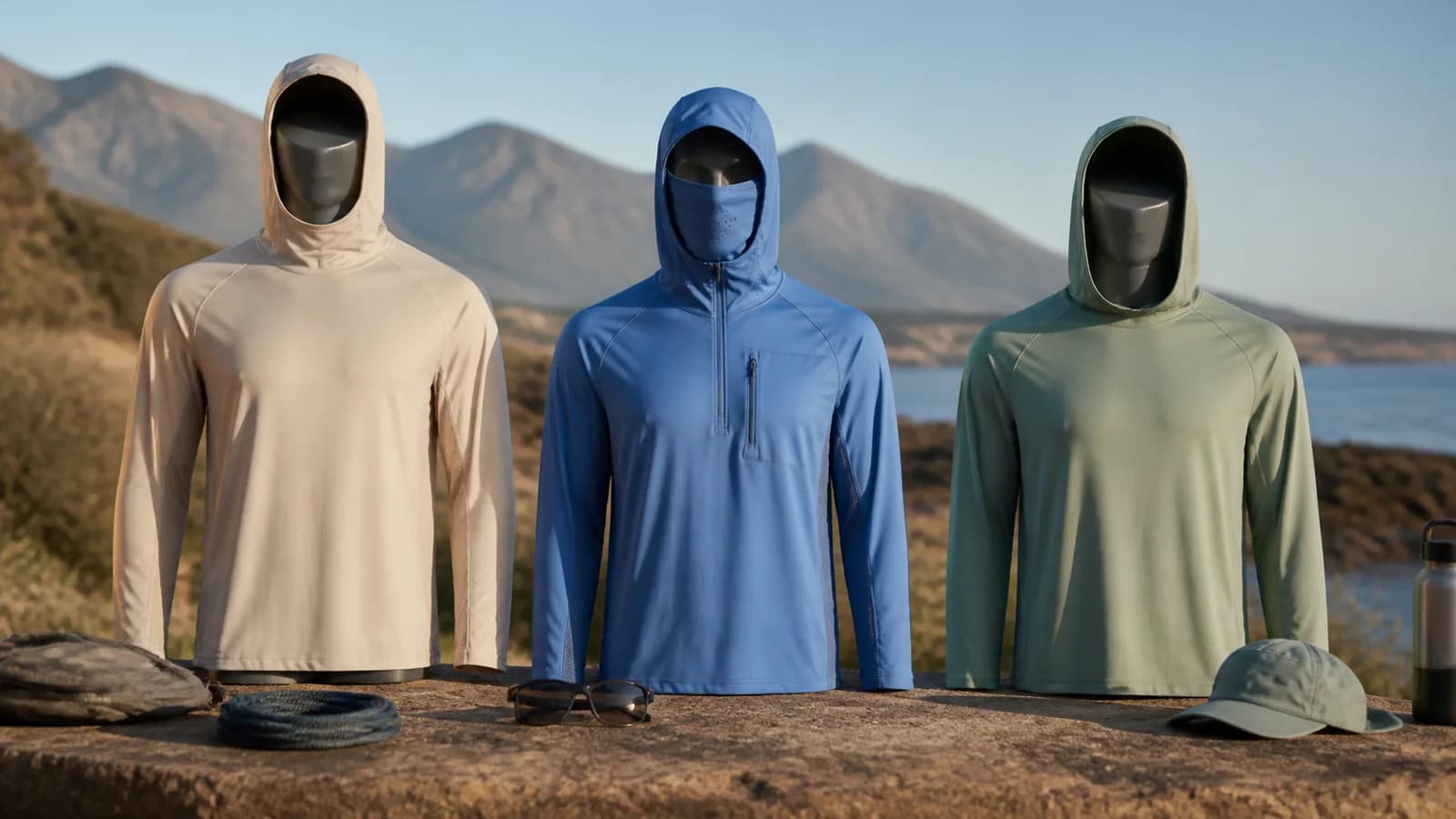
Choose Coolibar when documented coverage details and odor control matter most, Columbia PFG when humid-heat airflow is the priority, and Baleaf when you want UPF 50+, thumbholes, quick drying, and sizes through 3XL without paying for a premium brand system.
Specification-based comparison, not a hands-on test. We checked current manufacturer pages for one representative men's performance hoodie from each brand on August 28, 2026. Prices, ratings, colors, and inventory can change and are deliberately not scored.
Direct answer
Buy the brand that solves your hardest condition
Compare the features you need. Coolibar's Agility documents length, coverage, quick drying, stretch and antimicrobial treatment. Columbia's Solar Stream uses Omni-Shade Broad Spectrum Air Flow and Omni-Wick. Baleaf's AGA030 includes UPF 50+, a hood, thumbholes, flatlock seams, quick drying and XS–3XL sizing, with fewer published details for comparison.
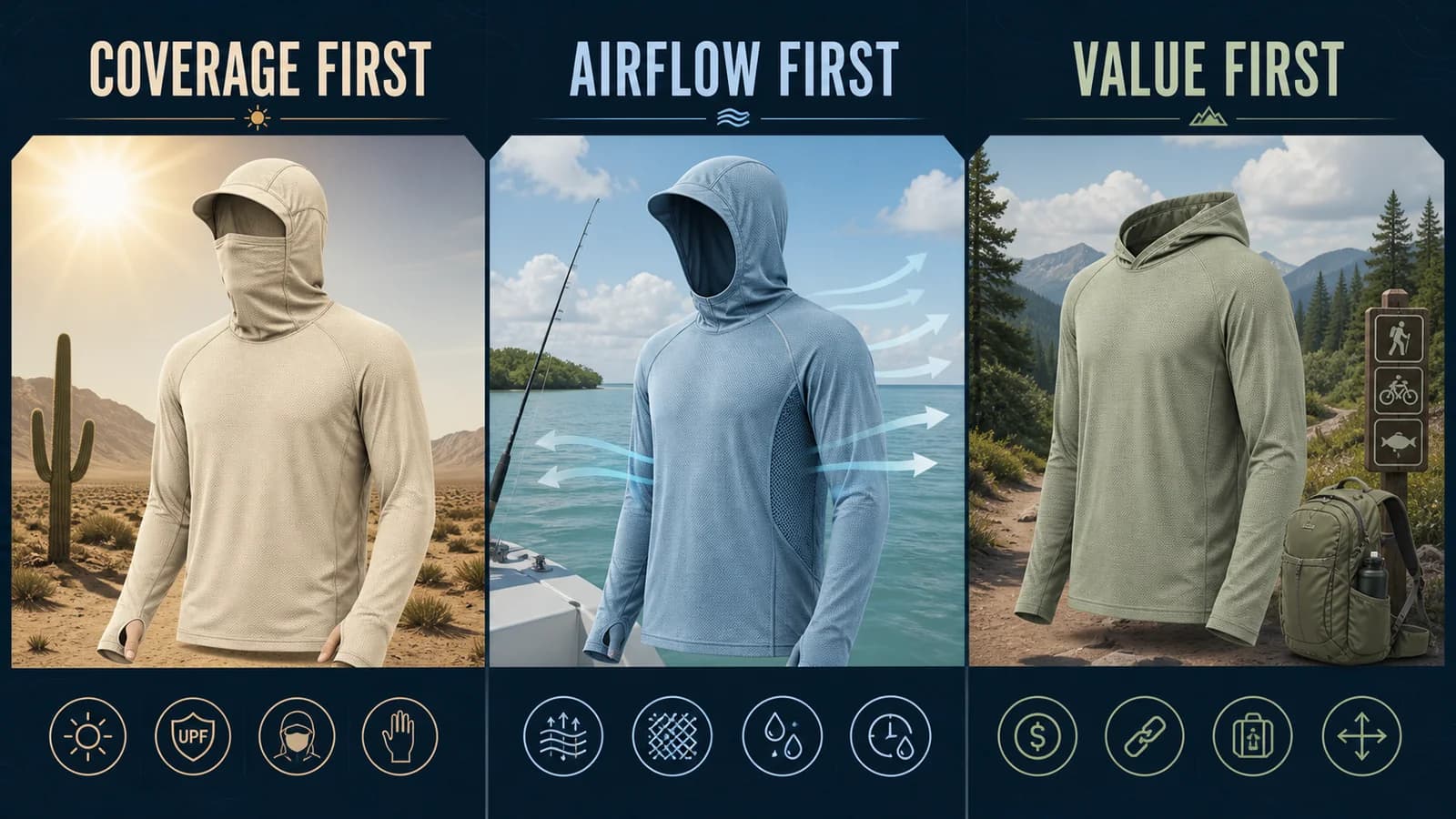
Coverage-first
Coolibar
Published 30 in body length, UPF 50+, antimicrobial finish, thumbholes, and a high-neck hood.
Airflow-first
Columbia PFG
The clearest manufacturer claim for ventilated humid-heat use, plus fast drying and a 29 in back length.
Value-first
Baleaf
UPF 50+, quick drying, hood, thumbholes, raglan sleeves, flatlock seams, and the broadest listed size range.
Model-specific buying path
Three Amazon searches for the reference models
An exact product card appears only when the current API listing matches the reference model. A named search is the fallback when that match cannot be confirmed.
Specification-based shortlist, not a hands-on product test. Amazon supplies exact-listing titles, images, availability, offer data, and destinations when a match is available.
Coolibar Men's Agility Performance Hoodie
The Coolibar reference model used for the published length, hood, stretch, quick-dry, and antimicrobial details in this guide. A matching catalog card may appear when available; otherwise use the named model search.
Columbia Men's PFG Solar Stream Hoodie
The airflow-first Columbia reference model in the comparison. If a matched Solar Stream card appears, verify its selected color, size, UPF wording and seller; otherwise use the model search.
Baleaf Men's AGA030 UPF 50+ Sun Hoodie
The value-focused Baleaf reference model. Similar Baleaf hoodies exist on Amazon, but none was verified as the exact AGA030 build, so this CTA intentionally stays a model search.
1. Method and scope
A brand comparison needs a product-level evidence boundary
Brands sell several fabrics and cuts. This comparison uses three reference products: the Coolibar Agility Performance Hoodie, Columbia PFG Solar Stream Hoodie and Baleaf AGA030 Sun Hoodie. Compare their coverage, ventilation, fit and core features before generalizing to the rest of each catalog.
We recorded only specifications visible on the manufacturers' current US product pages: UPF, fabric, size selector, garment length when published, hood and cuff construction, drying language, and odor-control treatment. We did not assign invented scores, estimate durability from price, or convert marketing language into laboratory results. If a brand does not publish a comparable number, the table says so.
Community threads raise useful questions about heat buildup, odor, sleeve length, hood comfort and budget UPF claims. We use those questions to guide the FAQ, while the answers rely on published specifications and clearly stated limits.
2. Side-by-side evidence
Coolibar vs. Columbia vs. Baleaf comparison table
Read this as a comparison of the named reference hoodies, not a permanent score for every product carrying the brand. On small screens, swipe horizontally to see all columns.
| Decision field | Coolibar | Columbia | Baleaf |
|---|---|---|---|
| Best starting point | Coverage-first performance and the most detailed published fabric story | Hot, humid fishing and buyers prioritizing engineered airflow | Core hoodie features and broad sizing without paying for a premium brand system |
| Representative current hoodie | Agility Men’s Performance Hoodie | PFG Solar Stream Hoodie | Men’s UPF 50+ Sun Hoodie (AGA030) |
| Climate | Dry/hot or active sun; breathable and quick-dry claim, but no comparable airflow number | Humid/hot and on-water use; Air Flow construction is the clearest ventilation claim | Warm mixed-use conditions; breathable claim, but no comparable airflow test published |
| Confirmed manufacturer UPF | UPF 50+ | UPF 50 | UPF 50+ |
| Hood stability | High-neck, full-coverage hood; no adjuster listed on Agility | Hooded construction; no adjuster listed on Solar Stream | Basic hood; no adjuster listed on AGA030 |
| Torso / sleeve information | 30 in body length in Large; full sleeves, thumbholes, watch openings | 29 in center-back length; sun-protection cuffs | Garment length not published; long raglan sleeves and thumbholes |
| Current size selector | S–XXL | XS–XXL | XS–3XL |
| Fit information | Performance-oriented; exact fit label not published on current page | Regular Fit | “Comfort fit” in product name; no detailed fit definition published |
| Odor control | Antimicrobial finish listed for Active Athlon fabric | No odor-control treatment listed on current product page | No odor-control treatment listed on current product page |
| Drying | Manufacturer says quick-drying | Manufacturer says fast-drying via Omni-Wick | Manufacturer says quick-drying |
| Backpack abrasion evidence | No comparable abrasion rating published | No comparable abrasion rating published | No comparable abrasion rating published |
| Published material | 87% polyester / 13% elastane (checked White model’s Active Athlon data) | 100% polyester | 100% polyester |
| Evidence limitation | No garment weight or air-permeability result published | No garment weight, odor treatment, or hood adjuster listed | No garment length, weight, odor treatment, or airflow result published |
3. Visual decision aid
Coverage, airflow, or value?
The fastest way to choose is to name the failure you are trying to prevent: uncovered skin, heat buildup, or paying for features you do not need.
4. Coverage-first
Choose Coolibar when published coverage details reduce uncertainty
Agility provides a useful reference for integrated hood, wrist and pocket coverage. Coolibar lists UPF 50+, a high-neck hood, full sleeves with thumbholes, overlapped watch openings, a rear zipper pocket, and a 30-inch body length in size Large. The Active Athlon fabric is described as lightweight, breathable, moisture-wicking, quick-drying, four-way stretch, and finished with an antimicrobial treatment.
That package makes sense for a buyer who wants coverage continuity from torso to wrist and would rather see specific construction details before ordering. The published body length is especially helpful for taller torsos. The antimicrobial claim also gives multi-day travelers a feature to verify, while Columbia and Baleaf do not list an odor treatment on the compared pages.
The limitation is comparative cooling evidence. Coolibar uses confident performance language, but the page does not publish garment weight, air permeability, or a drying time that can be compared directly with Columbia or Baleaf. Do not translate a higher price or more detailed specification sheet into automatic superiority in humid heat.
Why it makes the shortlist
- • UPF 50+ with the longest published reference length
- • High-neck hood, thumbholes, watch openings, and zipper storage
- • Quick-dry and antimicrobial claims are explicitly published
Where the evidence stops
- • No comparable airflow or drying-time result
- • Current selector stops at XXL
- • No published backpack-abrasion rating or garment weight
5. Airflow-first
Choose Columbia PFG when humid heat and fishing drive the purchase
Columbia positions the Solar Stream specifically for fishing and hot conditions. Its Omni-Shade Broad Spectrum Air Flow construction combines a manufacturer-stated UPF 50 rating with textile venting, while Omni-Wick is described as moving moisture to the surface for rapid evaporation. Among the three reference products, that is the clearest published case for humid, active, on-water use.
The Solar Stream also supplies useful fit evidence: Regular Fit, sizes XS through XXL, 100% polyester, sun-protection cuffs, and a 29-inch center-back length. A regular cut can create more air space than a tight shirt, but sizing up blindly is not a universal cooling hack. Excess fabric can flap in wind, snag on hardware, or interfere with casting and pack straps.
Columbia does not list an odor-control treatment, hood adjuster, garment weight, or abrasion rating for this model. Availability belongs to the selected size and color, not the whole model. The card shows whether a current matching variant is confirmed; a search does not imply stock.
Why it makes the shortlist
- • Only reference model with a specific Air Flow ventilation claim
- • UPF 50, fast-drying claim, Regular Fit, and 29 in published length
- • Fishing-specific positioning and sun-protection cuffs
Where the evidence stops
- • No odor-control treatment listed
- • No hood adjuster, garment weight, or abrasion rating listed
- • Model and color availability can be inconsistent
6. Value-first
Choose Baleaf when the core feature list matters more than technical depth
Baleaf's AGA030 has the most straightforward proposition: a 100% polyester hoodie with manufacturer-stated UPF 50+, moisture wicking, quick drying, thumbholes, flatlock seams, a tag-free collar, long raglan sleeves, and sizes XS through 3XL. Those are meaningful features for walking, gardening, casual hiking, fishing, and travel.
The broad size selector is useful, but it is not the same as a published tall fit or garment measurement. The current page does not list body length, sleeve length, garment weight, hood retention, odor control, or air permeability. Community comments about shorter arms or faster odor can highlight what to inspect, yet they cannot establish that every color, production run, or wearer will behave the same way.
Baleaf is a useful starting point if you want the main sun-hoodie features at a lower price. If you need a precise torso length, documented antimicrobial treatment or a specific airflow system, confirm those details before buying.
Why it makes the shortlist
- • UPF 50+, hood, thumbholes, raglan sleeves, and flatlock seams
- • Quick-dry and moisture-wicking claims
- • Broadest current selector at XS–3XL
Where the evidence stops
- • No garment length or detailed fit definition published
- • No odor-control or hood-retention feature listed
- • No comparable airflow, weight, or abrasion result
Manufacturer references · October 10, 2026
Compare exact models, cost and care
Prices below are USD references for one shirt before tax or shipping, checked October 10, 2026. They are not live Amazon offers. Promotions, selected colors and unavailable variants are identified; a search link does not confirm stock. These comparisons use published specifications, without SleeveShirts wear or laboratory testing.
| Exact model / source | Checked cost | Published UPF | Fit / size / length |
|---|---|---|---|
| Coolibar Men’s Agility Performance Hoodie (10383) ↗ | $85; White/S reference; White was marked FINAL SALE | 50+ | S–XXL; 30 in. body length on size L; no Tall length chart found |
| Columbia Men’s PFG Solar Stream Hoodie (2069181) ↗ | Exact selected-variant price was not retrievable from the maker page | 50 | Regular; 29 in. center-back length; do not substitute Solar Stream II or its Tall version |
| Baleaf Men’s UPF50+ Sun Hoodie (AGA030) ↗ | $36; Gray/S reference | 50+ | Comfort fit; XS–3XL; no separately documented Tall cut or garment length |
Coolibar Men’s Agility Performance Hoodie (10383)

- Choose it if
- You want integrated wrist/head coverage and a back pocket for walking or active days.
- Fabric and everyday details
- Active Athlon: 87% polyester, 13% elastane in this page’s fabric data; antimicrobial/Cooltect maker claims; hood, thumbholes and wrist-watch openings
- Care
- Cold gentle machine wash with like colors; no softener or bleach; tumble dry low, remove promptly; cool iron if needed; no dry-clean.
- Drawback to accept
- The White reference was excluded from returns and promotions; do not buy that variant for a returnable fit trial.
Columbia Men’s PFG Solar Stream Hoodie (2069181)
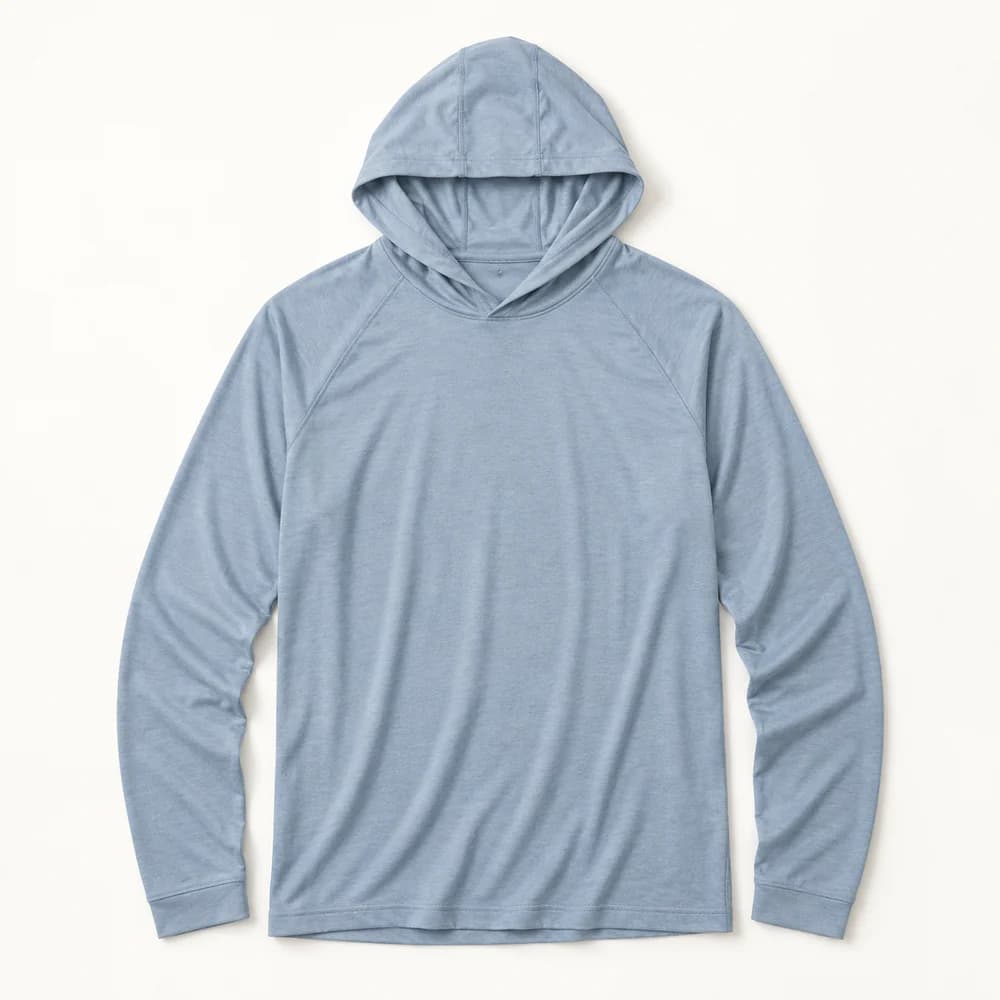
- Choose it if
- You prefer a regular cut over the relaxed Terminal Tackle and want the maker’s Air Flow construction.
- Fabric and everyday details
- 100% polyester; Omni-Shade Broad Spectrum Air Flow and Omni-Wick claims; no GSM or odor finish stated
- Care
- Machine wash; bleach when needed; tumble dry; iron; dry-clean in the online summary. Follow the garment label for settings.
- Drawback to accept
- Air Flow is not a published comparison of cooling between these shirts; no thumbholes stated.
Baleaf Men’s UPF50+ Sun Hoodie (AGA030)
- Choose it if
- You want a hood and thumbholes while keeping the checked price below the premium hoodies here.
- Fabric and everyday details
- 100% polyester; hood, thumbholes, raglan sleeves and flatlock seams; GSM and odor finish not stated
- Care
- Machine wash cold with like colors; no bleach; tumble dry low; no iron or dry-clean.
- Drawback to accept
- No separately documented Tall cut or garment length; size letters alone do not establish sleeve reach.
7. Before checkout
A five-minute fit and evidence check prevents the wrong purchase
1. Match the exact model
Confirm that the product title, color, and sewn-in label carry the UPF claim discussed here. Brand-level reputation is not a substitute for a model-level rating.
2. Raise both arms
The hem should remain over the waistband and thumbholes should not pull. Coolibar and Columbia publish reference lengths; Baleaf does not.
3. Turn your head with the hood up
Check peripheral vision, cap compatibility, and whether wind exposes the neck. None of these three reference pages lists a hood adjuster.
4. Simulate pack contact
Wear the hoodie under your actual shoulder straps. Look for seam pressure and rubbing at shoulders and lower back; no brand publishes a comparable abrasion test here.
5. Plan for humidity
Prioritize ventilation language and a comfortable cut when sweat cannot evaporate quickly. Columbia has the clearest published airflow story in this comparison.
6. Protect the uncovered areas
A hoodie does not cover every part of the face or hands. CDC recommends combining protective clothing with shade and sunscreen on exposed skin.
Sun-safety context: CDC guidance recommends protective clothing as part of a broader strategy that also includes shade and protection for exposed skin.
8. Final decision
Our specification-based verdict
Coolibar is the coverage-first choice. The Agility provides the deepest published specification set, including a 30-inch Large body length, high-neck hood, thumbholes, watch access, quick drying, stretch, and antimicrobial treatment.
Columbia PFG is the airflow-first choice. The Solar Stream's manufacturer description is the most directly aligned with humid, active fishing through textile venting, wicking, fast drying, Regular Fit, and a 29-inch back length.
Baleaf is the value-first choice. The AGA030 supplies the essential UPF hoodie package and sizes through 3XL, but you accept more uncertainty around length, hood retention, odor control, weight, and comparative airflow.
None wins backpack durability because none publishes a comparable abrasion test. None wins a measured cooling contest because the brands do not provide a shared airflow or drying protocol. That uncertainty is more useful than a fabricated score: it tells you what to inspect during the return window.
Community-informed, source-checked
9. Questions buyers actually ask
These questions reflect recurring concerns in outdoor and sun-protection communities. Reddit helps identify the uncertainty; current manufacturer specifications and cautious editorial reasoning support the answers.
Is Coolibar actually better than Columbia or Baleaf?
Coolibar publishes the most detailed protection and fabric information for the representative Agility hoodie: UPF 50+, a 30-inch body length in Large, quick-dry performance, an antimicrobial finish, thumbholes, and a high-neck hood. That makes it the strongest coverage-first starting point. It does not prove that every Coolibar garment is cooler, tougher, or better fitting than every Columbia or Baleaf option. Compare the exact product pages, not only the brand names.
Which brand is the best choice for hot, humid weather?
Start with Columbia PFG if humid heat is the main problem. The Solar Stream is the only representative model here whose current manufacturer page explicitly pairs UPF protection with Air Flow textile venting. Coolibar and Baleaf both describe their selected hoodies as breathable and quick-drying, but none of the three brands publishes directly comparable air-permeability or drying-time results. A loose enough fit and an uncovered face can matter as much as the logo.
Do Baleaf sun hoodies smell faster?
Community discussions frequently raise odor as a concern with inexpensive polyester sun hoodies, but that is not controlled evidence. The current Baleaf AGA030 page does not list an odor-control treatment. Coolibar does list an antimicrobial finish for the Agility’s Active Athlon fabric; Columbia does not list one for the Solar Stream. Choose Coolibar when a published odor-control feature matters, while remembering that no treatment eliminates the need to wash and dry the garment properly.
Which option has the longest torso and sleeves?
Coolibar publishes a 30-inch body length for the Agility in size Large, while Columbia lists a 29-inch center-back length for the Solar Stream. Baleaf does not publish a garment length on the current AGA030 page. Sleeve construction also differs: Coolibar lists thumbholes and watch openings, Columbia uses sun-protection cuffs, and Baleaf lists long raglan sleeves with thumbholes. Body-length measurements are not perfectly interchangeable, so confirm the brand’s measurement method before comparing an inch literally.
Can I trust a UPF 50+ claim from a budget brand?
Treat the exact garment listing and sewn-in label as the evidence boundary. Baleaf currently states UPF 50+ for the AGA030 hoodie, while Coolibar states UPF 50+ and Columbia states UPF 50 for the compared models. We did not independently laboratory-test those claims. If the listing, label, color, or model number does not match what you ordered, return or verify it rather than assuming every garment from the brand carries the same rating.
Is a sun hoodie always cooler than a button-up shirt?
No. A hood adds coverage but can trap warmth around the neck, while a loose button-up can vent through the placket and back panels. Reddit threads repeatedly ask this question in humid climates, but the answer depends on fabric, cut, wind, sweat rate, and whether the hood is up. Choose a hoodie when neck and ear coverage are hard to maintain; choose a ventilated button-up when adjustable airflow is the dominant need.
Should I wear a T-shirt underneath a sun hoodie?
For hot-weather activity, most technical sun hoodies are intended to work as the next-to-skin layer, and another shirt usually adds warmth and slows moisture movement. A light base layer can still make sense for chafe management, modesty, or changing conditions. Test the combination with your pack and raise both arms: the hem should stay covered, the cuffs should not pull, and the neckline should not become restrictive.
Does washing remove the UPF protection?
Do not assume one rule applies to every fabric. Follow the care label for the exact garment and inspect thinning, stretched areas, snags, and damaged seams. The compared manufacturers all make product-specific claims, and those claims should not be extended to a different fabric or discontinued model. Replace a garment when coverage or fabric integrity is compromised rather than relying only on its age.
Question discovery examples: hot-humidity discussion and UPF, fit, sleeve, and odor discussion. Community comments are anecdotal and were not used as product-test evidence.
Continue the decision
Best Sun Hoodies
Compare eight models across climate, hood, sizing, drying, odor, pack use, and current UPF.
Columbia Sun Protection Clothing
Explore Columbia technologies and product categories beyond one reference hoodie.
Best Budget UPF Shirts
Compare purchase-ready lower-cost options without relying on fixed prices.
Sun Protection Clothing Guide
Understand UPF, coverage, fit, exposed skin, and care before buying.
Sun Hoodies for Big Guys
Prioritize torso room, sleeve reach, hood comfort, and explicit size evidence.
Sun Hoodie vs. Shirt Quiz
Use an interactive decision aid to choose your garment format.