Best Sun Hoodies for Big Guys in 2026: Roomy UPF Fits That Cover
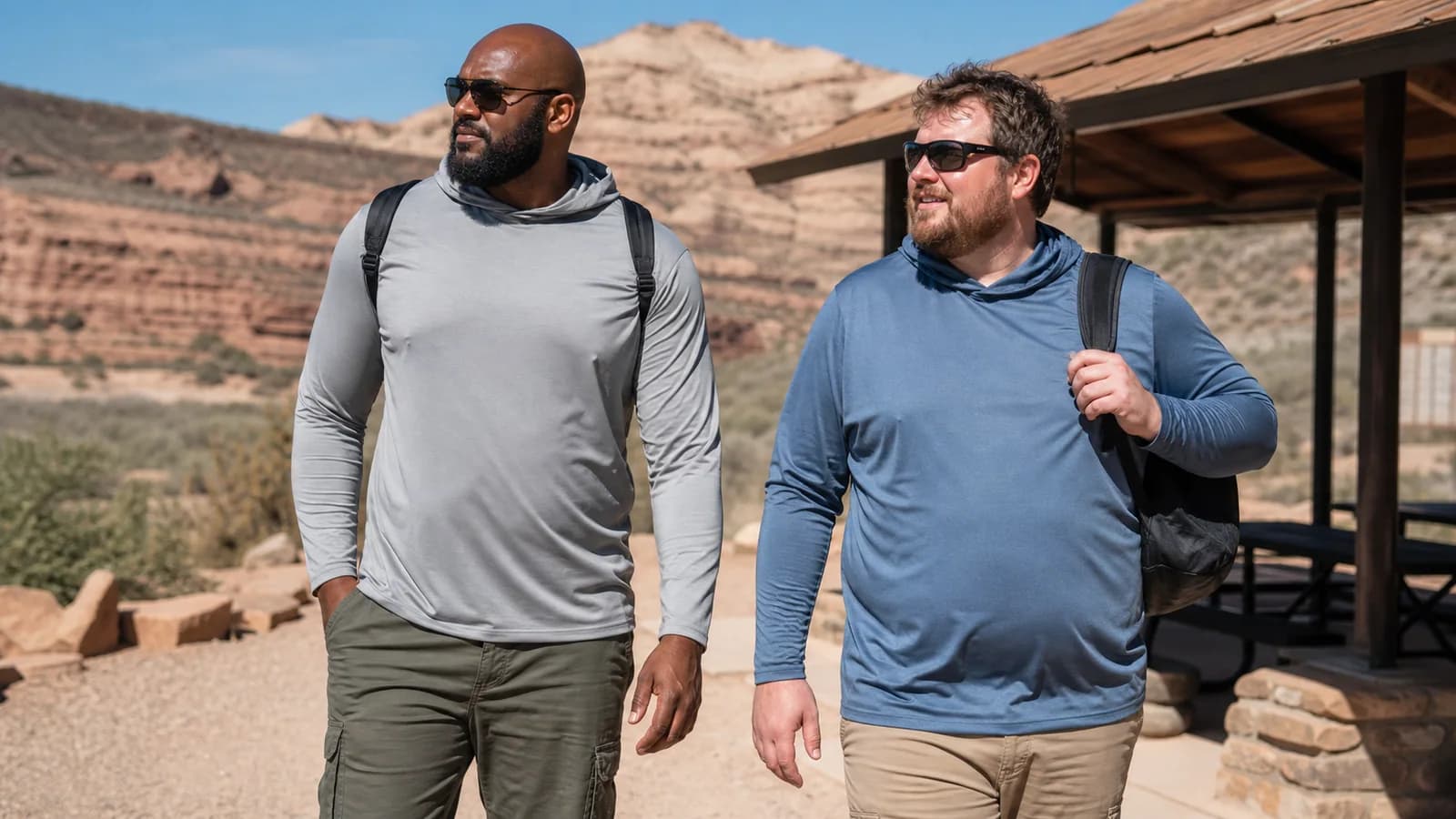
Compare sun hoodies by shoulder room, midsection fit, sleeve reach and hem length. This guide covers relaxed, extended-size, Tall, lightweight and zip-front formats; a letter size alone cannot predict the fit.
Direct answer
What is the best sun hoodie for a big guy?
Start with a relaxed or big-and-tall UPF hoodie whose current chart covers your chest and fullest torso measurement without relying on extreme stretch. Prioritize a long back hem, enough sleeve reach, a hood that turns with the head, and lightweight fabric with a specific UPF claim. Choose tall sizing for torso and arm length, not simply as a substitute for more body room.
Affiliate disclosure: SleeveShirts may earn from qualifying Amazon purchases. The shortlist is based on practical criteria, not paid placement.
Amazon inventory, sellers, specifications, ratings, and prices can change. Open the current listing and verify the exact size chart, material, coverage, and return terms.
Quick picks
Start with the format that fits the job
Compare these 6 options, then check the exact model, size and seller.
Most big-and-tall shoppers
Relaxed extended-size sun hoodie
A straight or gently shaped body with explicit 2XL-5XL measurements reduces dependence on stretch and gives the hem a better chance of staying down.
Long torso and arms
Tall-length performance hoodie
Extra body and sleeve length can preserve coverage while reaching. Confirm that the tall version also has enough chest and waist room.
Humid active use
Lightweight loose-knit sun hoodie
A low-bulk fabric and roomy cut can reduce cling, while a larger neck opening allows heat release. Verify whether light colors or mesh panels share the rating.
Easy layering and removal
Full-zip UPF hoodie in extended sizes
A zipper adds ventilation and makes changing easier, but introduces a central gap, hardware, and potential bunching under packs.
Model-specific buying path
3 exact Amazon sun hoodies to fit-check
These exact listings create three concrete fit-check routes. Amazon’s selected variant is not proof that every big or tall size is available, so compare the current size chart with chest, fullest torso, sleeve, and back-length measurements.
Specification-based shortlist, not a hands-on product test. Amazon supplies exact-listing titles, images, availability, offer data, and destinations when a match is available.
Columbia PFG Terminal Tackle Long-Sleeve Hoodie
A widely recognized loose fishing-hoodie format that can work for buyers prioritizing torso drape and simple coverage. Verify the current extended-size options rather than assuming all colors share the same size range.
Vapor Apparel UPF 50+ Performance Hoodie
A simple performance-hoodie route without a heavy feature stack. Use the exact chart and selected variant to confirm belly room, hem length, sleeve reach, hood pull, and the UPF statement.
Willit UPF 50+ Lightweight Sun Hoodie
A value-oriented loose sun-hoodie format for shoppers who want room without relying on extreme fabric stretch. Confirm the exact selected size, garment measurements, color-specific details, and return policy.
What the official guidance changes about this purchase
Fit changes how much skin a garment actually covers, while fabric and design determine what its UPF label can reasonably describe. The strongest choice combines published dimensions with a realistic heat and activity plan.
Coverage is part of the protection system
WHO notes that garment design, coverage, stretch, wetness, wear, and condition influence practical ultraviolet protection. A highly rated fabric does not help where a short hem rides up or an overstretched panel opens.
World Health Organization →Clothing works with shade and sunscreen
The American Academy of Dermatology recommends protective clothing and shade plus sunscreen on uncovered skin. A hooded shirt still leaves the face, hands, and changing neckline gaps exposed.
American Academy of Dermatology →More coverage can add thermal burden
NIOSH explains that clothing and personal protective equipment contribute to occupational heat stress. For strenuous use, a hoodie must be considered alongside environment, exertion, hydration, rest, and other layers.
CDC/NIOSH Heat Stress →How we evaluate the category
SleeveShirts evaluates current size charts, listed garment or body measurements, extended-size availability, torso and sleeve construction, hood and neckline details, fabric and UPF descriptions, care, returns, and repeated fit themes. We do not claim hands-on testing, laboratory UPF measurement, or universal size equivalence. The goal is to help the buyer create a verifiable shortlist and reject ambiguous listings.
Fullest-torso fit
Compare the chart with the chest and the fullest point the garment must pass over. A hoodie that fits the chest can still cling or ride up across the belly or hips.
Length where it matters
Torso, back hem, front hem, and sleeve length should preserve coverage while reaching, sitting, wearing a pack, or lifting the arms.
Shoulder and arm mobility
Raglan or articulated sleeves can reduce pulling, but the finished garment still needs enough biceps, forearm, and wrist room for the intended movement.
Hood and neck geometry
The hood should cover the neck and sides of the head without pulling the shirt backward, closing vision, or tightening the neckline when the head turns.
Heat-release design
Fabric permeability, relaxed air space, neck opening, zip options, and the other layers matter more than an unsupported cooling claim.
Specific UPF evidence
Look for a numerical rating tied to the exact fabric and variation. Check whether stretched or vented panels and alternate colors are included.
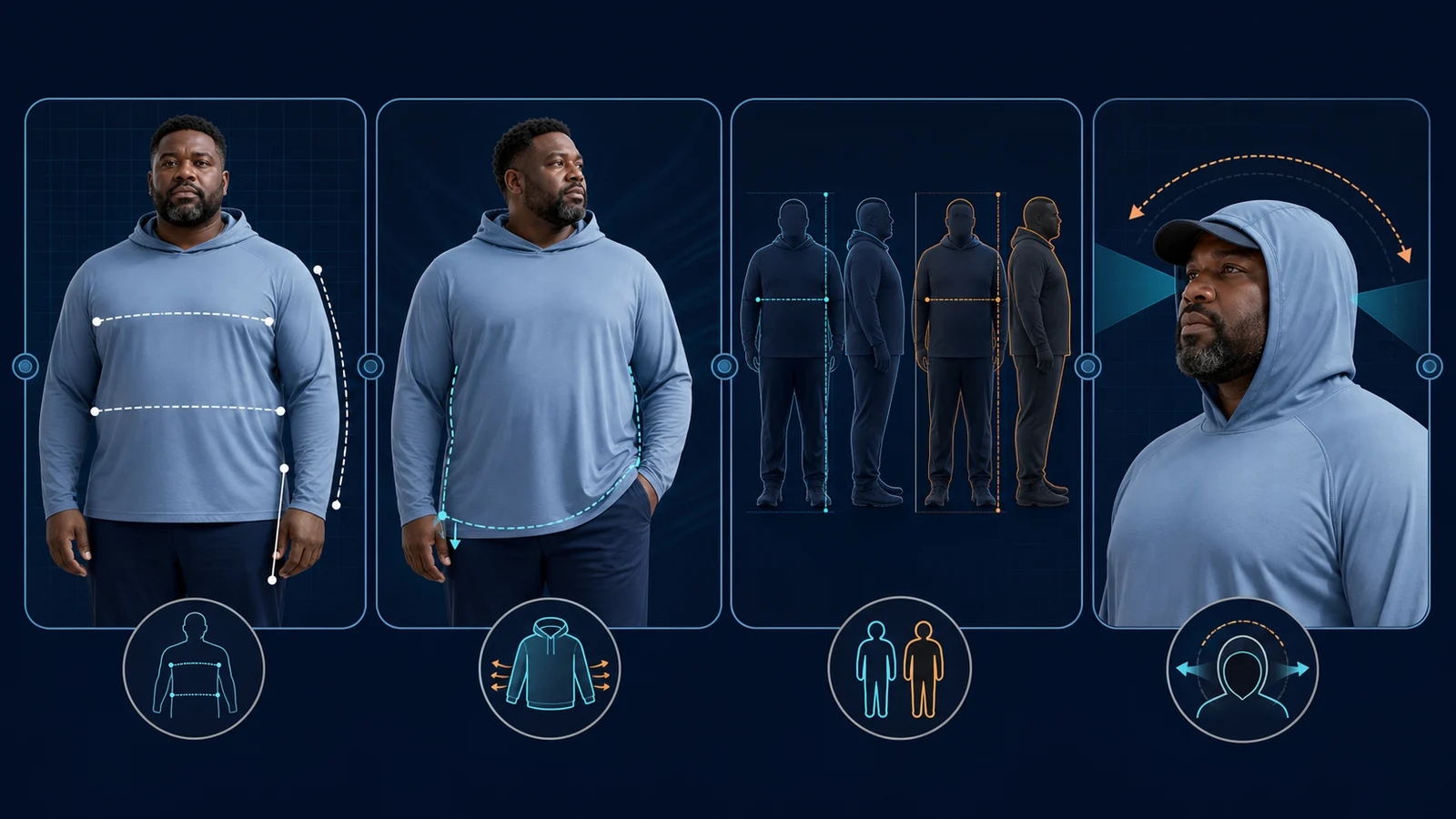
Visual buying framework
Big-and-tall sun-hoodie fit without guesswork
The visual separates circumference, garment drape, length grading, and hood geometry so one oversized letter label does not carry the whole decision.
1. Measure the full path
Compare chest, fullest torso, hem line, sleeve reach, and desired body length over the intended base layer.
2. Require relaxed drape
The body should hang without sharp stretch lines, constant cling, or a hem that creeps upward during movement.
3. Separate big from tall
Big sizing adds circumference; tall sizing adds body and sleeve length. Some buyers need both, others need only one.
4. Turn inside the hood
The hood should move with the head without throat pressure, shoulder lift, hearing loss, or blocked peripheral vision.
Editorial category infographic generated for SleeveShirts. It explains selection logic and does not depict or certify an exact marketplace product.
Decision visual
Big-and-tall sun-hoodie decision map
Use body shape and garment length to choose the size family before comparing colors, pockets, or marketplace ratings.
Measure the body
Record chest, fullest torso, hip where the hem sits, shoulder or sleeve reference, and preferred finished length over a light base layer.
Choose big, tall, or both
Big sizing adds circumference; tall sizing adds body and sleeve length. Select the combination that solves the actual mismatch.
Map heat and movement
Separate a beach walk from humid hiking, paddling, outdoor work, or layering beneath a pack.
Verify the cart variation
Recheck the exact size chart, fabric, UPF statement, seller, returns, color, and care immediately before checkout.
Sun-hoodie formats for bigger bodies compared
These six formats are sizing strategies, not six tested models. The model-specific examples below separate Columbia Big, REI Tall and AFTCO Big Guy Regular charts. Garment chest, body chest and different length measurement origins cannot be compared as the same measurement.
| Format | Best for | Prioritize | Trade-off | Listing check | Amazon |
|---|---|---|---|---|---|
| Relaxed extended-size pullover | General walking, travel, and shore use | Full torso room, long hem, open neck | Can look boxier under a pack | Actual 3XL-5XL chart and finished length | Search |
| Tall-length pullover | Long arms and torso | XLT body length, sleeve reach, thumbhole position | Tall does not guarantee belly room | Circumference plus tall increments | Search |
| Lightweight athletic hoodie | Active hot-weather use | Loose drape, low bulk, stable hood | Thin fabric may cling or show wear sooner | Stretch, opacity, and rating scope | Search |
| Full-zip sun hoodie | Ventilation and easy changing | Smooth zipper, flap coverage, long body | Hardware and front gap add complexity | Zipper comfort under pack straps | Search |
| Fishing-style hoodie | Boat, shore, and open exposure | Neck coverage, loose body, quick drying | Graphics and heavier fabric vary widely | Exact material and sleeve dimensions | Search |
| Thumb-loop coverage hoodie | Walking and exposed hand-back coverage | Long sleeves, low-tension loops, cuff fit | Loops can pull on broad shoulders or interfere with gloves | Reach test without shoulder drag | Search |
Detailed buying guidance
Columbia PFG Terminal Tackle Hoodie — Big (1536173)
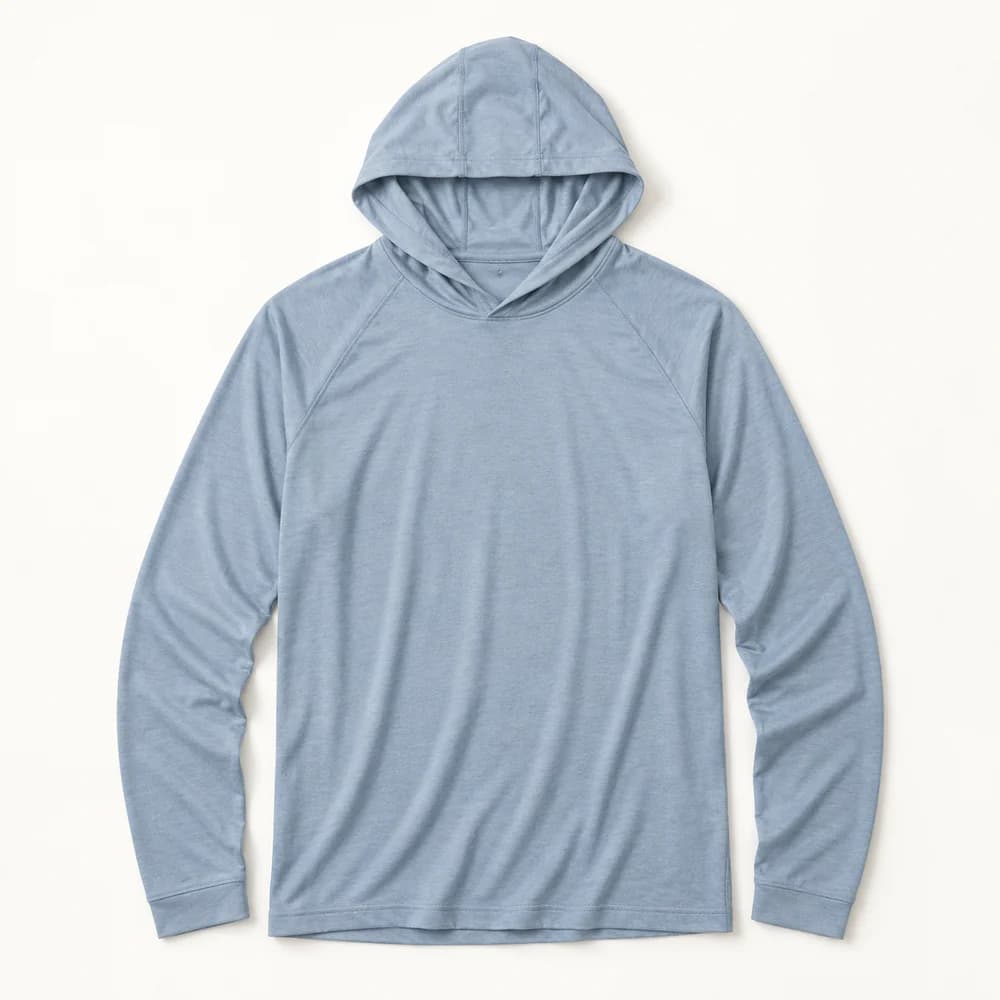
Choose this model if your chest needs a genuine Big pattern instead of sizing up a regular shirt. UPF 50. Big selector 1X–6X; relaxed; 32 in. center-back length; not a Tall designation
US cost reference, October 10, 2026: $45; Green/1X reference. One shirt before tax or shipping; not a live Amazon offer. 100% polyester; Omni-Wick; no GSM or odor finish stated
- Care: Machine wash; no bleach; tumble dry; iron; no dry-clean. Use the label for temperatures.
- Drawback: The 32-inch page reference is not a length chart for every size; compare waist and sleeve measurements before purchase.
REI Co-op Sahara Shade Regular-Fit Hoodie — Men’s (C01844)
Choose this model if you need a published regular-versus-Tall length difference and prefer a relaxed stretch knit. UPF 50+. S–XXXL; selected M–XXL Tall; M back 27.5 in., M Tall 29.5 in.; stock varies by color
US cost reference, October 10, 2026: $59.95 regular colors; $41.93 Black Heather shown sold out. One shirt before tax or shipping; not a live Amazon offer. 91% polyester, 9% spandex; 7.8 oz listed garment weight; drawcord hood and hidden thumb loops
- Care: Machine wash warm; do not bleach; tumble dry low.
- Drawback: Heavier listed garment weight than minimalist active layers; the sold-out sale color is not an available bargain.
AFTCO Big Guy Samurai Hooded Performance Shirt

Choose this model if you need more torso circumference in a documented Big pattern rather than extra Tall length. UPF 50. Big Guy Regular, designed for 5 ft 11 in. and shorter: 3X/4X/5X garment chest 57/61/65 in.; shoulder-to-hem 33/34/35 in.; center-back sleeve 34.75/36/37.25 in.
US cost reference, October 10, 2026: $49; Splish Splash Heather/3X reference. One shirt before tax or shipping; not a live Amazon offer. 92% polyester, 8% spandex; quick-dry, wicking and stain-resistance maker claims; no GSM or finish-lifetime result stated
- Care: Full wash/dry instructions were not visible on the checked product page; use the garment label.
- Drawback: This is the Big Guy Regular chart, not the standard Samurai or a Tall cut. Compare garment chest with desired ease, not directly with a skin-tight body fit.
Measure the fullest path, not only the chest
Many charts provide a chest range, but the garment also has to pass comfortably over the abdomen and hips. Measure the fullest torso point where the fabric will fall, then decide whether the hem should sit above or below it. If a listing provides only flat garment width, double it and compare while allowing appropriate ease.
Do not plan to stretch a performance knit to its published limit all day. Constant tension can create cling, upward creep, seam pressure, and less predictable fabric coverage. A relaxed size that drapes is usually more comfortable than a smaller size selected for a trim product photograph.
- Measure over the base layer you will wear.
- Compare chest and fullest torso.
- Look for garment dimensions when available.
- Choose ease intentionally rather than by guesswork.
Big and tall are separate fit variables
Big sizing generally increases circumference, while tall sizing adds body and sleeve length. A tall shopper may need both; another buyer may need more midsection room but standard sleeves. Automatically buying tall to gain coverage can leave cuffs too long, thumb loops misplaced, and extra fabric bunching at the wrists.
Check whether the manufacturer publishes the increments between regular and tall. If it does not, ask or use a returnable order rather than assuming. The most useful review pairs an actual body measurement with the exact labeled size and describes the posture in which coverage failed or succeeded.
- Use tall for length, not as a generic upsizing trick.
- Check sleeve and body increments independently.
- Confirm hem position while seated and reaching.
- Ignore size reviews without relevant measurements when evidence conflicts.
The hood must fit the body and the head together
A small hood can pull the shoulder seams upward and drag the front neckline against the throat. An oversized hood may cover peripheral vision or fall backward in wind. The solution is enough hood volume, a neckline that opens comfortably, and a seam position that lets the head turn without moving the whole garment.
Test with sunglasses, a cap if used, and the pack or flotation equipment relevant to the activity. Avoid loose cords around machinery, and never treat a recreational hood as a replacement for required head protection. If the hood becomes too warm, it should lower without bunching into a thick collar.
- Turn the head fully in both directions.
- Check throat pressure and shoulder lift.
- Preserve side vision and hearing.
- Confirm equipment and workplace compatibility.
Air space can matter as much as fabric branding
A roomy cut can create a small air layer and reduce wet fabric clinging directly to the torso. The benefit depends on wind, humidity, movement, and every layer, so words such as cooling, ice, or performance are not proof. Inspect fabric composition, weight when disclosed, vent locations, and the neck opening.
Dark and light colors can differ in heat absorption and sometimes in published rating details. Verify the exact color variation instead of transferring a claim from the hero listing. In high heat or heavy exertion, use local guidance, hydration, shade, pace, and rest; a sun hoodie does not prevent heat illness.
- Prefer a drape that does not cling at rest.
- Check the rating for the exact color.
- Consider a zip or larger neck opening for controllable ventilation.
- Lower the hood and take safe breaks when conditions demand it.
A good rotation is better than one overstretched favorite
Repeated sweat, salt, sunscreen, pack abrasion, and laundering can change shape and surface condition. Two or three correctly fitting hoodies allow complete drying and make it easier to inspect the shoulders, cuffs, and lower torso for thinning or seam stress.
Follow the care label, especially around heat and fabric softener, rather than assuming all synthetics behave alike. Replace or reassign a hoodie when stretched panels no longer recover, the hem twists upward, or holes create coverage gaps. A lower-cost rotation can be more practical than one premium garment worn beyond its useful condition.
- Rotate clean, dry garments.
- Inspect high-stretch zones and pack contact points.
- Follow product-specific care.
- Recheck measurements after substantial body or garment changes.
Mid-guide shortlist
Ready to compare current listings?
Use the criteria above as a filter. Do not buy from the thumbnail alone: open the exact size chart, material details, care instructions, seller information, and return policy.
Choose by real-world situation
Humid hiking and walking
A loose lightweight pullover with a stable hood and sufficient back length balances coverage and movement.
- Use the pack during the reach test.
- Carry water and follow heat guidance.
- Keep sunscreen for face and hands.
Fishing and boating
A relaxed fishing-style hoodie can work well when the hood, cuffs, and hem remain secure in wind and around equipment.
- Preserve hearing and peripheral vision.
- Avoid loose cords near gear.
- Follow flotation and local safety rules.
Travel and everyday errands
A full-zip or clean pullover format makes layering and removal easier across air-conditioned and sunny environments.
- Choose a packable fabric.
- Verify seated hem coverage.
- Bring a nonhooded alternative when indoor comfort matters.
Amazon listing traps to avoid
Buying only by the 3XL or 4XL label
Letter sizes are not standardized. Compare the current chart with chest, fullest torso, sleeve, and length measurements.
Tall size used to solve missing circumference
Extra length does not guarantee more waist or belly room and can misplace cuffs and thumb loops.
Stretch treated as fit
A fabric can technically stretch around the body while remaining clingy, restrictive, or overstressed. Look for intended ease.
A generated image mistaken for the exact item
The hero is a clearly labeled category illustration. It does not prove how any Amazon variant fits, looks, or performs.
Before checkout
Final verification checklist
- 1Chest, fullest torso, hip or hem line, sleeve, and preferred torso length were measured.
- 2The chart solves circumference and length without relying on maximum stretch.
- 3Big, tall, or combined sizing matches the actual fit problem.
- 4The hem stays covered while reaching, sitting, and wearing the intended pack.
- 5The hood turns with the head without throat pressure or blocked vision.
- 6The exact color and panels carry the stated UPF claim.
- 7Seller, variation, fabric, care, and return terms were checked at checkout.
- 8Shade, hydration, rest, and sunscreen for exposed skin remain in the plan.
Continue with the right adjacent guide
Best sun hoodies
Compare the broader category by hood, fabric, coverage, and activity.
Sun hoodie buyer’s guide
Learn how thumb loops, hoods, neck openings, and fabric claims change the decision.
Best men’s UPF shirts
Compare nonhooded crews, button-ups, and relaxed alternatives when a hood is unnecessary.
Frequently asked questions
Should big guys size up in a sun hoodie?
Not automatically. Compare the current chart with both chest and fullest torso, then add the ease you prefer. Sizing up can add room but may also create overly long sleeves or an unstable hood. Big or big-and-tall sizing is more precise when available.
What is the difference between big and tall sun-hoodie sizing?
Big sizing primarily adds body circumference; tall sizing primarily adds torso and sleeve length. Some buyers need both. Check the manufacturer’s exact increments because the labels are not standardized.
How should a sun hoodie fit around the belly?
It should drape without sharp horizontal stretch lines, constant cling, or a hem that creeps upward during normal movement. The garment must still be safe for the activity and not so loose that it snags or bunches beneath equipment.
Are sun hoodies too hot for bigger men?
They can be comfortable in some conditions and too warm in others. Fabric permeability, cut, neck opening, hood use, humidity, exertion, and other layers all matter. Use a sun hoodie as part of a heat plan, not as a guarantee against overheating.
Is UPF 50 enough in a stretched sun hoodie?
The rating is useful evidence for the fabric as tested, but WHO notes that stretch, wetness, wear, and design affect practical protection. Avoid overstretching, verify the exact claim, and protect exposed areas separately.
Should I choose a pullover or full-zip sun hoodie?
A pullover is simpler and removes the central opening; a full zip offers easier ventilation and changing. For either, verify torso length, zipper or neckline comfort, pack compatibility, and the exact UPF coverage.
Do thumb holes improve sun protection?
They can keep sleeves over part of the hand, but only when sleeve length is sufficient and the loops do not pull across the shoulders or restrict the thumbs. They can interfere with gloves, watches, and repetitive gripping.
Can a sun hoodie replace sunscreen?
No. It covers only the fabric-covered areas and can shift at the face, neck, wrists, and waist. Use broad-spectrum water-resistant SPF 30+ sunscreen on exposed skin according to current public-health guidance, plus shade and timing where possible.
Sources checked
- World Health Organization: Protecting against skin cancer - How fit, stretch, coverage, wetness, wear, and design influence clothing protection.
- American Academy of Dermatology: Shade, clothing, and sunscreen - Layered protection and sunscreen use on uncovered skin.
- CDC/NIOSH: Heat Stress - How environment, exertion, clothing, and PPE contribute to heat stress.
Editorial transparency
We are not a medical provider, manufacturer, or accredited product-certification body. Recommendations combine public product data, standards-based claims, independent reviews, buyer feedback patterns, and SleeveShirts editorial judgment. AI may assist research organization and drafting, but final page wording should remain transparent about which signals come from direct source data versus secondary review patterns.
About the author
SleeveShirts Editorial
SleeveShirts Editorial researches UPF clothing, sun hoodies, fishing shirts, running layers, and family sun-protection gear for shoppers comparing products online. We prioritize clear criteria, source quality, practical fit/use-case signals, and transparent affiliate disclosures over brand sponsorship claims.
We do not present SleeveShirts as a dermatologist, medical authority, or accredited product-certification body. When a guide relies on manufacturer specifications, public standards, third-party reviews, or buyer feedback, it should say so plainly.