SleeveShirts · Practical guide
Sun Hoodie Buyer's Guide: UPF, Hood Fit, Sleeves & Everyday Trade-offs
Choose a sun hoodie by verified rating, hood stability, sleeve reach, climate and pack compatibility, with a visual try-on guide and concrete model examples.
SleeveShirts Editorial Review · Updated · 12 min read
Based on the official guidance and manufacturer specifications linked below. Recommendations and try-on checks are editorial judgments, not hands-on or laboratory test results. We may earn a commission from qualifying Amazon purchases.

The practical answer
Choose a hoodie with a documented rating that meets your needs, then test the hood, sleeve reach and hem while moving. UPF 50+ is a useful high-rating target, but the word sun hoodie does not guarantee it. Fit, coverage and comfort determine whether the features work for you; no universal GSM, brand or price tier answers all three.
What is your main reason for buying?
Compare stable hood coverage and seam placement under your loaded pack.
- Turn your head without the hood slipping or blocking your view.
- Reach with thumbholes in use; check finger tension.
- Look for hem bunching under the hip belt.
Editorial decision aid. It does not calculate safe exposure time, heat tolerance or a product performance score.
Features that solve a real problem
| Feature | Useful when | Try-on question | What not to assume |
|---|---|---|---|
| Hood | You want attached head and neck coverage | Does it stay put when you turn? | Every hood covers the face |
| Thumbholes | Sleeves retreat during reach | Do they pull against your fingers? | The whole hand is protected |
| Zip or ventilation panels | You want adjustable openings | Will a pack cover the vent? | Openings retain the same skin coverage |
| Longer hem | The waist becomes exposed when bending | Does it bunch beneath a belt? | Longer is always better |
| Named finish | You want a documented added feature | What does the maker actually claim? | A measured advantage without comparable testing |
See what to check
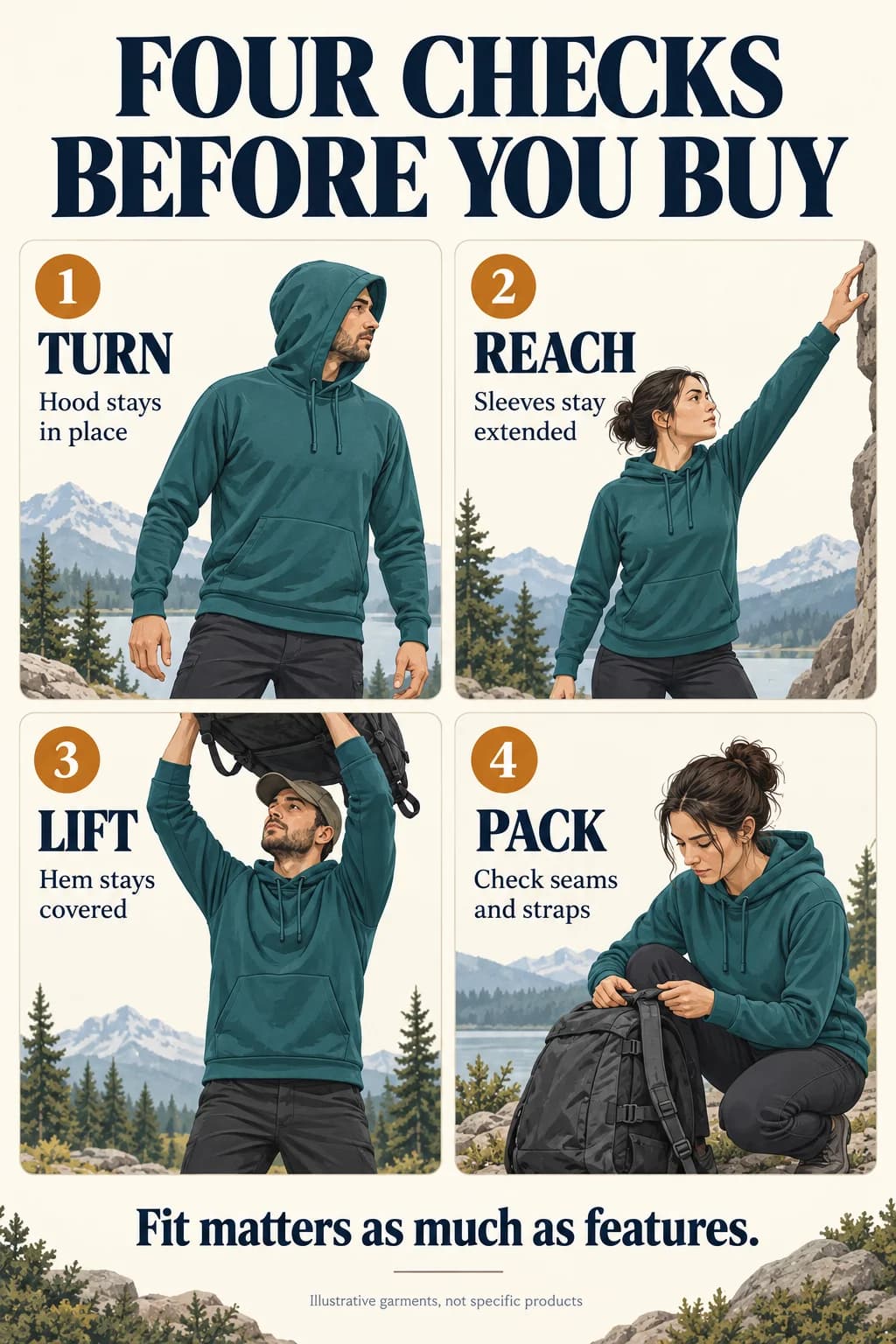
- Turn your head both ways and check whether the hood stays comfortable and clear of your view.
- Reach forward and overhead to assess sleeves and thumbholes.
- Raise your arms and bend to check the hem at the waistband.
- Wear your loaded pack and check the seams beneath straps; inspecting the pack alone is not enough.
A hood adds potential coverage, not an automatic win
A hoodie keeps a head-covering option attached to your shirt. That can simplify an outfit, but only if the hood fits and you use it. A hood left down does not cover the head, and even a close-fitting hood normally leaves facial skin exposed. Compare what the actual design covers rather than treating the category as complete protection.
A collared shirt and suitable hat may suit your activities better if you value pockets, an adjustable opening or a particular brim. A hoodie may suit you better if separate neck coverage is inconvenient. Neither format wins every situation; the useful comparison is the complete outfit in motion.
Sun protection should be combined with other appropriate measures. The CDC recommends clothing, shade, a hat, sunglasses and sunscreen on exposed areas. Do not buy a hoodie expecting it to replace every other part of that plan.
Sources: CDC: Sun safety
Check the rating before comparing premium features
Look for a rating tied to the exact model, color or material variant. A product can be sold in a sunwear category without sharing the rating of another product beside it. Keep the distinction between UPF 50 and UPF 50+ as the manufacturer states it, and do not add a plus sign to make a comparison look more uniform.
If you specifically want UPF 50+, make that a shortlist requirement. That does not mean a lower-rated garment has no protection; it means it does not meet your chosen requirement. The Echo example below makes this trade-off visible rather than labeling every technical hoodie equivalent.
A high rating cannot compensate for gaps or an unsuitable fit. Once the specification is clear, check the hood opening, cuffs and hem. Ask about intended use when the garment will be repeatedly wet or used for swimming; a rating alone is not a universal wet-performance promise.
Sources: ARPANSA: Clothing labels
Understand the rating difference →Test four parts of the cut
Start with the hood. Try it with the hat you expect to wear, then turn and look upward. Check whether it slides backward, catches on the brim or pulls at the neckline. A very large hood may be designed for a helmet; a close one may not suit your head or preferred hat. An adjuster is useful only if the resulting fit is comfortable.
Next check the sleeves. Reach forward and overhead, both with and without thumbholes engaged. A sleeve that looks long while standing still can pull back during movement. Thumbholes should not be used to force a short sleeve into place or create sustained tension on your fingers.
Finally, examine the torso and hem. Bend and twist. The hem should maintain the coverage you need without excessive bunching under a pack or belt. If the shoulders bind but the waist is already roomy, the cut may be wrong for you. Try a different shape rather than solving every fit problem by moving one size up.
Hot and humid is a different buying question from hot and dry
Describe the conditions in which your current clothing disappoints you. In humid, still weather, you may notice clinging or poor comfort under a pack. In dry conditions, you may value coverage alongside adjustable openings. Those observations can guide a fitting and comparison process without inventing a universal cooling ranking.
Wicking, quick drying and cooling treatments are different claims. If a manufacturer provides a test, look at the method and conditions before comparing numbers. Without a comparable test, we cannot say a finish lowers your temperature by a fixed amount or makes one garment the best choice for every climate.
Check whether your equipment defeats the advertised feature. A large mesh panel may sit under a pack, and a zip may be uncomfortable beneath a strap. A very light fabric may feel different when stretched across the shoulders. Use the complete outfit rather than a flat product photograph as the basis for your decision.
Separate fabric features and comfort claims →A pack changes how a hoodie fits
Load the pack as you expect to use it, fasten the straps and reach for bottles or pockets. Check seam contact at the shoulders and where the hip belt meets the hem. Turn your head with the hood up. The pack may restrict the rear panel and change how the collar or hood moves.
Do not assume a flat seam is automatically comfortable under every strap. Placement and tension still matter. Likewise, a more substantial fabric may feel reassuring without having a documented abrasion advantage. Inspect high-contact areas after use and ask for relevant evidence if durability is central to your purchase.
Consider whether you need the hood under another layer. Two hoods can stack awkwardly, while a hoodless base may work well beneath a weather layer. The right configuration depends on what you already own and the conditions you intend to cover.
Check the whole hiking layer system →Use exact models rather than a brand showdown
A broad brand table can conceal important differences. Not every Columbia PFG model has the same rating or construction, and an Outdoor Research Echo is not the same garment as an ActiveIce model. Compare the style number, rating, size chart, hood, cuffs and care instructions.
The examples below are deliberately different: one establishes a lower, color-specific rating; another has a stated UPF 50; a third technical hoodie has no numeric UPF in the current specifications we checked. This is a buying lesson, not a ranked test. A missing number should stay missing rather than being borrowed from an older version.
For a wider model shortlist, use the dedicated Best Sun Hoodies comparison. This guide focuses on the selection process so the two pages serve different jobs: first decide which requirements matter, then compare products that actually meet them.
Compare specific sun hoodies →Match the design to a real outing
For fishing, mimic casting and sit with your life jacket or other equipment. Check the hood with your hat, cuff coverage and pocket access. A separate collared shirt may work better if storage is important. For outdoor work, account for workplace requirements and required protective equipment; a sun hoodie is not a substitute for task-specific protection.
For hiking, use the loaded-pack checks and plan weather layers separately. For running, check collar pull and hood movement during arm swing. If the hood is an annoyance and stays down throughout your runs, a rated shirt plus suitable accessories may be a more practical purchase.
For everyday wear, try the hoodie during ordinary movements: reaching a shelf, sitting and carrying a bag. A simpler design can be useful if it fits well and meets your documented coverage needs. Do not assume that more technical features make a shirt more suitable for daily use.
Compare outdoor-work clothing →Decide what is worth paying for
Start with a clear rating where required, workable fit and a care routine you can follow. Then identify the extra feature that solves your problem: a particular sleeve length, an adjustable opening or a hood that works with your hat. Those are more useful reasons to spend more than an unverified overall quality ranking.
Compare total usefulness rather than invented percentages of premium performance. A lower-priced hoodie is not automatically a poor choice, and a higher price does not establish better UV protection or abrasion resistance. Current prices, sale terms and sellers change; check them at the time of purchase.
If you are uncertain about a cut, buy cautiously enough to evaluate it within the return terms. A discount loses its value when you keep an unsuitable item because it was final sale. Before ordering multiple colors, check whether the material or rating differs between variants.
Review marketplace buying considerations →Measure the dimensions that caused your last problem
Use the exact model's chart and distinguish body measurements from garment measurements. A chest range describes the intended wearer differently from a flat garment width. If torso length is published, note the reference size; do not compare two lengths as though they were measured on identical sizes when that information is absent.
Sleeve reach and hood stability need a try-on even when the chart looks right. Tall sizing, a longer torso or a different shoulder cut may solve a problem more directly than simply choosing a larger letter size. If you are between sizes, ask the seller for the specific measurement that matters.
Record which detail failed when you reject a garment. Short sleeves, a tight neck opening and a loose torso are distinct problems. A concise fit note helps you compare the next option rather than restarting with another generic best-seller list.
Understand cut and measurement differences →Protect the useful features through appropriate care
Read the exact label for washing, drying, bleach and softener restrictions. An odor-control or wicking finish does not remove the need for care, and a product-family name does not mean every version uses the same instructions. If a required routine does not fit your life, choose another garment.
Inspect cuffs, the neckline, hem and pack-contact zones after repeated use. A permanently stretched sleeve or visibly thinning panel deserves attention. No universal wash count tells you the remaining UPF; a home inspection can show damage but cannot recertify the textile.
Keep the original model information so you can ask the manufacturer a specific question. If the garment no longer meets your fit or condition needs, repair what can appropriately be repaired or replace it. Do not promise permanent protection merely because a product originally carried a high rating.
Follow label-first UPF care →Concrete options and their limits
Use these examples to identify a suitable construction or cut. They are not ranked winners. Match the exact model and label; sizes, colors and availability can change.
Outdoor Research Echo Hoodie — 287625
Evidence: UPF 15 light colors / 20 dark colors; thumbholes and a three-panel hood are listed.
Consider it when: You want to evaluate a lighter hooded design.
Check the limitation: Not a UPF 50 option. Check exact color and fit.
Columbia PFG Terminal Tackle Hoodie — 1536171
Evidence: UPF 50 and polyester construction are listed.
Consider it when: You want a fishing-oriented hooded option.
Check the limitation: Keep the stated rating as 50; do not assume every PFG hoodie has identical features.
Patagonia Capilene Cool Daily Hoody — 45311
Evidence: Regular fit and minimal seams; no numeric UPF stated in current specifications.
Consider it when: You want to assess a general technical hoodie.
Check the limitation: Not a confirmed UPF-rated recommendation on this evidence.
Before you buy or head outside
- Specify the rating and features you actually require.
- Match model, color and current label.
- Turn your head with hood and hat together.
- Reach with the sleeves and thumbholes in use.
- Lift, bend and wear your loaded pack.
- Check care, sizing and return terms before buying several.
Frequently asked questions
Does every sun hoodie have UPF 50+?
No. Read the exact model and variant. Technical hoodies may have lower ratings or no numeric rating on the current page. A category name is not a substitute for specifications.
Are thumbholes essential?
Only if they solve your sleeve-position problem comfortably. A well-fitting sleeve can work without them. Thumbholes that pull on your fingers may indicate unsuitable sleeve length or cut.
Do I need a built-in face covering?
It depends on the coverage you want and whether the design is comfortable and suitable for your activity. Verify its rating and fit independently; do not assume every hoodie includes one or covers the full face.
Is a lighter hoodie always cooler?
Not necessarily. Fabric construction, fit, openings, humidity, airflow and equipment affect the experience. A weight figure alone cannot establish a measured cooling advantage.
Can I swim in a hiking sun hoodie?
Check the intended use and care instructions. If swimming is the main purpose, compare water-use garments rather than assuming that a hiking hoodie has equivalent fit or wet-performance evidence.
Sources checked
Reviewed September 18, 2026. Official guidance supports the safety and labeling explanations; manufacturer pages support only the specifications attributed to them.
- CDC: Sun safety — Combined protection for exposed skin.
- ARPANSA: Clothing labels — Rating, coverage and condition limitations.
- Outdoor Research: Echo Hoodie — Model and color-specific specifications.
- Columbia: Terminal Tackle Hoodie — Exact model rating.
- Patagonia: Capilene Cool Daily Hoody — Current features; no numeric UPF stated.