SleeveShirts · Practical guide
Fishing Apparel Guide: What to Wear on Shore, on a Boat & in Changing Weather
Build a practical fishing outfit around coverage, casting movement, pockets, spray and weather, with verified shirt examples and a head-to-toe checklist.
SleeveShirts Editorial Review · Updated · 11 min read
Based on the official guidance and manufacturer specifications linked below. Recommendations and try-on checks are editorial judgments, not hands-on or laboratory test results. We may earn a commission from qualifying Amazon purchases.
The practical answer
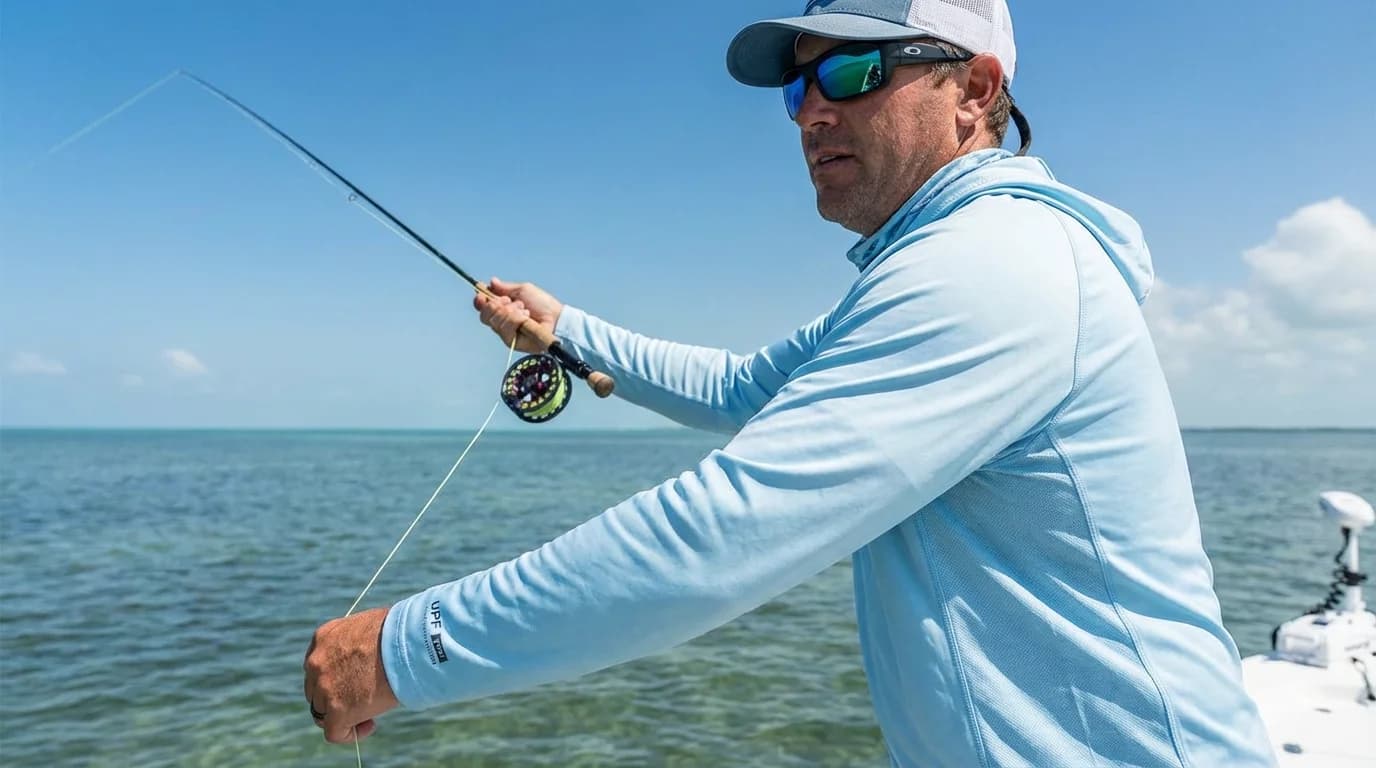
Start with a rated long-sleeve shirt or hoodie that lets you cast comfortably, then add a suitable hat, eye protection and coverage for exposed skin. Choose pockets or an integrated hood according to how you fish. Rain protection, cold-water preparation and a life jacket are separate requirements; a sun shirt does not replace them.
Where will you be fishing?
Prioritize walking comfort, casting reach and coverage that stays in place.
- Try bending to tackle and reaching with a rod.
- Check cuffs, collar and hat together.
- Plan footwear and outer layers for the actual ground and forecast.
Editorial decision aid. It does not calculate safe exposure time, heat tolerance or a product performance score.
Hoodie, button-up or outer layer?
| Format | Why consider it | What to test | What it does not establish |
|---|---|---|---|
| Sun hoodie | Integrated head and neck coverage | Hood position and cuffs while casting | Full face coverage or a universal UPF rating |
| Collared button-up | Pockets and adjustable opening | Shoulder reach and collar with a hat | A rating for exposed forearms when sleeves are rolled |
| Rain shell | Weather protection appropriate to its specification | Casting over the base outfit | Insulation, flotation or a sun rating |
| Gloves and accessories | Coverage for specific gaps | Grip, dexterity and cuff overlap | Complete coverage from a category name alone |
See what to check
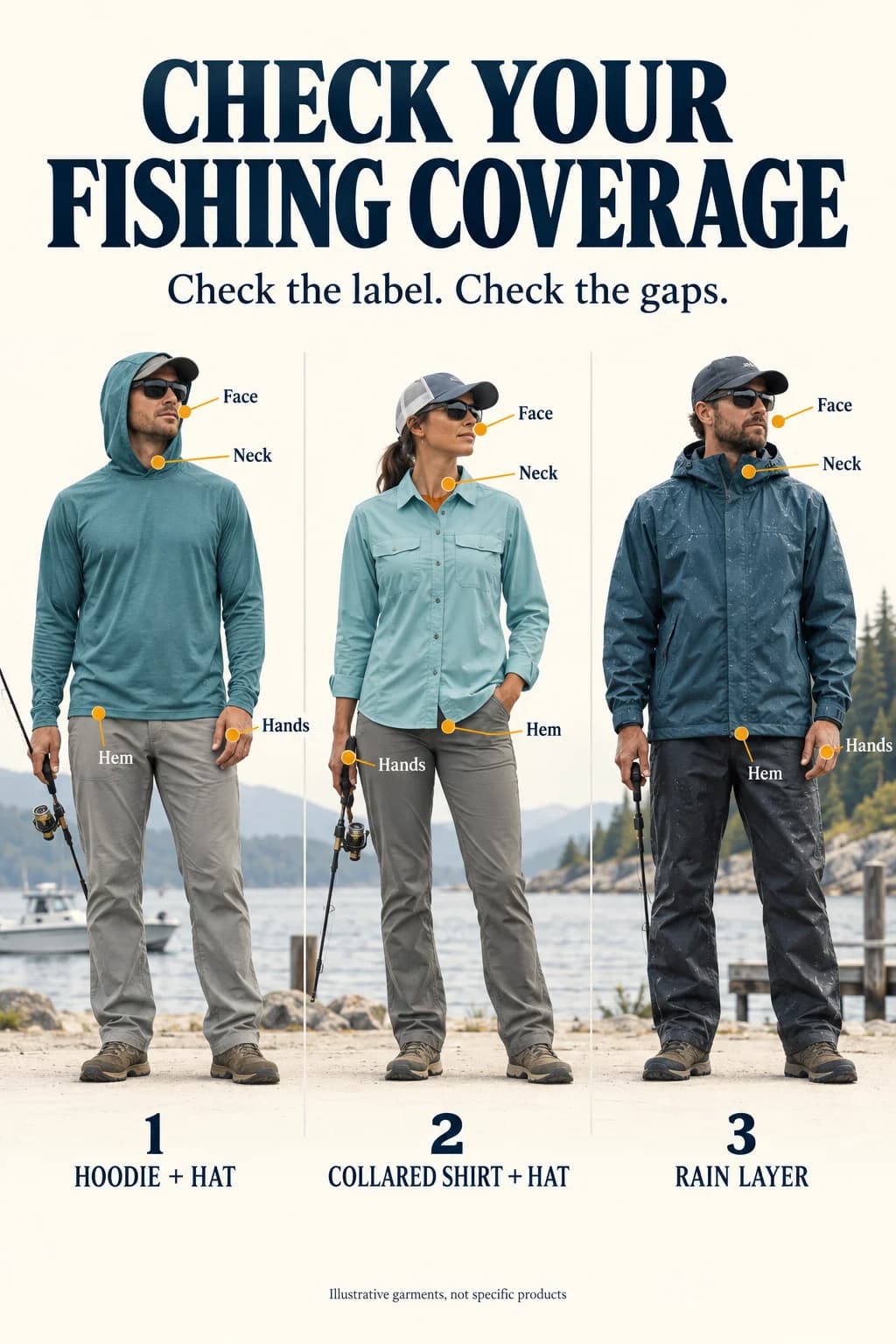
- Check the face and neck even when a hood or cap is worn.
- Reach forward with both hands and inspect sleeve coverage.
- Bend as if handling tackle; check the back and front hem.
- Assess the rain layer as weather equipment, not proof of UV protection or flotation.
Sun exposure near water: plan coverage without scare math
Fishing can involve long periods outside with few convenient breaks. Reflection, the local UV index, time of day and how much skin your outfit covers all matter. A universal statement that water doubles your UV dose is not a sound basis for choosing a shirt. Start with the actual outing and a combined protection plan.
The CDC recommends shade, protective clothing, a hat, sunglasses and sunscreen on exposed skin. That means a long-sleeve garment is one part of the outfit. Your face, ears, hands or neck may remain exposed; sleeves and collars can move during casting. Check those gaps instead of assuming a high number on the torso label protects everything.
A rated fabric is also not a promise of identical performance in every condition. ARPANSA notes that moisture, stretch, wear and chemicals can affect protection. If spray or immersion is expected, look for relevant instructions for the exact garment. Do not turn a generic UPF claim into an unqualified wet-use guarantee.
Sources: CDC: Sun safety · ARPANSA: Clothing labels
Build the outfit from head to toe
Start at the head. Try your hat with any hood you plan to use, including while looking down and turning to the side. A brim and a hood can interfere with one another, and a cap leaves areas uncovered. Choose sunglasses with an appropriate UV-protection claim; a polarized lens feature alone is not the same specification as UV protection.
At the upper body, decide whether an integrated hood or a collar and pockets better matches your tasks. Raise both arms and mimic casting. The shirt should allow that movement without pulling the cuffs far back or dragging the hem upward. If you use a gaiter, check its rating, fit and covered area independently.
For the lower body, try sitting, kneeling and stepping over an imagined obstacle. Check pocket access in the posture you actually fish in. Choose footwear for the surface and activity rather than matching the shirt brand. Gloves should provide the dexterity and coverage you need without creating a gap at the wrist. A label on one item does not certify the entire outfit.
Compare fishing hat coverage →Choose between a shirt and hoodie by task
A button-up can be useful when you want accessible chest storage and adjustable openings. Check where a pocket sits beneath life-jacket straps and whether its closure is practical with your equipment. Rolling sleeves changes coverage; a ventilation feature should not be confused with protection for skin exposed through an opening.
A hoodie makes it easier to keep a head-covering option attached to the shirt, but the hood still needs to work in motion. Turn your head, look down and reach. If it falls back or obstructs your view, the feature is not helping. Thumbholes can help maintain sleeve position, but they should not pull hard against your fingers when your arms extend.
Do not buy by feature count alone. A shirt with fewer details may work better if its fit is right and the missing functions are already supplied by your other gear. Conversely, if you constantly add a separate neck covering, an integrated design may simplify your routine. Compare the complete outfit before deciding.
Check practical hoodie features →Compare models rather than assigning one rating to a brand
Huk, Columbia PFG and AFTCO each sell different constructions. A brand-level table that assigns one UPF, one cooling treatment or one durability level to everything in the range hides the differences a buyer needs. Record the style number, material, fit and rating from the exact product page.
The model examples below illustrate the approach: a vented collared shirt and a hooded top have different strengths. Neither is an automatic winner for every angler. We have not performed abrasion, drying, salt-spray or on-water comfort tests, so those properties are not scored as measured advantages.
Before following a marketplace link, match the product name and model number. Search results can include a newer generation, a children's version or a similar shirt with different sleeves. Check the seller's return terms and the garment label when it arrives. Price and reviews can inform shopping, but they do not establish a fabric rating.
Read the detailed fishing-brand comparison →Saltwater and freshwater change the care questions
Do not choose a garment only because the packaging mentions saltwater or freshwater. Ask what it will encounter: repeated spray, full immersion, hot sun, fish handling or a long ride home in damp clothing. Those conditions tell you which care instructions and construction details to examine.
Follow the manufacturer’s directions after salt or chlorine exposure, and check closures and seams as well as the fabric. A sun hoodie is not automatically a rashguard, and a water-repellent finish is not proof of waterproofing. If water use is central to the activity, choose a garment with an explicit intended use and the necessary instructions.
Cold-water preparation requires separate consideration. The National Weather Service explains that unexpected cold-water immersion can be life-threatening and emphasizes life-jacket use. Comfortable air temperature and a technical shirt are not substitutes for a boating safety plan or clothing suited to the actual water conditions.
Sources: NWS: Cold-water hazards
A practical boat-day packing routine
Check the forecast and the operator's requirements before selecting clothing. Try your shirt, hat, outer layer and life jacket together rather than as isolated purchases. Sit down, look over your shoulder and reach for something at your side. Straps should not prevent essential access or gather clothing into uncomfortable folds.
Keep a suitable weather layer where you can reach it when conditions change. Pack spare clothing according to the trip and keep it protected from spray. The point is not to carry every garment in your wardrobe, but to know what each item is for and how you will use it without reorganizing the entire bag.
Before leaving, inspect sunscreen and eyewear, check coverage gaps and confirm that you can secure accessories appropriately. On a boat, follow the operator's instructions and relevant safety guidance. This clothing checklist is not a replacement for required safety equipment, training or a weather decision.
- Base outfit tested while seated and casting.
- Hat and hood checked together.
- Appropriate life jacket fitted with the outfit.
- Weather layer and protected spare clothing as conditions require.
- Exposed-skin protection, suitable eyewear and accessible essentials.
Sources: NWS: Cold-water hazards · NWS: Prepare for boating hazards
Make the try-on resemble an actual fishing movement
Stand naturally first, then extend your arms as if presenting a rod. Check whether the shoulder panel pulls across your upper back and whether cuffs retreat beyond the coverage you intended. Lift your arms and bend to an imaginary tackle box. Repeated hem movement is more informative than how neat the shirt looks while standing still.
Next, sit with your normal equipment. Check the collar against your neck, pocket bulk under straps and whether your trousers and shirt remain overlapped at the back. If the torso fits but the sleeves do not, try another cut rather than assuming that all shirts from the brand will behave the same.
For a larger or smaller size, repeat the checks rather than treating size as a simple comfort dial. A roomier body may improve reach but change hood stability or pocket placement. The useful outcome is comfortable movement and stable coverage, not a particular letter on the tag.
Spend on the feature you will actually use
List the requirements you need before comparing offers: a clear rating, workable fit and care instructions. Then choose task-specific features such as bank-fishing storage, life-jacket compatibility or a hood.
Avoid buying several untried shirts because one color is discounted. Start with a single model when you are unsure about the cut. A higher price does not prove that a garment tolerates your particular equipment better, and a lower price does not automatically make a clearly labeled, comfortable shirt unsuitable.
Use specialist comparisons for the final shortlist. If you want a collared shirt, compare it with other collared shirts in the sizes you need. If you want a hoodie, compare hood fit and sleeve reach before worrying about small differences in marketing language. Keep a note of the exact model so future replacements are deliberate rather than accidental.
Build a model-level shortlist →Care for the exact garment, then inspect it
Read the sewn-in instructions for washing temperature, detergents, bleach, softener and drying. These can differ between a sun shirt, rain shell and garment with a special finish. Do not apply one aggressive cleaning method to every item or assume that every garment remains protective for a fixed number of washes.
Inspect cuff edges, elbows, seams and areas that contact straps or equipment. Visible thinning, permanent stretching and damage deserve attention. Repairing a seam may restore construction, but it does not measure the fabric's remaining UV performance. Ask the manufacturer when the condition makes a rating uncertain.
Make the routine realistic. If you fish frequently, having enough garments to wash and dry them properly can be more useful than one elaborate top that stays damp in a bag. Store the outfit ready for the next trip and recheck it after rough use.
Understand washing and UPF limitations →Concrete options and their limits
Use these examples to identify a suitable construction or cut. They are not ranked winners. Match the exact model and label; sizes, colors and availability can change.
Columbia PFG Tamiami II Long Sleeve — 1286061
Evidence: Columbia lists UPF 40, polyester ripstop and a mesh-lined back vent.
Consider it when: You want a collared fishing shirt with pockets.
Check the limitation: No integrated hood. Rolled sleeves expose forearms; check the exact size chart and current version.
Columbia PFG Terminal Tackle Hoodie — 1536171
Evidence: Columbia lists UPF 50 and polyester construction for this hooded model.
Consider it when: You prefer an attached hood over a collared design.
Check the limitation: Do not infer face coverage, pocket layout or wet-use performance from the product family name.
Before you buy or head outside
- Verify exact model, rating, size and intended use.
- Cast, bend and sit before committing to the fit.
- Check the hood, hat and life jacket together.
- Identify uncovered face, neck, hands and hem gaps.
- Check weather and water conditions separately from garment claims.
- Read the care label and return terms before removing tags.
Frequently asked questions
Does reflected light mean twice the UV exposure?
Do not use a universal multiplier. Conditions, surfaces, angle and duration vary. Plan coverage and use current UV information rather than treating a fixed doubling claim as a clothing specification.
Is UPF 50 always guaranteed when the shirt is wet?
No. A dry rating is not an automatic wet-use guarantee. Check the exact garment's guidance and test claims. Moisture, stretch and condition can affect protection.
Do I need a fishing-specific shirt?
Not necessarily. A comfortable, appropriately rated shirt may work if it allows your movements and fits your other equipment. Fishing-specific pockets and closures are useful only if they solve a real task.
Can a rain jacket replace a sun hoodie?
They serve different purposes. Choose a rain layer for the relevant weather specification and a sun garment for its documented rating and coverage. Wearing an outer layer also changes ventilation and movement; assess the combination.
Which brand is most durable?
We have no controlled durability comparison for the whole brands. Compare the exact construction, relevant manufacturer evidence and your equipment contact points. Avoid universal rankings based on logo, price or fabric weight alone.
Sources checked
Reviewed September 18, 2026. Official guidance supports the safety and labeling explanations; manufacturer pages support only the specifications attributed to them.
- CDC: Sun safety — Combined protection and exposed skin.
- ARPANSA: Clothing labels — Rating and condition limitations.
- NWS: Cold-water hazards — Immersion and life-jacket considerations.
- NWS: Prepare for boating hazards — Weather and safety-equipment planning.
- Columbia: Tamiami II — Exact-model specifications.
- Columbia: Terminal Tackle Hoodie — Exact-model specifications.