SleeveShirts · Practical guide
How UPF Fabrics Work: Ratings, Coverage, Stretch & Wetness
Understand what a UPF rating measures, how construction and condition affect protection, and what to verify before buying sun-protective clothing.
SleeveShirts Editorial Review · Updated · 11 min read
Based on the official guidance and manufacturer specifications linked below. Recommendations and try-on checks are editorial judgments, not hands-on or laboratory test results. We may earn a commission from qualifying Amazon purchases.
The practical answer
UPF describes ultraviolet transmission through a tested textile under defined conditions. UPF 50 corresponds to about 1/50, or 2%, transmission in the rating calculation. It does not mean every body area is protected, that all wavelengths behave identically, or that a garment keeps the same performance through unlimited wetting, stretching and wear.
Which claim are you trying to check?
Check that the claim belongs to the exact model and material you will buy.
- Match model, color and garment label.
- Look for an identified test or labeling standard.
- Check coverage in motion separately from the number.
Editorial decision aid. It does not calculate safe exposure time, heat tolerance or a product performance score.
Read the rating without overinterpreting it
| Rating | Approximate transmission | Approximate blocked fraction | AS/NZS 4399:2020 class |
|---|---|---|---|
| UPF 15 | 1/15 ≈ 6.7% | 93.3% | Minimum protection |
| UPF 30 | 1/30 ≈ 3.3% | 96.7% | Good protection |
| UPF 50 | 1/50 = 2.0% | 98.0% | Excellent protection |
| UPF 50+ | Below the UPF 50 transmission threshold | Above the UPF 50 blocked threshold | Excellent protection; not zero transmission |
See what to check
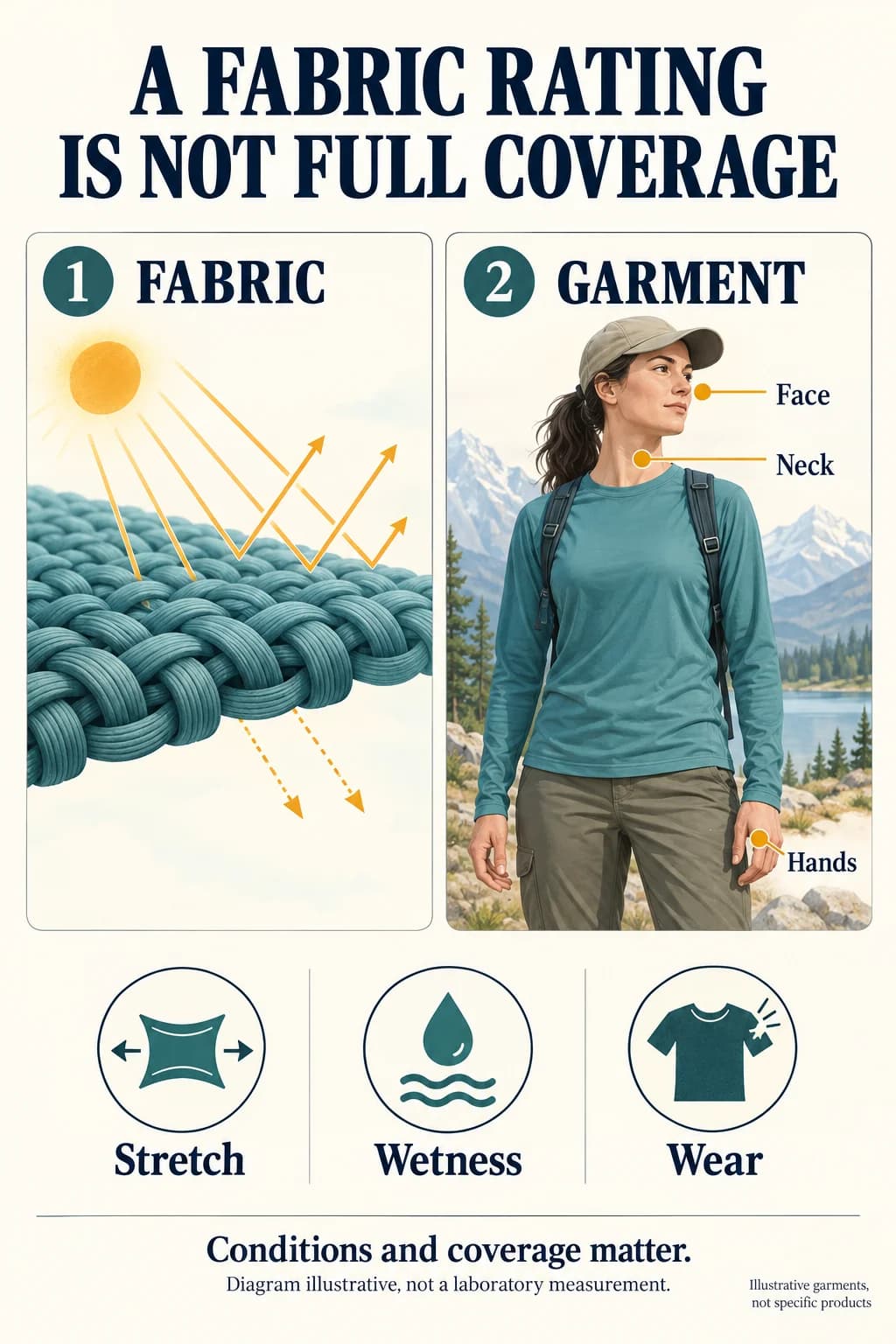
- Distinguish light passing through fabric from light reaching uncovered skin.
- Look for face, neck, hand and hem gaps in the actual outfit.
- Check instructions for stretch, wetness and wear.
- Treat the diagram as an explanation, not a measured transmission plot.
What a UPF number actually tells you
A useful sun-clothing label links a rating to a particular material or garment and an identified testing or labeling framework. That is more meaningful than a generic statement such as sun safe or outdoor performance. A technical-looking fabric and a well-known brand do not independently establish a number.
The rating is about tested transmission, not a personal countdown. Do not multiply an assumed unprotected exposure time by the UPF to calculate how long you can stay outside. Real use includes uncovered skin, movement, changing conditions and the state of the garment.
For shopping, separate three questions: is there an appropriate current rating, does the design cover the areas you need, and does the garment stay suitable in use? A page that answers only the first is incomplete. A page that answers none and relies on dramatic ultraviolet graphics is weaker still.
US methods: measurement, preparation and labeling
AATCC TM183 measures erythemally weighted ultraviolet transmission through a textile. ASTM D6544 prepares material before testing, while ASTM D6603 addresses labeling. These roles are different; a lab-method name alone does not certify every finished garment.
ASTM D6544’s prescribed laundering, simulated sunlight and chlorinated-water preparation represents a defined laboratory exposure. Its simulated two-season context is not a guarantee that a shirt lasts two actual years or a rule to retire it on that date. Look for the exact version and conditions behind the model’s claim, including any wet or stretched testing.
Sources: AATCC: current test-method catalog · ASTM D6544: UV-textile preparation · ASTM D6603: UV-protective textile labeling
Why one percentage is not the whole spectrum
UPF is a standardized, weighted measure of ultraviolet transmission. The simple inverse calculation is useful for explaining the scale, but it is not a spectral chart. Saying UPF 50 therefore blocks exactly the same percentage at every UVA and UVB wavelength would go beyond what that single number establishes.
Read the test claim as stated. If a manufacturer provides additional spectral or wet-condition results, those are separate pieces of evidence. If it does not, leave the detail unknown. Avoid inferring a complete laboratory result from a marketing badge or an image of rays bouncing off a shirt.
For most buying decisions, you do not need to reconstruct laboratory equipment. You need a traceable rating for the exact item and a realistic coverage check. Technical explanations should help those decisions rather than obscure missing product information behind scientific vocabulary.
Sources: UKHSA: UV clothing protection
UPF and SPF describe different products and methods
UPF is used for textiles; SPF is used for sunscreen. They should not be treated as interchangeable test results or added together to produce a combined protection score. Clothing and sunscreen also have different practical limitations: a shirt may leave a gap, while sunscreen needs to be applied and used according to its label.
The useful question is which areas your outfit covers. A long-sleeve top can cover much of the torso and arms, while the face, neck or hands may remain exposed. The CDC recommends combining clothing, shade, a hat, sunglasses and sunscreen on uncovered skin.
Plan the combination by body area rather than asking which one universally wins. A shirt that rides up while reaching is different from the same shirt standing still. A rolled sleeve no longer covers the forearm. A hood may shade or cover some areas without enclosing the face.
Sources: CDC: Sun safety
Plan clothing and sunscreen by covered area →Construction matters more than a fiber slogan
UV transmission depends on knit or weave structure, openings, dyes, finishes, thickness and stretch, as well as fiber type. UK government guidance also identifies fabric condition. Compare the actual garment's rating.
Clothing can interact with radiation through absorption and scattering as well as through openings in the construction. An illustration of reflected arrows is a simplification, not proof that a fabric works as a perfect mirror. The shopper needs the tested result, not a guessed result from an attractive microscopic picture.
An additive or treatment can be relevant when the manufacturer documents it, but it is not the only possible route to a protective fabric. Conversely, the presence of a named additive does not let you calculate a garment's rating. Keep claims tied to the finished textile and relevant testing.
Sources: UKHSA: UV clothing protection
Cotton versus polyester: avoid assigning universal ratings
Ordinary fabrics can differ widely. It is not reliable to give every cotton T-shirt one UPF value and every synthetic one another. A dense construction, a loose knit, a stretched panel and a particular dye can produce different results within the same broad fiber category.
If the rating matters to your purchase, compare labeled garments. Then use material information for separate questions such as feel, care, fit and suitability for the intended activity. A fiber preference is legitimate, but it should not silently substitute for a current protection claim.
The same principle applies to color. A manufacturer may state different ratings for colors in one model, as the Echo example demonstrates. Do not generalize that exact difference to other fabrics, and do not assume a dark color repairs an absent or unclear rating. Verify the item you intend to order.
Sources: UKHSA: UV clothing protection
Separate fabric comfort from protection claims →Stretch and wetness need condition-specific evidence
Stretch can affect UV transmission. UK guidance notes that wetness can increase or decrease protection depending on the textile. Check the specific fabric's test scope rather than assuming every wet garment behaves the same way.
For a fitted garment, check that it is used as intended and fits according to the model's guidance. Do not assume a tight rashguard is wrong simply because it stretches; it may be designed for that use. Equally, do not force an ordinary shirt into an excessively stretched fit and assume the original label resolves the question.
When shopping for swimming or repeated spray exposure, ask whether the claim covers relevant conditions. A seller should distinguish intended water use, drying claims and tested UV performance. If the information is missing, record it as unknown rather than filling the gap with an optimistic statement.
Sources: UKHSA: UV clothing protection
Compare water-use designs →Turn the number into a useful garment check
Put the item on with the equipment and other layers you expect to use. Raise your arms, reach forward, bend and turn your head. Look at the cuffs, neckline and waistband. The rating cannot protect skin that the garment has moved away from.
Inspect the hood and hat as a combination. A hood that repeatedly falls back, or a cap that leaves the ears and neck exposed, needs to be considered in the overall coverage plan. Thumbholes can help a sleeve stay extended, but they do not necessarily cover the whole hand.
Check deliberate openings too: a zip neck, vent, rolled sleeve or loose gap is part of the design. That may be a useful comfort feature, but it should not disappear from your protection assessment. Compare the outfit in the position you will use rather than only the product photograph.
Use the visual coverage and fit checks →How to read a product claim in five steps
First, match the model and version. Second, check whether the rating applies to your color or material variant. Third, look for the identified test or labeling standard. Fourth, review use and care instructions. Fifth, check the garment in motion after delivery.
A product title, a marketplace description and a sewn-in label can disagree. If they do, ask the manufacturer or seller to clarify before relying on the stronger claim. Save the relevant product information for your purchase. A broad brand-level guarantee should not hide a mismatch between versions.
Do not convert user reviews into testing evidence. They can reveal questions about fit or durability, but a reviewer feeling cool or not noticing sunburn does not measure UPF. The same applies to our editorial photographs and illustrations: they explain concepts and buying checks, not laboratory outcomes.
- Exact model and generation identified.
- Color or fabric variant matched.
- Rating and relevant standard traceable.
- Use, care and limitations reviewed.
- Coverage checked through actual movements.
What washing and wear can tell you
Follow the garment's care label. Fabric and finishes differ, so a wash count without a defined garment and test does not establish an expiry date. Check the evidence and scope behind any permanent-performance claim.
A home inspection can identify a hole, a thinning area or a permanently stretched cuff. It cannot assign a new UPF number. Looking through the fabric or shining a household light at it does not reproduce a standardized ultraviolet test.
When the garment's condition makes its intended use uncertain, ask the manufacturer for guidance. If that cannot resolve the concern, choose a suitable replacement. Repairing stitching and verifying the UV performance of worn fabric are different tasks; success at the first does not prove the second.
Read the label-first care guide →Keep environmental claims separate from UV claims
A recycled-content statement, a fabric rating and a claim about environmental effects answer different questions. One does not establish the others. A clothing guide should not use unsupported environmental comparisons to discourage appropriate sunscreen on exposed skin.
If a destination has rules for sunscreen or other products, check current official local guidance. Do not rely on a universal reef-safe label or assume a law in one place applies everywhere. For garment shopping, ask what a sourcing or material certification actually covers.
Choose items you can use and care for consistently. Repair suitable damage where practical and avoid replacing clothing only because a newer finish is advertised. When protection or condition is uncertain, however, a sustainability preference is not a reason to invent a rating that cannot be verified.
Read material and sustainability claims carefully →Concrete options and their limits
Use these examples to identify a suitable construction or cut. They are not ranked winners. Match the exact model and label; sizes, colors and availability can change.
A clearly labeled UPF garment
Evidence: ARPANSA's AS/NZS 4399:2020 explanation distinguishes UPF 15, 30 and 50/50+ classifications.
Consider it when: You want a documented rating rather than a generic sunwear claim.
Check the limitation: Other labeling systems may differ; the rating still applies to covered skin and relevant conditions.
Outdoor Research Echo: a color-specific example
Evidence: The product page lists UPF 15 for light colors and 20 for dark colors.
Consider it when: You need an example of why the exact variant matters.
Check the limitation: Do not transfer these values to another model or treat it as UPF 50.
Before you buy or head outside
- Read the exact item label, not only the category heading.
- Keep rating, coverage and comfort as separate checks.
- Do not calculate safe outdoor hours from UPF.
- Ask for condition-specific evidence when wet use matters.
- Treat illustrations and reviews as explanation or experience, not measured data.
- Inspect wear and follow the garment's own care instructions.
Frequently asked questions
Does UPF 50 mean no ultraviolet radiation gets through?
No. In the rating calculation it corresponds to about 2% transmission. It is also not a claim about uncovered skin or a guarantee for every use condition.
Can I add the UPF of two shirts?
Do not add label numbers to create a new rating. A combination has not been characterized merely because its individual pieces have ratings. Plan practical coverage and comfort rather than inventing a combined score.
Does a dark shirt always outperform a light one?
Color can matter, but construction, material and other factors also matter. Use the rating for the exact item. A broad color rule cannot replace product-specific evidence.
Is a household light test enough?
No. It can help you notice holes or obvious thinning, but it does not measure ultraviolet transmission using a standardized method. Do not assign a UPF from how much visible light you can see.
Should every sun-protection guide recommend a product?
No. Understanding labels and uncertainty can be the useful outcome. This science guide explains how to assess claims; the linked buying guides address fit, use and concrete model options.
Sources checked
Reviewed September 18, 2026. Official guidance supports the safety and labeling explanations; manufacturer pages support only the specifications attributed to them.
- ARPANSA: Australian sun-protective clothing — Current classifications, coverage and label limitations.
- UKHSA: UV clothing protection — Testing concepts and textile factors, including wetness and stretch.
- CDC: Sun safety — Combined protection for covered and exposed skin.
- Outdoor Research: Echo Hoodie — Example of color-specific ratings.
- AATCC: current test-method catalog — TM183 measures erythemally weighted UV transmission through fabric.
- ASTM D6544: UV-textile preparation — Laboratory preparation before measurement, including specified laundering and exposure.
- ASTM D6603: UV-protective textile labeling — Labeling framework; not a promise of unlimited protection.