Recycled Polyester and Clothing Certifications: What to Check
Check recycled content, garment quality and the scope of certifications before choosing performance clothing.

A recycled-content label describes part of a garment's materials. It does not by itself establish its total environmental impact, quality or how long you will use it.
Polyester is used for durability and moisture wicking. Conventional virgin polyester uses fossil-based inputs; recycled polyester uses existing material as feedstock.
Compare the actual recycled percentage, construction and care requirements. Keeping a suitable garment in use can matter more to your buying decision than a broad sustainability slogan.
This guide explains recycled polyester and what GRS and OEKO-TEX certifications can tell you about a product.
Table of Contents
- 1. The Problem with Virgin Polyester
- 2. The Chemistry of Recycled Polyester (rPET)
- 3. Carbon Footprint Analysis
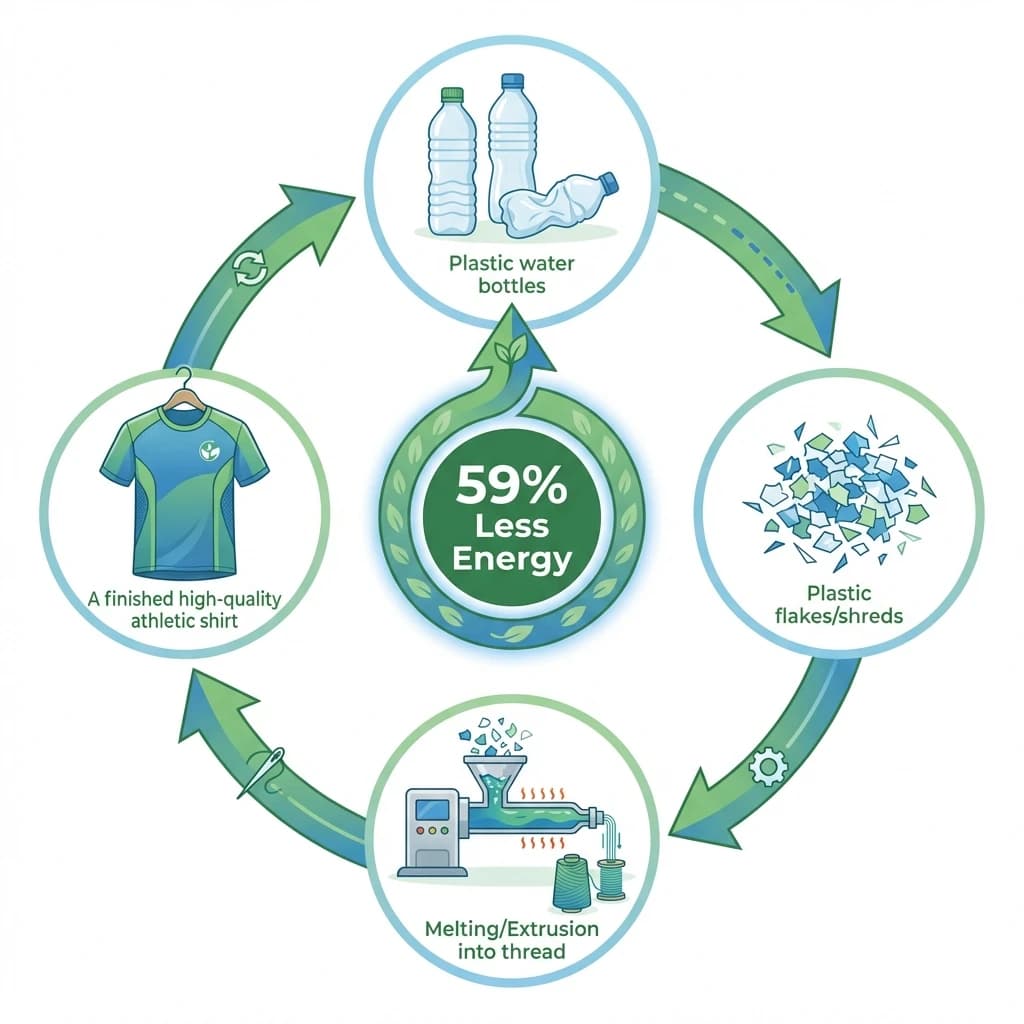
- 4. The Manufacturing Process: Bottle to Shirt
- 5. Certifications: GRS and Oeko-Tex
- 6. The Microplastic Challenge
- 7. Future Innovations: Biodegradable Synthetics
- 8. Frequently Asked Questions (FAQ)
1. The Problem with Virgin Polyester
Polyester is common in athletic clothing. Check the garment's composition and care requirements alongside any recycled-content claim.
Conventional polyester production uses fossil-based feedstocks to make the chemical building blocks for PET, including ethylene glycol and terephthalic acid.
Petroleum → Naphtha → Monomers → Polyester
The Linear "Take-Make-Waste" Model
Polyester can shed microfibers during use and washing. A recycled source does not remove that issue.
2. The Chemistry of Recycled Polyester (rPET)
Recycled polyester, or rPET, is made from recovered PET material.
Recycled content does not by itself prove either lower or higher garment quality.
The feedstock differs, while the finished yarn and fabric still need to meet the intended use. Check fit, construction and performance claims at the garment level.
Mechanical recycling reprocesses recovered PET. Textile quality depends on the material and the process.
A bottle-to-fiber claim describes a feedstock route. Verify the recycled content of the actual garment.
3. Carbon Footprint Analysis
Environmental comparisons need a defined scope. Textile Exchange’s polyester assessment explains why the material route and comparison boundaries matter. Do not apply one percentage to every shirt.
Avoid applying a single energy or carbon-saving percentage to every recycled shirt. Production method, transport and the comparison baseline all affect the result.
Ask for a product-specific comparison with a defined method and boundary. A fiber label cannot establish a fixed carbon or energy saving.
SleeveShirts does not manufacture shirts. We cannot assign a bottle count or an ocean-waste saving to a garment without product-specific evidence.
4. The Manufacturing Process: Bottle to Shirt
A typical bottle-to-fiber process includes sorting, cleaning, processing and spinning. Details differ by producer.
- Collection & Sorting: Post-consumer plastic bottles are collected. Clear bottles are preferred for easy dyeing later.
- Cleaning & Shredding: The material is sorted, cleaned and processed into flakes; labels and caps need to be separated.
- Depolymerization (Optional): In chemical recycling, flakes are broken down to monomers. In mechanical (more common), they are melted directly.
- Extrusion: Molten PET passes through a spinneret to form filaments.
- Texturizing: Manufacturers can texture yarns to change their feel. A recycled label alone does not prove softness or moisture-wicking performance.
5. Certifications: GRS and Oeko-Tex
Check the exact certification and its scope. A brand's general environmental claim is not evidence that every garment meets the same standard.
Global Recycled Standard (GRS)
The GRS verifies recycled content and chain of custody and includes additional processing requirements. Check whether the claim applies to the product you are considering.
- Traceability: Chain-of-custody requirements follow certified material through relevant supply-chain stages.
- Social Compliance: The standard includes social and environmental processing requirements.
- Chemical Restrictions: It includes chemical restrictions for certified processing.
Oeko-Tex Standard 100
While GRS looks at where the material came from, Oeko-Tex addresses harmful-substance testing for the certified textile article.
OEKO-TEX STANDARD 100 tests certified articles against harmful-substance criteria. Requirements vary with intended skin contact. Check the article's label and certificate rather than assuming the entire brand is covered.
Check the certificate, then the product
Use OEKO-TEX Label Check with the certificate number or scan the label’s QR code. Match the holder, validity and product scope. STANDARD 100 addresses harmful substances; it is not a UPF or recycled-content certificate.
Textile Exchange distinguishes GRS certification for products with at least 20% recycled material from the 50% threshold for consumer-facing GRS product labeling. Check the exact claim and current standard; a brand-wide statement does not certify every item.
For odor claims, identify the finish too. HeiQ Mint, for example, is described by its supplier as non-antimicrobial odor control.
6. The Microplastic Challenge
Both virgin and recycled synthetics can shed microfibers. Recycled content alone does not solve microfiber release.
Follow the care label and avoid unnecessary wear or washing.
What We Are Doing: Yarn and fabric construction can affect shedding. We do not manufacture textiles or claim that all recycled shirts use the same yarn structure.
What You Can Do:
- Wash Less: Some models have a documented odor-control finish. Performance fabrics are not all antimicrobial. Air after light use if appropriate; wash when soil or odor requires it.
- Use a Filter: Install a microfiber filter on your washing machine or use a Guppyfriend bag.
- Cold Wash: Use the temperatures and drying method allowed by the garment's care label.
7. Future Innovations: Biodegradable Synthetics
When comparing new material claims, distinguish recycled content from bio-synthetics.
. A plant-based input does not automatically mean the finished garment biodegrades in normal disposal conditions.
Check the scope of any textile-to-textile recycling claim, including collection access and accepted materials. Do not assume every polyester blend can become a new shirt indefinitely.
Check the certification scope
- Textile Exchange: RCS and GRS requirements
- OEKO-TEX: STANDARD 100 harmful-substance testing
- Textile Exchange: polyester and recycled feedstock
These standards describe different attributes. Check the exact product and certificate; none alone establishes UPF, comfort or a fixed environmental saving.
8. Frequently Asked Questions (FAQ)
Is recycled polyester lower quality than virgin polyester?
Recycled content alone does not establish quality. Compare the finished shirt's construction, fit, care and documented performance.
Does recycled polyester still release microplastics?
Recycled synthetic fabrics can still shed microfibers. Follow the care label and check what any filter or catchment product is designed to capture; it does not eliminate all shedding.
What is the GRS certification?
GRS is a voluntary standard covering recycled content, chain of custody and additional social, environmental and chemical requirements for certified processing. Verify the product-specific certification and claim.
Why is Oeko-Tex important for gym clothes?
OEKO-TEX STANDARD 100 indicates that the certified textile article has been tested against harmful-substance criteria. Its requirements account for intended skin contact. It does not prove UPF, cooling performance or an absence of all environmental impact.
Is rPET breathable?
It can be. Compare the fabric construction and fabric weight alongside the garment's fit. Recycled content alone does not establish airflow or moisture-wicking performance.
Wear the Future
Compare recycled content, certifications, fit and care before buying a replacement shirt.
As an Amazon Associate, we earn from qualifying purchases. This helps support our research at no extra cost to you.