Moisture-Wicking Fabrics: How They Handle Sweat
Compare wicking and drying claims alongside fabric construction, fit and the conditions you expect.
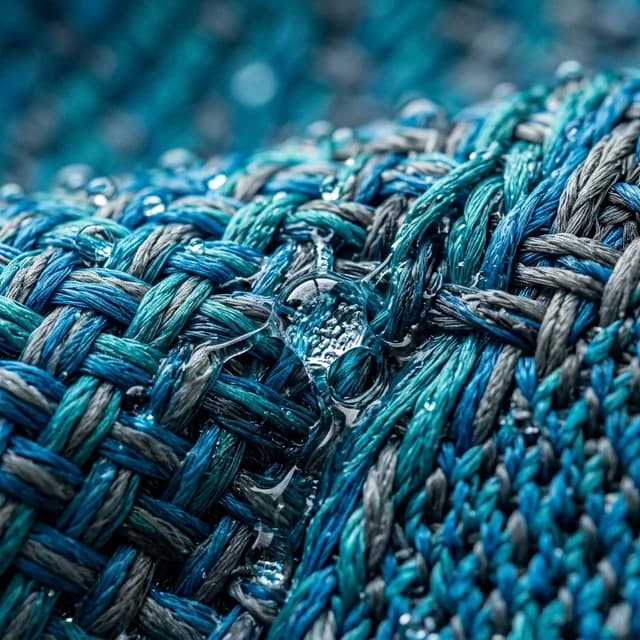
For millennia, humans have sought to protect themselves from the elements. We wore animal skins for warmth, woven grasses for breathability, and eventually, cotton and wool. But as our athletic endeavors pushed the limits of human physiology, our natural fibers began to fail us.
A wet shirt can cling and feel uncomfortable during a run. Wicking fabrics are designed to spread liquid through the textile, but they do not guarantee cooling or dry skin in every condition.
Start with how liquid moves through a textile, then check what the product actually documents.
Table of Contents
- 1. Introduction: The Biology of Sweat
- 2. History: From Wool to Coolmax
- 3. Capillary Physics: The Equation of Dryness
- 4. Hydrophobic vs. Hydrophilic Mechanics
- 5. Engineering the Perfect Fiber
- 6. Testing absorbency, wicking and drying separately
- 7. The Art of Layering
- 8. Thermodynamics: The Cooling Engine
- 9. Frequently Asked Questions (FAQ)
1. Introduction: The Biology of Sweat
Exercise produces heat. Sweating and evaporation help the body release it, while clothing, effort and environmental conditions affect how much heat can be lost.
Sweat glands release a fluid that is mostly water with dissolved salts and other components. Clothing comfort depends partly on where this liquid goes and whether it can evaporate.
Sweat contributes to evaporative cooling when it evaporates. Humidity, airflow and clothing can limit that process; a wicking label cannot guarantee cooling.
Liquid remaining in a garment or dripping away is not the same as evaporation from skin or clothing. Heat for evaporation can come from the body and its surroundings. Wet clothing can also affect heat loss during a windy or cold stop.
A useful shirt balances coverage, comfort and moisture movement. Evaluate it during the activity and with the rest of your clothing.
2. History: From Wool to Coolmax
Wicking performance depends on the finished fabric as well as the fiber.
The Era of Natural Fibers
For centuries, wool was the original performance fiber. It is naturally hydrophilic (water-absorbing) on the inside of the fiber but has a hydrophobic (water-repelling) outer scale structure. It can absorb 30% of its weight in water without feeling wet.
Wool garments differ in weight and construction. Compare the actual shirt's comfort and care instead of declaring it unsuitable for every summer run.
Cotton can absorb water and remain damp. On a hike that turns cold or windy, carrying a suitable dry layer and weather protection matters. The phrase “cotton kills” is a warning about wet clothing in exposure, not proof that all insulation disappears or that every cotton garment transfers heat at a fixed rate.
The Synthetic Revolution
Polyester and nylon appear in many outdoor garments. Their comfort depends on construction and fit, so the fiber label is only a starting point.
A water-repellent fiber surface alone does not create reliable liquid transport. Yarn spacing, wettability and the finished fabric determine the paths available to water.
The Breakthrough: 1986
COOLMAX describes its original moisture-management fiber as dating to 1986. The current brand belongs to The LYCRA Company. Its profiled fibers are one approach to moisture transport; the brand name is not a test result for every garment.
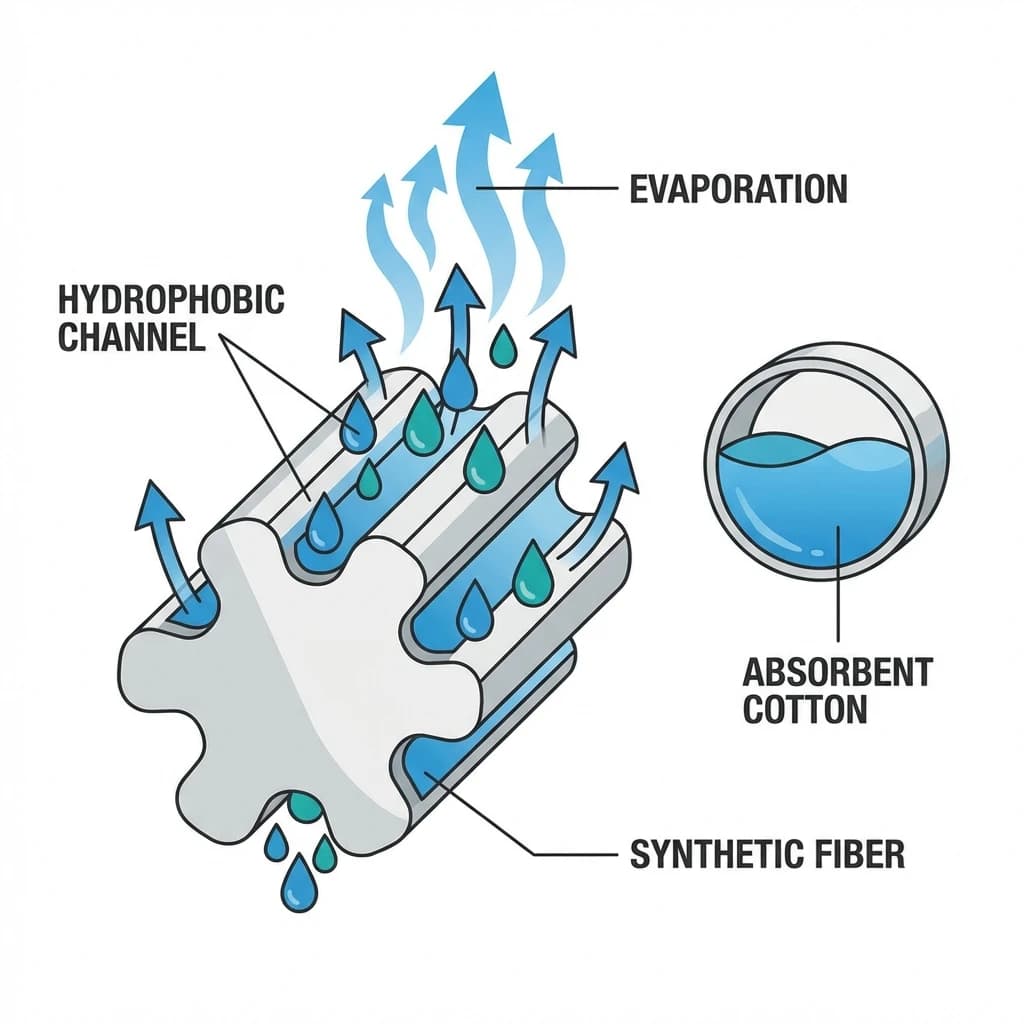
Profiled synthetic fibers create surfaces and channels that can help liquid spread. Compare the finished fabric and any published test, not just its marketing name.
Fiber geometry is one design input. Finishes and construction also influence transport; a shirt does not act as a powered water pump. See our sustainable-fabric guide for a separate check of recycled-content claims.
3. Capillary Physics: The Equation of Dryness
So, how does a piece of plastic move water against gravity? The answer lies in Capillary Action.
Capillary action is the ability of a liquid to flow in narrow spaces without the assistance of, or even in opposition to, external forces like gravity. It occurs because of intermolecular forces between the liquid and surrounding solid surfaces.
The efficiency of this flow is governed by Capillary Pressure ($P_c$). We can quantify this using the Young-Laplace Equation for a cylindrical tube:
$P_c = \frac{2\gamma \cos\theta}{r}$
The Young-Laplace Equation
- $P_c$ (Capillary Pressure): A pressure difference, measured in pascals, that can drive liquid movement when wetting conditions permit. A larger value alone does not establish a faster wicking rate.
- $\gamma$ (Gamma): The liquid’s surface tension; it depends on temperature and composition.
- $\theta$ (Theta): The contact angle between the water and the fiber. This dictates wettability.
- $r$ (Radius): The radius of the capillary tube (the space between fibers).
In this idealized cylindrical-capillary equation, decreasing radius increases the pressure magnitude at the same surface tension and contact angle. Flow also faces viscous resistance. A textile’s irregular connected spaces are more complicated than a single tube.
Fine filaments can change the spaces and surface area in a yarn. Their effect depends on the construction and wetting behavior; microfiber content alone cannot establish superior transport.
For a wetting contact angle below 90°, the idealized equation gives a positive capillary-driving pressure. Above 90°, spontaneous wetting is resisted. That is why a hydrophobic fiber label alone cannot predict wicking.
4. Hydrophobic vs. Hydrophilic Mechanics
The variable $\theta$ (Theta) in our equation represents the Contact Angle.
High Contact Angle (>90°)
Example: Waxed Car, Teflon, Untreated Polyester
The surface is Hydrophobic. Water beads up high. It refuses to spread.
Low Contact Angle (<90°)
Example: Cotton, Viscose, Treated Synthetics
The surface is Hydrophilic. Water collapses and spreads out into a thin film.
Surface wetting and water absorbed inside a fiber are different processes. A fabric can transport water through connected spaces while some of its fibers absorb moisture. Compare both properties instead of labeling all hydrophilic fabrics as unsuitable.
High-performance fabrics solve this with a Gradient Structure.
Some engineered fabrics use different wettability on the two faces to encourage outward transport. Confirm that construction for the exact fabric; it is not a feature of every performance shirt.
Directional transport needs a relevant test. A gradient does not guarantee that moisture cannot move back, dry skin or comfort under every pack and weather condition.
5. Engineering the Perfect Fiber
We can't change the laws of physics, but we can engineer the tools. Textile scientists optimize moisture transport by manipulating the Cross-Sectional Shape of the fiber.
Round Fibers (The Failure of the 70s)
Yarn shape, knit or weave structure and finishes can affect the paths available for liquid movement.
Round filaments can still form liquid pathways between fibers. Their shape alone does not make a textile incapable of wicking.
Grooved Fibers (The Modern Standard)
Modern wicking yarns, like those used in specific Coolmax or specialized top-tier athletic variants, have complex cross-sections.
- Tetra-Channel (4-groove): Looks like a four-leaf clover.
- Hexa-Channel (6-groove): Looks like a snowflake.
- Trilobal (3-groove): Looks like a propeller.
These grooves form physical channels that run the entire length of the shirt. They act exactly like the gutters on a house, directing the flow of fluid.
Different fiber profiles can change exposed area and liquid spreading. The finished fabric still needs a separate drying test.
Yarn shape can affect surface area and liquid movement. A percentage improvement needs a defined fabric, test and comparison.
6. Testing absorbency, wicking and drying separately
Ask which property a claim addresses and whether the maker reports a comparable method. AATCC provides separate methods for absorbency, liquid transport and drying; a single number does not describe all of them.
These examples show what a published method can tell you. We do not claim that every shirt in our guides has been tested by these methods.
AATCC TM79: Absorbency of Textiles
Absorbency is one property to compare. A result needs a defined specimen and test conditions.
AATCC TM197: Vertical Wicking Rate
This method addresses vertical wicking to specified distances. It does not directly predict drying on a person.
AATCC TM198: Horizontal Wicking
Horizontal wicking is another liquid-movement measure. Use comparable methods and conditions before ranking fabrics.
See the AATCC standards catalog for method names. SleeveShirts has not performed these tests and does not assign universal passing thresholds.
Drying requires its own method
The AATCC catalog lists TM199 for drying time with a moisture analyzer, TM200 for drying rate at absorbent capacity with airflow, and TM201 for drying on a heated plate. TM195 covers liquid moisture management. A wicking height from TM197 or TM198 cannot be converted into a drying time. Compare specimen preparation, water quantity and conditions as well as the method.
7. The Art of Layering
Even the best shirt can fail if used incorrectly in a system. Moisture management is a relay race.
- Base Layer (Your Wicking Shirt): Its job is transport. It moves sweat off the skin. Choose a fit that permits movement and works with the intended layers. Neither compression nor one fiber type is mandatory.
- Mid Layer (Fleece/Grid): Its job is insulation + transport. It accepts the moisture from the base layer and continues passing it outward while creating trapped air pockets for warmth.
- Shell Layer (Jacket): Its job is protection + breathing. This is the hardest part. It must stop rain from coming in but let the water vapor (sweat gas) out. Shell constructions differ. Check the particular jacket’s protection and moisture-transfer claims.
Common Error: Wearing a cotton t-shirt under a purely wicking fleece. The cotton stops the relay race. It holds the sweat. You get wet, then you get cold. The base layer is the foundation of the entire system.
8. Thermodynamics: The Cooling Engine
Why do we care so much about evaporation?
Evaporation requires energy, and the amount depends on water temperature. We do not use the approximately 2,260 kJ/kg value at boiling temperature to calculate heat removed from a clothed runner. Air, fabric and surroundings contribute to the energy balance; a low fabric mass does not establish a fixed cooling gain.
However, evaporation is proportional to surface area.
- Scenario A (Cotton): Sweat pools in a small, saturated patch on your back. Surface Area = 100 cm². Evaporation is slow. Heat stays. bacterial growth accelerates (producing odor).
- Scenario B (Wicking Fabric): Liquid spreads over more fabric area. This can support evaporation, but drying and cooling depend on the garment and conditions.
9. Frequently Asked Questions (FAQ)
What is moisture-wicking fabric?
Wicking fabrics help spread liquid through the textile. Drying and comfort still depend on construction, fit, airflow and humidity. The claim does not guarantee dry skin or prevent heat illness.
How does moisture-wicking fabric work?
Capillary action can spread liquid through narrow spaces in a textile. Yarn shape, fabric construction and surface finishes affect movement; evaporation also depends on the surrounding conditions.
Is moisture-wicking better than cotton?
Compare the complete garment for your activity. Some cotton shirts retain moisture longer than some synthetic shirts, but the fiber name alone cannot establish drying time, comfort or chafing risk.
Can I wear moisture-wicking clothing in cold weather?
A base layer is part of a cold-weather system. Plan suitable insulation, weather protection and dry clothing; a wicking claim alone cannot guarantee warmth during stops.
How to laundry care for wicking clothes?
Follow the garment’s care label, including any restriction on softener, bleach or drying heat. No single wash recipe suits every performance textile.
Compare Moisture-Management Claims
Compare wicking claims alongside coverage, fit and care before buying a shirt for your activity.
As an Amazon Associate, we earn from qualifying purchases. This helps support our research at no extra cost to you.