Best Fishing Sun Hats in 2026: Boonie, Wide-Brim & Neck-Cape Options
Affiliate disclosure: SleeveShirts may earn from qualifying Amazon purchases. Recommendations are based on official guidance, current manufacturer specifications, category research, buyer-feedback patterns, and our published editorial criteria. We do not claim hands-on or laboratory testing.
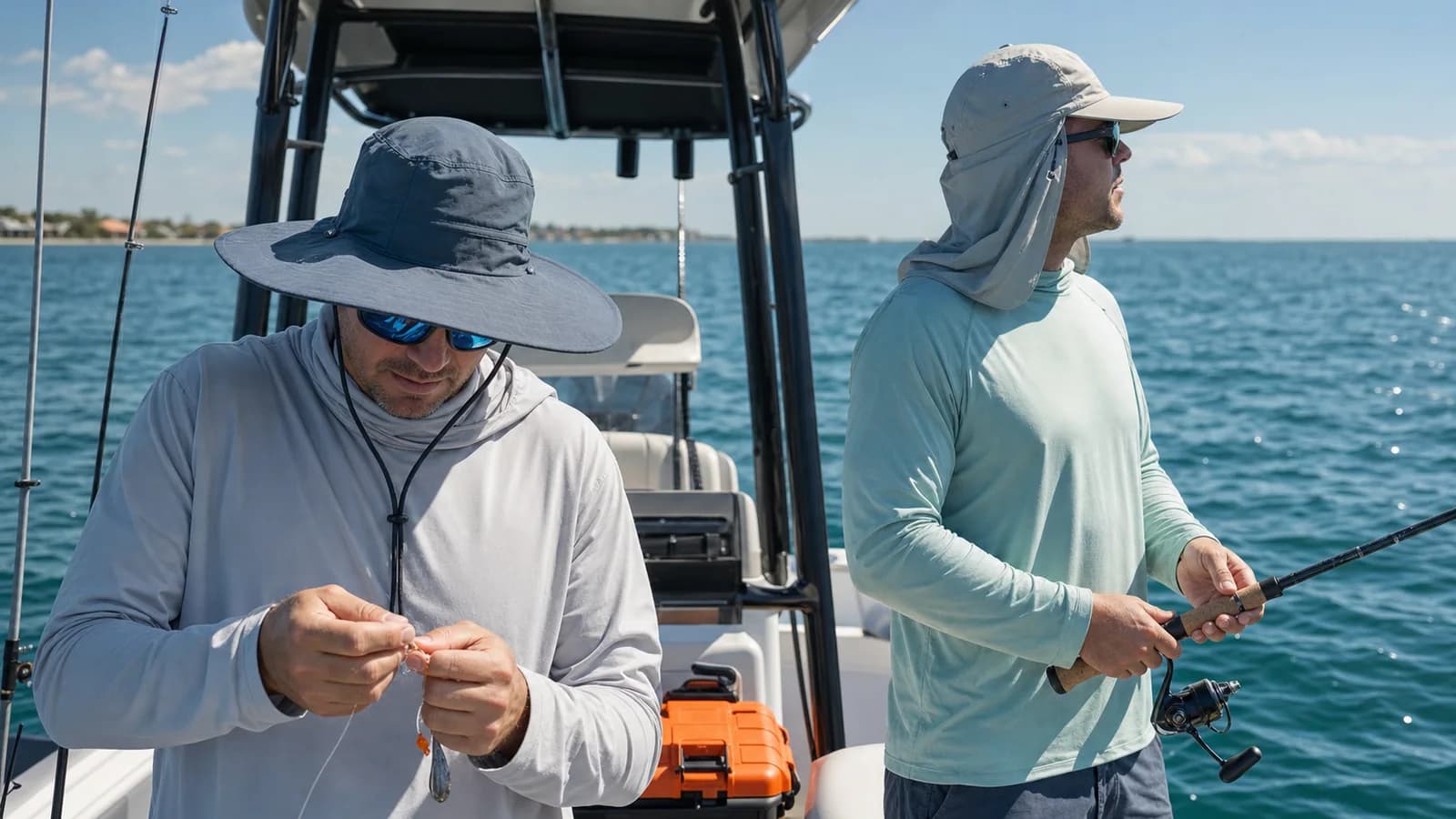
Fishing exposes the head, ears and neck for hours while water and pale boat surfaces add reflected brightness. The right hat must create useful shade without becoming a sail, manage sweat, stay secure during a run and recover from spray. This guide compares boonie hats, solar sombreros, sunshield caps and lightweight cape designs for shore, boat and kayak anglers.
Quick answer
For most boat anglers, start with a secure wide-brim UPF hat with a dark underbrim and quick-dry construction.
Choose a brim that shades the ears and neck without collapsing into your eyes, plus a functional chin cord for wind. A floating brim is valuable around water, while a cape-style cap provides stronger rear coverage for long exposed runs. Verify which panels carry the UPF claim; breathable mesh may be treated differently from the solid crown and brim.
Quick picks
Best starting points by use case
Verify the current listing for the exact UPF claim, covered panels, size range, care instructions, seller, and return terms before buying.
Best full-coverage fishing format
Simms Solar Sombrero-style wide-brim hat
The current manufacturer model combines an official UPF 50+ claim, wide brim, adjustable chin cord and floating construction. It is a strong format for open boats where shade and retention matter more than compact styling.
Best neck and side coverage
Simms SunShield-style cape cap
A long bill and neck cape target rear and side exposure while snap closure can add security in wind. It suits long runs and high exposure but creates a more enclosed feel than a boonie.
Best value boonie search
AFTCO Cast Printed Boonie
The Cast model uses printed microfiber and an adjustable locking cord. Its checked official page did not state a numeric UPF, circumference range or brim width. Do not borrow the Tropics model’s specifications.
Best budget Amazon search
Floating UPF 50 fishing boonie
Budget marketplace options can work, but prioritize explicit brim dimensions, a non-reflective underside, size adjustment and a real retention cord. Ignore permanent price and rating claims because both change.
Model-specific buying path
3 exact Amazon fishing hats for boat and shore use
These exact listings map to floating wide-brim, cape-cap, and compact boonie strategies. Verify retention, brim behavior, covered panels, sizing, and water claims on the selected listing.
Specification-based shortlist, not a hands-on product test. Amazon supplies exact-listing titles, images, availability, offer data, and destinations when a match is available.
Simms Superlight Solar Sombrero
A fishing-specific wide-brim route for open boats and high exposure. Confirm the selected size, brim stability, retention setup, UPF statement, flotation language, and comfort with sunglasses.
Simms Superlight Sunshield Cap
A cape-cap route for anglers prioritizing stable rear coverage during shore sessions and boat runs. Verify the current cape construction, bill, ventilation, size, and exact UPF details.
AFTCO Cast Boonie Hat
A conventional fishing-boonie alternative for shoppers who want a smaller, packable brim. Confirm the exact model’s material claim, ventilation, cord, brim dimensions, color, and fit before ordering.
Who this guide is for
Use this guide if
- Boat anglers exposed to wind, water reflection and long periods without reliable shade.
- Shore, surf and kayak anglers comparing boonie, wide-brim and neck-cape designs.
- Shoppers pairing a hat with an existing fishing shirt, sun hoodie or gaiter.
- Amazon buyers who need to distinguish a fishing-specific technical hat from a logo cap.
Skip or narrow the search if
- You only need a casual dock cap for brief trips and already cover your ears and neck another way.
- You are shopping for a baby or toddler; use the child-specific guide instead.
- You need cold-weather headwear, hard-hat compatibility or insect-net certification.
- You want a medical guarantee. No hat eliminates UV exposure or replaces a complete sun-safety strategy.
What official sun-safety guidance says
A fabric rating and a protective hat shape answer different questions. UPF describes the tested material; brim width, neck coverage, ear coverage, and the way the hat sits determine how much useful shade the design can create. These source notes shape our buying criteria.
Water reflection changes the comfort problem
The American Cancer Society notes that UV can still reach people through reflection from surrounding surfaces and recommends a wide brim, protective clothing, sunglasses and sunscreen as complementary measures.
American Cancer Society →A broad brim covers more target areas
CDC guidance favors a brim around the hat that shades the face, ears and rear neck. A standard fishing logo cap leaves those areas dependent on a hood, gaiter, sunscreen or shade.
CDC Sun Safety →Material rating and hat geometry differ
ARPANSA explains that fabric UPF testing does not evaluate design coverage. We therefore check the solid crown and brim claim separately from brim width, cape shape and mesh openings.
ARPANSA standard guidance →How we evaluate sun hats
We compare fishing hats by verified manufacturer details and the demands of shore, boat and kayak use. We do not claim to have field-tested every model. A strong listing identifies UPF-rated panels, brim construction, retention, fabric, water behavior and fit rather than relying on fishing imagery alone.
Coverage on moving water
We favor useful side and rear shade because anglers change direction and reflected brightness is not limited to the front. A cape can add coverage where a brim ends.
Underbrim glare control
A dark matte underside is valuable around water and pale decks. It is a comfort feature, not a substitute for suitable UV-blocking sunglasses.
Wind retention
Chin cords, rear adjustments and stable brims matter during boat runs and exposed shore fishing. A large unsupported brim that flips constantly loses practical value.
Water recovery
Floating components, quick-dry fabric and water-resistant finishes can make spray and accidental drops easier to manage. Verify whether the complete hat or only the brim floats.
Heat management
Sweatband, side panels and crown ventilation influence all-day wear. We check whether a UPF claim excludes mesh and whether the solid top still covers the scalp.
Rigging compatibility
The brim should not obstruct peripheral vision, rod movement or eyewear. Sunglass retention and a manageable cord can reduce interruptions while tying knots and casting.
Model details · checked October 10, 2026
Compare the specifications that affect your choice
Match style names before comparing. Current Simms PG14317 is not the older Solar Sombrero generation, and AFTCO Cast is not Tropics. A locking cord helps retention but is not a guarantee in strong wind.
Prices are manufacturer references in USD for one item, before tax and shipping. Promotions, stock and seller terms can change. These source checks do not establish a match to every Amazon SKU or color pictured elsewhere in this guide. Unknown specifications are marked below; we have not tested these products.
Simms Solar Sombrero — current style PG14317
$60 USD for one hat, Overcast variant.
- UPF and coverage
- UPF 50+ on the model page.
- Fit and measurements
- S/M and L/XL were listed; a numeric circumference and brim width were not recorded. Rear adjustment, cord and internal elastic.
- Fabric and construction
- Nylon crown/brim with stretch polyester side panels; fiber percentages were not specified.
- Care
- Complete care directions were not recorded; check the label.
Good fit if: Choose this for a fishing brim if the actual fit and side coverage work on your head.
Tradeoff: This current style differs from the older PG13968. Manufacturer flotation wording concerns retrieving the hat; it is not personal flotation equipment.
AFTCO Cast Printed Boonie Hat, style MC9027
$35 USD for one hat, Air Force OG Camo variant.
- UPF and coverage
- No numeric UPF rating was found on this exact manufacturer page. That does not establish zero UV protection.
- Fit and measurements
- One size fits most, with an adjustable locking cord. The exact circumference range and brim width were not published in the checked details.
- Fabric and construction
- Printed microfiber; fiber percentage and weight were not published.
- Care
- Complete care directions were not published in the checked details; use the label.
Good fit if: Consider this if the adjustable fit works and you accept the lack of a published numeric rating.
Tradeoff: Do not transfer the rating or measurements of the Tropics model to Cast. If documented UPF is essential, choose a model with that evidence.
Sunday Afternoons Ultra Adventure Hat
$60 USD for one hat.
- UPF and coverage
- UPF 50+, including the model’s mesh.
- Fit and measurements
- S/M 54–58 cm and L/XL 58–62.5 cm in the brand chart. Brim 3.5 inches; cape 6 inches.
- Fabric and construction
- Body 88% nylon/12% polyester, mesh and underbrim polyester; weight 73.7 g.
- Care
- Hand wash cold, line dry; no bleach, ironing or dry cleaning. The split brim is designed to fold.
Good fit if: Choose this for a brim-and-cape design when your head is within the offered size range.
Tradeoff: The cape does not shield the face from every angle, and L/XL is not an unlimited big-head size.
Check the exact manufacturer model ↗ · Supporting fabric or size documentation ↗
Fishing sun-hat comparison
This comparison uses official current specifications where available and separates confirmed product details from general category expectations. Recheck every marketplace listing because model years and sellers can change.
| Hat or category | Best use | Coverage signal | Comfort signal | Watch out for | Shop |
|---|---|---|---|---|---|
| Simms Solar Sombrero | Open boat and all-day exposure | Wide brim; current official UPF 50+ claim | Cooling side panels, elastic band and adjustable sizing | Large brim has more wind exposure; check exact size | Search |
| Simms SunShield Cap | Fast boat runs and maximum neck coverage | Long bill plus cape and front snaps; official UPF 50+ claim | Cape coverage with cooling panel construction | More enclosed feel and technical appearance | Search |
| AFTCO Cast Printed Boonie | Inshore, shore and value-focused anglers | All-around boonie brim; manufacturer describes face and neck shade | Printed microfiber with an adjustable locking cord | Verify an explicit UPF rating on the exact listing | Search |
| Floating UPF fishing boonie | Kayak and small boat | Moderate all-around shade | Soft, packable and often quick drying | Some listings call only the brim floatable | Search |
| Cape fishing cap | Surf, flats and exposed shoreline | Strong rear and side coverage with smaller brim | Stable in wind when properly adjusted | Cape can feel warm against the neck | Search |
| Traditional fishing bucket hat | Casual bank and dock use | Shorter all-around brim | Familiar, light and compact | Often lacks cord, dark underbrim or stated UPF | Search |
Prices, inventory, colors, seller quality, ratings, and specifications can change. Treat Amazon links as current search starting points.
Decision map
The four fishing-hat signals that matter most
Coverage starts the decision; underbrim, retention and water behavior finish it. Weight these features differently for shore, boat and kayak use.
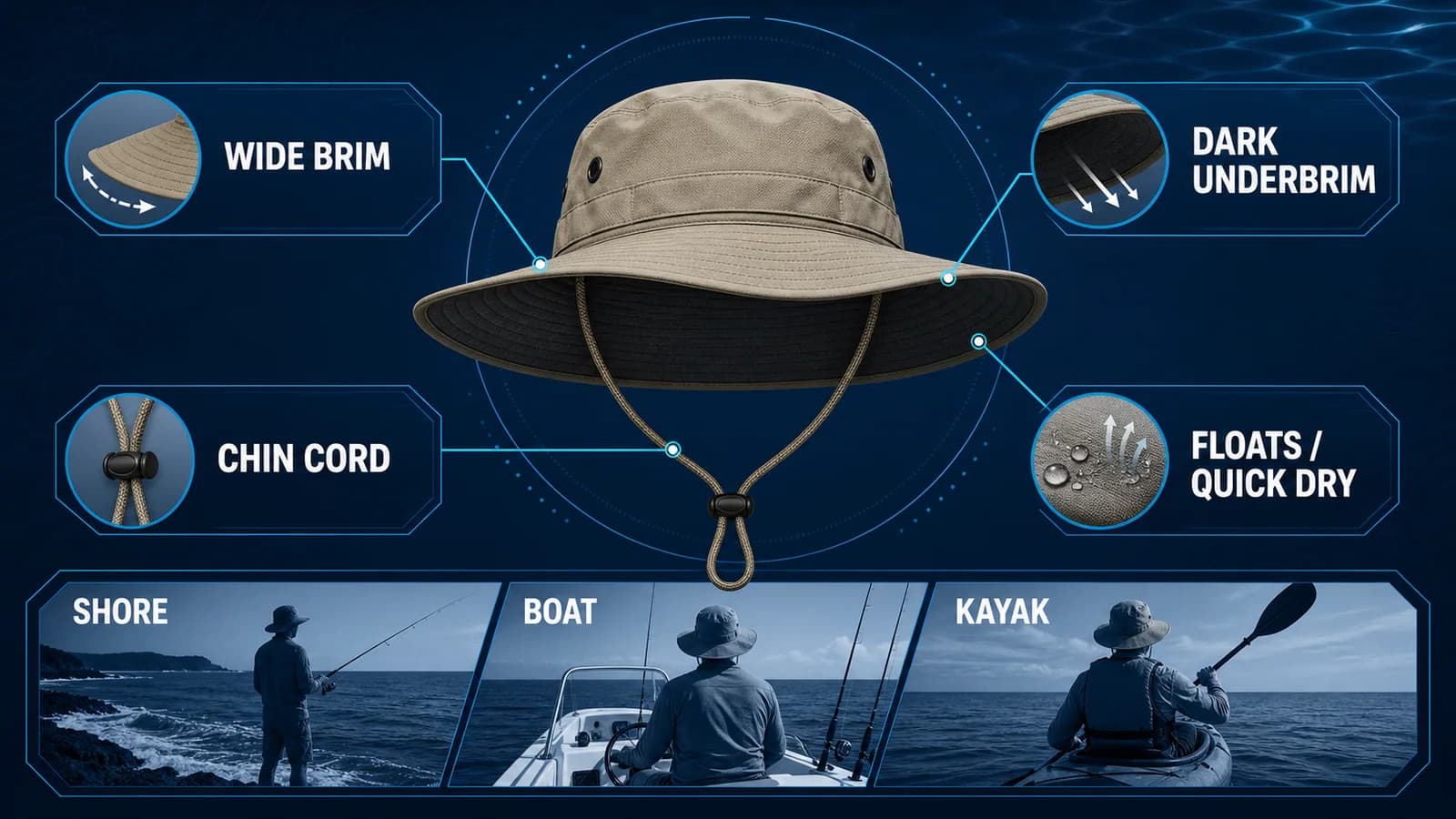
Generated category visual for editorial explanation; it does not depict exact Amazon products.
Choose by real-world situation
Center-console boat
Wind retention and a stable brim are essential. A floating design reduces the consequence of losing the hat overboard.
- Use a chin cord before the boat accelerates.
- Prefer a dark underbrim for water and deck glare.
- Check that the brim does not fold into your line of sight.
Shore and surf
Rear-neck coverage and corrosion-resistant simple hardware matter during long, exposed walks and repeated salt spray.
- Choose quick-dry fabric and easy rinsing.
- Use a cape when the sun stays behind you.
- Avoid heavy absorbent materials that remain wet.
Kayak and paddle fishing
Low seating increases reflected brightness while limited storage rewards a crushable hat that can be secured.
- Prioritize flotation and a dependable cord.
- Keep peripheral vision clear for paddling and traffic.
- Choose a brim stable enough for head turns and wind.
Detailed buying guidance
Boonie versus solar sombrero
Both shapes create all-around shade, but the typical boonie is softer, shorter and easier to pack. A solar-sombrero format uses a wider or more structured brim for greater shade and may incorporate a floating foam core or dedicated cooling panels. The larger brim can also catch more wind. Boat anglers should value retention and stiffness; shore anglers may prefer a lighter boonie that disappears into a pack.
- Choose a boonie for compact storage and moderate shade.
- Choose a wider sombrero for maximum open-water shade.
- Inspect the brim when wet; sagging can obstruct vision.
- Confirm whether the hat floats or only resists water.
When a cape cap is the better answer
A long-bill cap with a neck cape can stay more stable than a broad brim in wind and cover the back and sides of the neck consistently. Some designs close at the front for running a boat into wind. The compromise is less open airflow around the neck and a more technical feel. It is especially useful for flats, surf and anglers who do not wear a hood.
- Use a cape for sustained rear and side exposure.
- Check breathing room around the lower face and neck.
- Pair with sunglasses because side shade is not eye protection.
- Look for removable or adjustable cape features if versatility matters.
Read flotation claims precisely
Marketplace listings use phrases such as floating brim, buoyant hat and water-friendly as if they were interchangeable. They are not. A foam brim may help the front stay at the surface while a saturated crown still becomes heavy. A fully buoyant design can be easier to retrieve. In either case, a secure cord is the first line of defense because conditions may prevent retrieval.
- Find out which component provides buoyancy.
- Prefer a visible color if recovery matters.
- Rinse salt and reshape according to instructions.
- Do not rely on flotation instead of retention.
Why the underbrim deserves attention
Bright water, sand and white fiberglass create uncomfortable reflected light. A dark, non-reflective underside reduces brightness in the wearer's field of view and is common on purpose-built fishing hats. It does not block every reflected ray and should be paired with appropriate sunglasses. Still, it is one of the clearest signals that a product was designed around open-water conditions rather than only fishing branding.
- Check the exact color variation because underbrims may differ.
- Use matte rather than shiny underside materials.
- Prioritize polarized or UV-blocking eyewear separately.
- Keep the brim clean so salt residue does not increase glare.
Build the hat into a complete angler system
The ears, sides of the face, lips, hands and neck can remain exposed even with a good hat. Combine the hat with a UPF fishing shirt or sun hoodie, suitable sunglasses, a gaiter when needed and sunscreen on uncovered skin. A system also lets each item do a realistic job: the brim manages overhead shade, the shirt covers the torso and arms, and other layers close remaining gaps.
- Match the hat with the collar or hood design.
- Use a gaiter only when breathing and heat comfort remain acceptable.
- Add sun gloves for backs of hands during long sessions.
- Schedule shade and hydration rather than treating gear as unlimited protection.
Fit and retention checks
Measure before choosing one size
Fishing brands vary in crown depth and S/M versus L/XL ranges. Measure head circumference and consider whether a hood or gaiter will sit under the hat.
Simulate a boat run
Tighten the cord and turn the head quickly. The brim should stay clear of the eyes and the crown should not lift easily. Do this safely on land before relying on it underway.
Check casting visibility
Look left, right and behind as you would when casting or monitoring other anglers. A cape and brim should not block the peripheral view needed for hooks, lines and boat traffic.
Test with sunglasses
The crown, sweatband, cord and sunglass arms should coexist without pressure. If the hat repeatedly dislodges eyewear, it will interrupt actual fishing.
Amazon listing traps to avoid
Fishing logo mistaken for technical design
A branded baseball cap may have no rear coverage, retention or stated UPF rating. Judge the construction, not the fish graphic.
Mesh described as fully UPF rated
Some products rate the solid crown and brim but not open side panels. Look for an explicit statement and do not extend the claim to every opening.
Floating language without detail
Confirm whether the brim, crown or complete hat floats and how the material behaves after saturation. A cord remains more reliable than recovery.
Permanent price or review claims
Fishing gear varies by season, color and seller. Open current search results and verify specifications rather than trusting an old price badge or screenshot.
Before checkout
Use this final checklist.
- 1The brim or cape shades the ears, face and rear neck for your fishing position.
- 2The exact product identifies the UPF-rated solid panels and any mesh exception.
- 3A dark or non-reflective underbrim is present when glare is a priority.
- 4The chin cord and size adjustment remain secure in wind.
- 5The brim does not block casting visibility or collapse when damp.
- 6Flotation or quick-dry claims are specific enough to understand.
- 7Care instructions are compatible with salt, spray and sunscreen residue.
- 8The rest of the kit covers remaining skin without creating unsafe heat load.
Sun-hat cluster
Compare the other sun-hat guides
Use the specialist route when age, water glare, wind or activity changes the buying decision.
Fishing sun hats for big heads
Add deep-crown and XXL fit checks when standard fishing hats pinch or perch high.
Open guide →UPF sun hats for general use
Compare packability, hiking comfort and everyday wide-brim options beyond fishing.
Open guide →Baby and toddler sun hats
Build a child-specific headwear plan for family boat, beach and shoreline days.
Open guide →Continue the sun-protection kit
Frequently asked questions
What is the best hat style for fishing?
A secure wide-brim boonie or solar-sombrero format is the strongest general starting point because it shades more than a baseball cap. A neck-cape cap can be better in strong wind or when rear coverage matters most.
Should a fishing hat be UPF 50?
A clear UPF 50 material claim is useful, but brim geometry and covered areas remain essential. Verify whether mesh panels are excluded and whether the brim shades your ears and neck in the actual fishing position.
Why do fishing hats have dark underbrims?
A dark matte underside is intended to reduce reflected brightness from water, sand and pale decks in the wearer's field of view. It improves comfort but does not replace suitable UV-blocking sunglasses.
Do fishing hats really float?
Some use foam in the brim, while others describe the complete design as buoyant. Read the exact manufacturer statement. Even a floating hat can be difficult to retrieve in current or while a boat is moving, so use retention first.
Is a boonie hat better than a baseball cap for fishing?
For sustained sun exposure, a boonie usually shades the ears and more of the neck. A baseball cap can be stable and comfortable but needs a hood, cape, gaiter, sunscreen or shade to address exposed areas.
What is the best fishing hat for wind?
Look for a stable moderate brim, fitted crown, rear adjustment and chin cord. A cape cap may be more stable than an oversized floppy brim. Fit matters as much as the feature list.
How should I wash a fishing sun hat?
Follow the exact product instructions. Rinse salt and sweat when recommended, use mild detergent if allowed, avoid unsupported heat drying and reshape the brim while air drying.
Does a fishing sun hat replace sunscreen?
No. Reflected and angled UV can still reach exposed cheeks, lips, ears and neck. Combine the hat with shade, suitable clothing, sunglasses and sunscreen on uncovered skin.
Sources checked
- CDC Sun Safety Facts - Hat coverage and baseball-cap limitations.
- American Cancer Society: UV protection - Wide-brim and reflected-UV context.
- ARPANSA: Sun protection using hats - Coverage differences among hat types.
- Simms Men's Solar Sombrero - Current manufacturer UPF, brim, retention and flotation details.
- Simms SunShield Cap - Current manufacturer bill, cape, snap and UPF details.
- AFTCO Cast Printed Boonie MC9027 - Exact Cast model material and cord details; numeric UPF not documented.