Best UPF Sun Hats in 2026: Wide-Brim, Boonie & Neck-Cape Hats Compared
Affiliate disclosure: SleeveShirts may earn from qualifying Amazon purchases. Recommendations are based on official guidance, current manufacturer specifications, category research, buyer-feedback patterns, and our published editorial criteria. We do not claim hands-on or laboratory testing.

The right sun hat is not simply the one with the largest UPF number. A useful design must shade the face, ears and neck, stay on in wind, manage heat and fit well enough that you actually keep wearing it. This guide separates material claims from real coverage and helps you choose among wide-brim hats, boonie hats, neck-cape caps and packable travel options.
Quick answer
For most people, start with a UPF-rated wide-brim or technical boonie hat.
Look for a brim that shades the face and ears, a dark or non-reflective underside when glare matters, breathable crown construction and a retention cord for wind. Choose a neck-cape cap when maximum neck coverage matters more than casual styling. A baseball cap can be comfortable, but it leaves the ears and neck exposed unless it is paired with other protection.
Quick picks
Best starting points by use case
Verify the current listing for the exact UPF claim, covered panels, size range, care instructions, seller, and return terms before buying.
Best all-around technical coverage
Sunday Afternoons Ultra Adventure-style hat
A long brim, neck cape, ventilation and packable construction make this format practical for exposed trails and travel. The current official model lists UPF 50+ fabric, a 3.5-inch brim and a 6-inch neck cape; confirm those details on the listing you open.
Best traditional wide-brim option
Tilley LTM6 Airflo-style hat
This format prioritizes a structured all-around brim, crown ventilation, secure sizing and long-term outdoor use. It is a stronger match for travel and walking than for buyers who want the smallest possible packed size.
Best neck coverage
Outdoor Research Sun Runner-style cape cap
A removable cape covers more of the sides and back of the neck than an ordinary cap. It suits running, hiking and high-output activities where a full circular brim may feel cumbersome.
Best budget search
Adjustable UPF 50 boonie hat
Budget boonie hats can deliver useful shade and wind retention, but product pages often use vague wording. Check the exact UPF claim, brim dimensions, crown mesh coverage, head-size range and return policy instead of relying on the title alone.
Model-specific buying path
3 exact Amazon sun hats by coverage strategy
These exact listings map to neck-cape, structured wide-brim, and removable-cape strategies. Material UPF and hat geometry are separate checks, so confirm both the selected variant and the shaded areas.
Specification-based shortlist, not a hands-on product test. Amazon supplies exact-listing titles, images, availability, offer data, and destinations when a match is available.
Sunday Afternoons Ultra Adventure Hat
A technical cape-hat route for exposed hiking, travel, and long outdoor days. Verify head circumference, cape comfort, brim behavior, current UPF language, and the exact selected color and size.
Tilley LTM6 Airflo Broad-Brim Hat
A structured travel and walking format for shoppers prioritizing a conventional full brim and defined sizing. Confirm the exact hat size, brim dimensions, material claim, ventilation, and care instructions.
Outdoor Research Sun Runner Cap
A cap-and-cape route for high-output use where a full circular brim may feel cumbersome. Verify the current model’s cape attachment, size, coverage, fabric claim, and interaction with eyewear.
Who this guide is for
Use this guide if
- Hikers, travelers, gardeners and beach visitors who need more head-and-neck shade than a baseball cap provides.
- Shoppers comparing wide-brim, boonie, bucket and cape-cap designs rather than looking for a fashion-only hat.
- People who want to understand which parts of a hat are actually covered by a UPF claim.
- Amazon shoppers who need a checklist for separating useful specifications from generic marketing language.
Skip or narrow the search if
- You need a dedicated baby or toddler hat; use the baby sun-hat guide for sizing and breakaway-strap considerations.
- You fish from a boat or kayak for long periods; use the fishing guide for glare, flotation and wind-specific priorities.
- You want a medical recommendation for a skin condition. This is a shopping guide, not individualized clinical advice.
- You only need a casual cap for brief, low-exposure trips and already protect your ears and neck in other ways.
What official sun-safety guidance says
A fabric rating and a protective hat shape answer different questions. UPF describes the tested material; brim width, neck coverage, ear coverage, and the way the hat sits determine how much useful shade the design can create. These source notes shape our buying criteria.
Shade the face, ears and neck
CDC guidance favors a brim that goes all the way around and shades the face, ears and back of the neck. It also notes that baseball caps leave important areas exposed unless you add clothing, sunscreen or shade.
CDC Sun Safety →Brim width and shape matter
CDC travel guidance describes an ideal circumferential brim of about three inches. ARPANSA likewise distinguishes broad-brim, wide bucket and legionnaire designs from caps and visors that provide less complete coverage.
CDC Yellow Book →UPF fabric is not the whole hat
ARPANSA explains that material testing reports a fabric UPF rating but does not by itself evaluate body coverage. That is why we score the brim, crown openings and neck design separately from the label.
ARPANSA standard guidance →How we evaluate sun hats
SleeveShirts does not run a laboratory or pretend that every product has been worn by a field team. We compare official specifications, sun-safety guidance, construction details, recurring buyer-fit signals and the practical compromises of each hat type. A product moves up the shortlist when its listing makes the important details easy to verify.
Useful shade
We look at brim shape and length, ear coverage and whether the back of the neck is shaded. A high material rating cannot compensate for a design that leaves the target area uncovered.
Material claim
We prefer a clear UPF rating tied to the relevant fabric. Mesh panels, open straw weaves and uncovered zones should not be silently treated as if they have the same rating.
Heat management
Crown ventilation, sweatband design, fabric weight and moisture handling influence whether a hat stays comfortable during a long walk or humid afternoon.
Wind security
A usable chin cord, rear adjustment or stable fitted size matters on exposed trails and beaches. Oversized flexible brims can catch wind even when they create good shade.
Packability
Crushable and folding designs travel more easily, but very soft brims may sag. Structured hats can hold shape better and occupy more luggage space.
Fit and value
We favor transparent head-circumference ranges and adjustable systems. A cheaper hat that cannot be sized securely is poor value even if the listing looks feature-rich.
Model details · checked October 10, 2026
Compare the specifications that affect your choice
Rated fabric and real head coverage are separate. A brim, cape and fit affect the face, ears and neck differently; reflected light can still reach the skin. Removing Sun Runner’s cape changes coverage even though it is the same cap.
Prices are manufacturer references in USD for one item, before tax and shipping. Promotions, stock and seller terms can change. These source checks do not establish a match to every Amazon SKU or color pictured elsewhere in this guide. Unknown specifications are marked below; we have not tested these products.
Sunday Afternoons Ultra Adventure Hat
$60 USD for one hat.
- UPF and coverage
- UPF 50+, including the model’s mesh.
- Fit and measurements
- S/M 54–58 cm and L/XL 58–62.5 cm in the brand chart. Brim 3.5 inches; cape 6 inches.
- Fabric and construction
- Body 88% nylon/12% polyester, mesh and underbrim polyester; weight 73.7 g.
- Care
- Hand wash cold, line dry; no bleach, ironing or dry cleaning. The split brim is designed to fold.
Good fit if: Choose this for a brim-and-cape design when your head is within the offered size range.
Tradeoff: The cape does not shield the face from every angle, and L/XL is not an unlimited big-head size.
Check the exact manufacturer model ↗ · Supporting fabric or size documentation ↗
Tilley LTM6 Airflo Sun Hat
$99 USD regular price; selected Frosted Mint clearance was $59.40, sold out and final sale.
- UPF and coverage
- UPF 50+ on the model page.
- Fit and measurements
- Numeric sizes listed include 8 and 8⅛. The brand’s published chart maps 8 to 63.5 cm but labels its larger 66.5 cm entry “8+,” not 8⅛; ask Tilley to confirm that larger fit. Brim 3.5 inches front/back and 2.5 inches at the sides; crown height 4 inches.
- Fabric and construction
- 100% recycled nylon; weight 113 g.
- Care
- Hand wash cold or delicate machine wash with mild detergent. Remove wind cord and pocket foam first; reshape and air dry. No softener, bleach, ironing or dry cleaning.
Good fit if: Choose this if a structured all-round brim and a verified numeric fit suit you.
Tradeoff: It has no neck cape. Listed large sizes do not mean stock is available; clearance return exclusions matter.
Check the exact manufacturer model ↗ · Supporting fabric or size documentation ↗
Outdoor Research Sun Runner Cap, style 300299
$44 USD for one hat; selected manufacturer variants were sold out.
- UPF and coverage
- UPF 40 as specified; do not label this model UPF 50.
- Fit and measurements
- S 53.5–55 cm, M 55–57 cm, L 57–59 cm, XL 59–61 cm. Brim 2.75 inches and removable cape 10.75 inches.
- Fabric and construction
- 60% recycled nylon, 40% nylon; weight 85 g.
- Care
- A complete wash/dry instruction was not recorded; check the label.
Good fit if: Choose this if a removable cape and cap profile work better for you than a full brim.
Tradeoff: The bare cap provides less side coverage. The checked page also restricted shipment to CA, NY and CO because of PFAS; check your location and exact variant.
UPF sun-hat comparison
This table compares buying paths, not permanent prices or rankings. Named models are recognizable starting points whose official specifications were checked during this update. Availability and marketplace listings can change.
| Hat or category | Best use | Coverage signal | Comfort signal | Watch out for | Shop |
|---|---|---|---|---|---|
| Sunday Afternoons Ultra Adventure | Exposed hiking and travel | Long front brim plus neck cape; official UPF 50+ claim | Lightweight, ventilated, folds flat | Technical silhouette is not subtle; check size range | Search |
| Tilley LTM6 Airflo | Travel, walking and durable everyday wear | Structured all-around brim; official UPF 50+ claim | Crown mesh and moisture-wicking band | Premium price and more packed volume | Search |
| Outdoor Research Sun Runner | Running and high-output hiking | Cap brim with removable long neck cape; official UPF 40 claim | Quick-dry fabric and external mesh | Less cheek shade than a broad circular brim | Search |
| Wide-brim technical sun hat | Gardening, beach and general outdoor use | Potentially strong face-and-ear shade | Varies by crown venting and brim weight | Measure brim and verify whether mesh is rated | Search |
| Adjustable boonie hat | Budget hiking, paddling and travel | Moderate all-around shade | Usually soft, light and easy to pack | Short brims and loose one-size fits are common | Search |
| Packable bucket hat | Casual travel and short outings | Better than a visor; often shorter at the sides | Compact and familiar styling | Do not assume every bucket hat is UPF rated | Search |
Prices, inventory, colors, seller quality, ratings, and specifications can change. Treat Amazon links as current search starting points.
Decision map
Choose the hat shape before choosing the brand
The silhouette determines shade and stability. Use this visual to shortlist the right construction, then compare the current product listing for material rating, dimensions and fit.
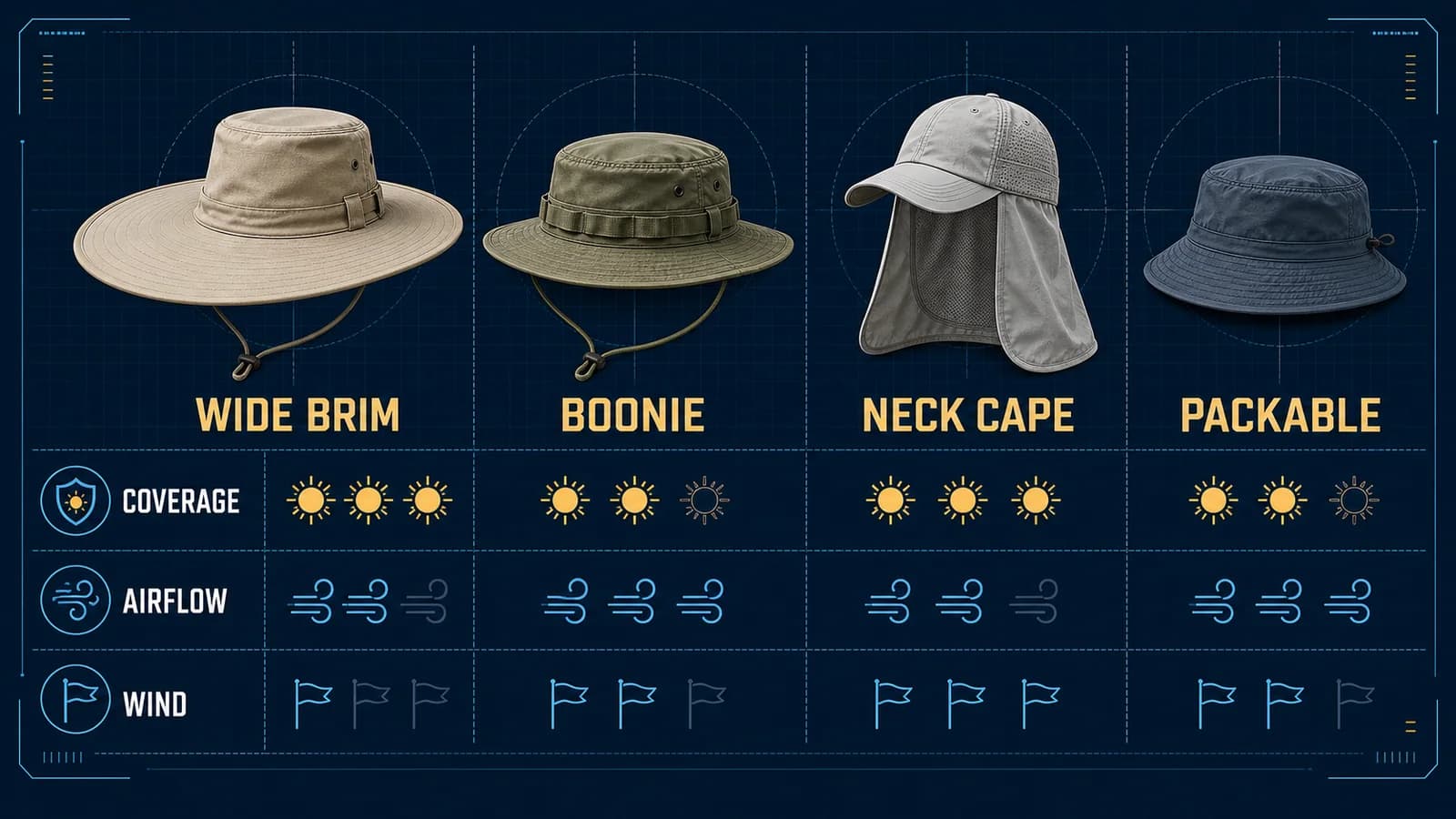
Generated category visual for editorial explanation; it does not depict exact Amazon products.
Choose by real-world situation
All-day exposed trail
Prioritize continuous coverage and retention over appearance. A neck cape can solve the gap between a shirt collar and ordinary hat brim.
- Choose a brim or cape that shades ears and neck.
- Check that ventilation openings do not expose large crown areas.
- Use a chin cord or stable rear adjustment for ridgelines.
Beach, pool or paddling
Reflected light and wind make a secure, non-glare design more useful than a floppy fashion brim.
- Look for a dark or non-reflective underbrim.
- Prefer quick-dry fabric and a floatable brim when water loss is likely.
- Pair the hat with sunglasses and protection for exposed cheeks.
Travel and everyday walking
The best travel hat is one you can pack without destroying the brim and wear without constant readjustment.
- Check packing instructions before folding.
- Measure your head instead of trusting one-size wording.
- Balance shade with a silhouette you will actually wear daily.
Detailed buying guidance
Wide brim versus neck cape
A broad circular brim creates shade without fabric touching the neck, which can feel cooler in still air. A cape provides more consistent rear and side coverage when the sun is low or the wearer changes direction. The trade-off is contact with the neck and a more technical appearance. For exposed hiking, a brim-plus-cape design is often the most complete. For gardening or travel, a structured wide brim may be easier to live with.
- Choose brim shade for airflow and familiar styling.
- Choose a cape for reliable neck coverage and lower-angle sun.
- Do not treat a front-only bill as equivalent to either option.
- Check whether a removable cape leaves attachment points that irritate the skin.
Why a dark underbrim helps in glare
A dark, matte underside is a practical signal for water, sand and bright pavement because it is designed to reduce reflected brightness reaching the face. It does not turn a hat into eye protection and it does not replace UV-blocking sunglasses. Treat it as a comfort and visibility feature that matters most for fishing, beach use and open terrain rather than as a universal requirement.
- Prioritize it for water, snow, sand and pale rock.
- Avoid shiny undersides when reflected glare is a recurring problem.
- Still wear sunglasses suited to the activity.
- Verify the underside color on the exact product variation.
Ventilation without accidental exposure
Mesh can make a hot-weather hat more wearable, but the product page should explain which panels carry the UPF rating. Small side vents beneath a solid crown are different from a crown built mostly from open mesh. If the listing promotes both maximum airflow and complete UPF coverage without defining the construction, inspect the images and manufacturer details carefully.
- Look for a solid top panel over the scalp.
- Check whether the brand excludes mesh from its UPF claim.
- Use crown vents as a comfort feature, not proof of protection.
- Prefer listings that show the hat from top, side and rear.
Packable does not always mean crushable
Some technical brims fold along a designed seam; others can be rolled; structured foam or laminated brims may crease permanently. Follow the maker care instructions. A travel hat that arrives flattened can sometimes be reshaped, but that is not the same as a design intended for repeated crushing. Buyers who fly often should value explicit packing instructions as much as marketing language.
- Distinguish folds-flat, rollable and crushable claims.
- Do not force a structured brim into a small pocket.
- Air-dry and reshape after washing.
- Check whether a flotation insert must be removed before care.
Style is part of performance
A technically complete hat has little value if it stays in a bag. Some shoppers are comfortable with a long cape; others will consistently wear a modest boonie or bucket hat. Use the most protective design you will actually keep on, then cover remaining exposed skin through clothing, shade and sunscreen. Honest buyer fit is more useful than declaring one silhouette the winner for everyone.
- Choose the maximum coverage you will wear consistently.
- Keep a more technical hat for prolonged exposure days.
- Use a casual UPF bucket for shorter errands if it improves compliance.
- Avoid buying on appearance alone when the listing omits dimensions.
Fit and retention checks
Measure the head
Wrap a soft tape around the widest part of the head, usually just above the eyebrows and ears. Compare centimeters or inches with the maker chart; do not translate one brand size into another automatically.
Test the brim field
The brim should not collapse into the eyes, lift excessively in moderate wind or block peripheral vision needed for the activity. A flexible brim can be useful, but uncontrolled flapping is not.
Check adjustment range
A rear toggle or internal band should fine-tune fit without creating pressure points. If you are already at the end of the range, the hat is probably the wrong base size.
Use the cord deliberately
A chin cord should secure the hat when needed and loosen easily when it does not. Keep cords managed around machinery, climbing equipment and children.
Amazon listing traps to avoid
UPF title, unclear covered area
A listing may place UPF 50 in the title without explaining whether the rating applies to the crown, brim, cape, mesh or the complete textile assembly. Look for a specification table or manufacturer statement.
Fashion straw sold as sun protection
Open weave and decorative holes can allow direct light through. CDC guidance specifically favors tightly woven material over straw hats with visible openings.
One size with no circumference
An adjustable toggle cannot rescue a crown that is fundamentally too small or too large. Prefer a measurable range and confirm whether hair volume changes the fit you need.
Live price and rating assumptions
Marketplace price, seller, rating and review count can change quickly. Our search links intentionally open current results rather than claiming a permanent price or live score.
Before checkout
Use this final checklist.
- 1The brim or cape shades the face, ears and back of the neck for your activity.
- 2The exact listing states a UPF rating and identifies any unrated mesh areas.
- 3The head-circumference range matches an actual measurement.
- 4A chin cord or adjustment system is present when wind is likely.
- 5Ventilation does not depend on large uncovered crown openings.
- 6Packing and washing instructions match how you intend to use the hat.
- 7The seller and return terms are acceptable for a fit-sensitive purchase.
- 8You have a plan for sunglasses, shade and sunscreen on still-exposed skin.
Sun-hat cluster
Compare the other sun-hat guides
Use the specialist route when age, water glare, wind or activity changes the buying decision.
Sun hats for big heads
Use measured circumference, crown depth, brim geometry and XXL adjustment instead of one-size assumptions.
Open guide →Baby and toddler sun hats
Compare child-specific fit, strap safety, washable fabrics and stroller or beach coverage.
Open guide →Fishing sun hats
Prioritize reflected glare, wind retention, quick-dry construction and boat-ready coverage.
Open guide →Continue the sun-protection kit
Complete sun-protection clothing guide
Build the rest of the wearable protection system around UPF ratings, coverage and activity.
Best sun hoodies
Compare hood and neck coverage when a hat alone leaves exposed areas.
Best UPF shirts for beach days
Match head coverage with swim-ready and dry-comfort shirt options.
Frequently asked questions
Is UPF 50 necessary for a sun hat?
UPF 50 is a strong material rating, but design coverage remains essential. A clearly rated UPF 30 or 40 hat with a useful brim and neck coverage can be more practical than a UPF 50 cap that leaves the ears and neck exposed. Verify the exact fabric claim and choose the shape for your exposure.
How wide should a sun-hat brim be?
CDC travel guidance describes a circumferential brim of about three inches as ideal for shading the face, neck and ears. Your activity can change the compromise: a slightly shorter stable brim may be preferable in high wind, while a neck cape can add coverage without an oversized side brim.
Is a baseball cap enough for sun protection?
It shades part of the scalp, forehead and nose, but it generally leaves the ears and back of the neck exposed. CDC and ARPANSA guidance recommend adding protection for those areas or choosing a broad-brim, wide bucket or legionnaire-style design.
Are straw hats good for UV protection?
Some tightly constructed hats can create useful shade, but visible holes and open weave allow direct light through. Do not assume a straw appearance equals a tested UPF rating. Inspect the weave and look for a specific material claim.
Do black sun hats get hotter?
Color can influence heat absorption, but comfort also depends on fabric weight, airflow, sweatband design and exposure. A dark underbrim can help with glare without requiring the whole crown to be black. Choose based on the complete construction rather than color alone.
Can I wash a UPF sun hat?
Follow the maker instructions. Many technical hats require hand washing and air drying, while some structured brims or flotation inserts need special handling. Avoid assuming that a crushable hat is machine washable.
What is the best sun hat for travel?
A travel-friendly option should have explicit folding or rolling instructions, a secure size adjustment and enough shade for the itinerary. The Sunday Afternoons Ultra Adventure format prioritizes flat packing and coverage; a structured Tilley-style hat favors shape and durability but takes more room.
Does a UPF hat replace sunscreen?
No. A hat shades only part of the body and reflected or angled UV can still reach exposed skin. Use it as one layer alongside shade, suitable clothing, sunglasses and sunscreen on uncovered areas.
Sources checked
- CDC Sun Safety Facts - Hat coverage, tightly woven materials and limitations of baseball caps.
- CDC Yellow Book: Sun Exposure in Travelers - Circumferential brim and neck-flap guidance.
- ARPANSA: Sun protection using hats - Comparison of broad-brim, bucket, legionnaire and baseball-cap coverage.
- ARPANSA sun-protective clothing standard overview - Difference between fabric testing and design coverage.
- Sunday Afternoons Ultra Adventure Hat - Current manufacturer specifications checked for the named starting point.
- Tilley LTM6 Airflo Sun Hat - Current manufacturer UPF, brim, material and care specifications.
- Outdoor Research Sun Runner Cap - Current manufacturer cape, brim, fabric and UPF specifications.