Best Sun Hats for Big Heads in 2026: XXL Fit Without the Pressure
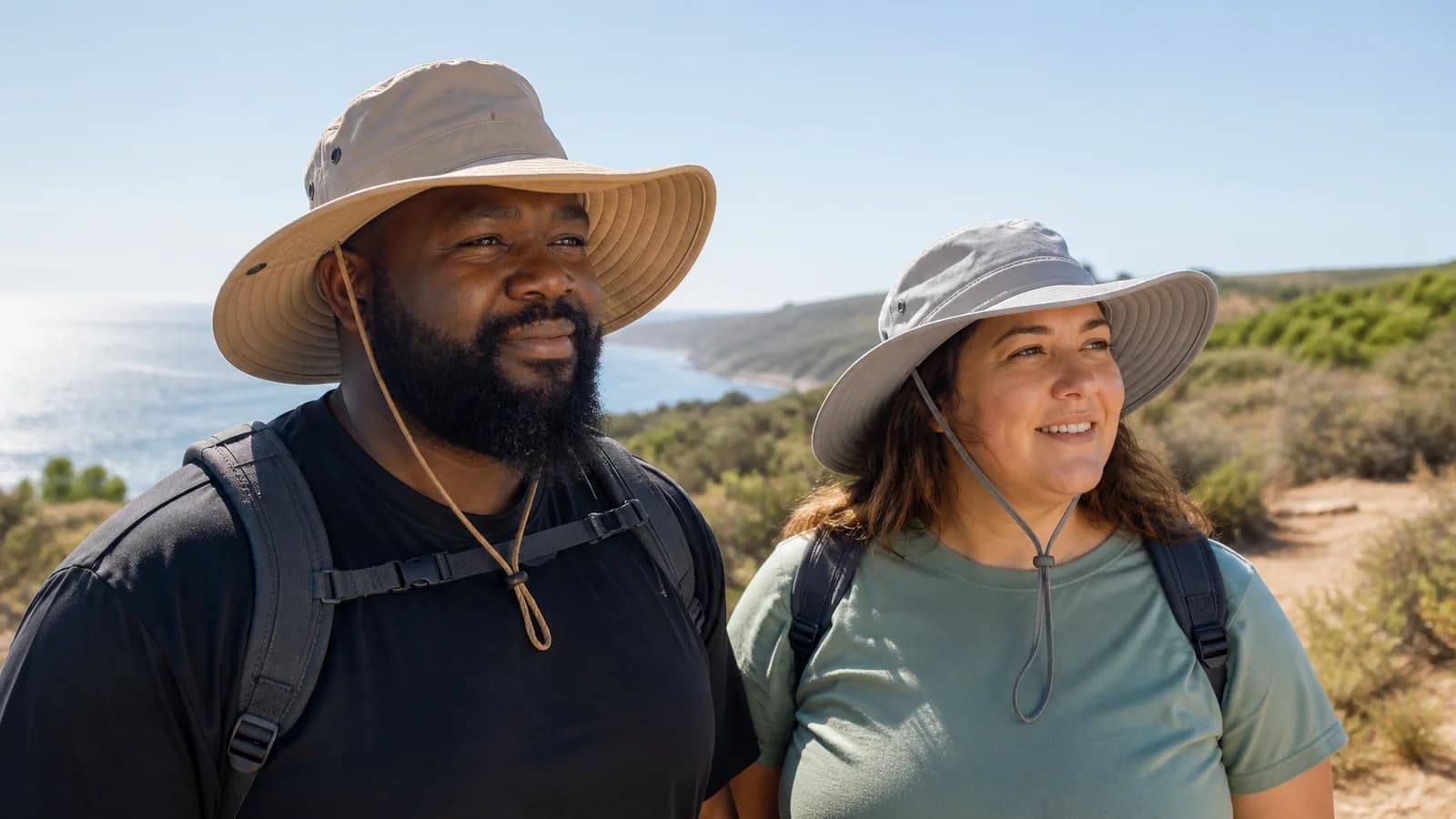
A sun hat can have an excellent brim and still fail if the band pinches, the crown rides high, or the advertised size stops below your measured circumference. This guide starts with fit evidence, then compares large and XXL hat formats for hiking, travel, fishing, yard work, and everyday outdoor use.
Direct answer
What is the best sun hat for a big head?
Choose by measured circumference and crown depth. Ultra Adventure L/XL is charted to 62.5 cm and Sun Runner XL to 61 cm. Tilley’s chart maps size 8 to 63.5 cm, but its larger chart entry and the current LTM6 selector use different labels. For a 64–65 cm head, ask Tilley to confirm the exact fit and stock before ordering; no currently available 64–65 cm fit was verified here. Check the brim and seller’s indoor try-on rules too.
Affiliate disclosure: SleeveShirts may earn from qualifying Amazon purchases. The shortlist is based on practical criteria, not paid placement.
Amazon inventory, sellers, specifications, ratings, and prices can change. Open the current listing and verify the exact size chart, material, coverage, and return terms.
Quick picks
Start with the format that fits the job
Compare these 6 options, then check the exact model, size and seller.
Most large-head buyers
Sized XXL technical boonie
A true numeric size range is more useful than one size fits most. A medium-firm brim and deep crown balance coverage, visibility, and wind control.
Hiking and active travel
Large vented hiking hat
Mesh zones, a sweatband, and a stable chin cord help during movement. Verify whether the mesh carries the same protection claim as the solid crown.
Beach and relaxed travel
Packable wide-brim hat in large sizes
A broader brim can cover more of the face, ears, and neck, but it must recover after packing and stay clear of the eyes in wind.
Fishing and open-water glare
Large fishing hat with neck coverage
A structured brim and optional neck cape can improve coverage where shade is scarce. Make sure the system preserves hearing and peripheral vision.
Model details · checked October 10, 2026
Compare the specifications that affect your choice
Measure above the eyebrows and ears, then use the exact chart. Ultra Adventure’s L/XL ends at 62.5 cm and Sun Runner’s XL at 61 cm. Do not treat “one size” or XL as evidence of a 64–65 cm fit. Check crown depth, glasses and the return rules before removing tags or wearing outside.
Prices are manufacturer references in USD for one item, before tax and shipping. Promotions, stock and seller terms can change. These source checks do not establish a match to every Amazon SKU or color pictured elsewhere in this guide. Unknown specifications are marked below; we have not tested these products.
Sunday Afternoons Ultra Adventure Hat
$60 USD for one hat.
- UPF and coverage
- UPF 50+, including the model’s mesh.
- Fit and measurements
- S/M 54–58 cm and L/XL 58–62.5 cm in the brand chart. Brim 3.5 inches; cape 6 inches.
- Fabric and construction
- Body 88% nylon/12% polyester, mesh and underbrim polyester; weight 73.7 g.
- Care
- Hand wash cold, line dry; no bleach, ironing or dry cleaning. The split brim is designed to fold.
Good fit if: Choose this for a brim-and-cape design when your head is within the offered size range.
Tradeoff: The cape does not shield the face from every angle, and L/XL is not an unlimited big-head size.
Check the exact manufacturer model ↗ · Supporting fabric or size documentation ↗
Tilley LTM6 Airflo Sun Hat
$99 USD regular price; selected Frosted Mint clearance was $59.40, sold out and final sale.
- UPF and coverage
- UPF 50+ on the model page.
- Fit and measurements
- Numeric sizes listed include 8 and 8⅛. The brand’s published chart maps 8 to 63.5 cm but labels its larger 66.5 cm entry “8+,” not 8⅛; ask Tilley to confirm that larger fit. Brim 3.5 inches front/back and 2.5 inches at the sides; crown height 4 inches.
- Fabric and construction
- 100% recycled nylon; weight 113 g.
- Care
- Hand wash cold or delicate machine wash with mild detergent. Remove wind cord and pocket foam first; reshape and air dry. No softener, bleach, ironing or dry cleaning.
Good fit if: Choose this if a structured all-round brim and a verified numeric fit suit you.
Tradeoff: It has no neck cape. Listed large sizes do not mean stock is available; clearance return exclusions matter.
Check the exact manufacturer model ↗ · Supporting fabric or size documentation ↗
Outdoor Research Sun Runner Cap, style 300299
$44 USD for one hat; selected manufacturer variants were sold out.
- UPF and coverage
- UPF 40 as specified; do not label this model UPF 50.
- Fit and measurements
- S 53.5–55 cm, M 55–57 cm, L 57–59 cm, XL 59–61 cm. Brim 2.75 inches and removable cape 10.75 inches.
- Fabric and construction
- 60% recycled nylon, 40% nylon; weight 85 g.
- Care
- A complete wash/dry instruction was not recorded; check the label.
Good fit if: Choose this if a removable cape and cap profile work better for you than a full brim.
Tradeoff: The bare cap provides less side coverage. The checked page also restricted shipment to CA, NY and CO because of PFAS; check your location and exact variant.
What the official guidance changes about this purchase
Hat shopping is partly a sun-protection decision and partly a geometry problem. Official guidance supports broad coverage; the listing still has to prove that the exact size and construction work for your head.
A broad brim covers more than a cap
The American Academy of Dermatology recommends a wide-brimmed hat. Baseball caps leave the ears and back of the neck exposed, so compare brim shape and actual coverage.
American Academy of Dermatology →Design affects real clothing protection
WHO describes fabric, garment design, coverage, stretch, wetness, wear and condition as relevant to protection. Check crown fit and neck coverage as well as the hat's label.
World Health Organization →UV conditions change through the day
The WHO UV Index is designed to communicate the expected level of sunburn-producing UV at the surface. Use the local index and conditions to plan timing, shade, clothing, and uncovered-skin protection together.
World Health Organization UV Index →How we evaluate the category
SleeveShirts compares published circumference ranges, crown depth when disclosed, brim dimensions, material and ventilation descriptions, retention systems, stated UPF claims, care details, and return signals. We do not claim to have measured every hat or tested its ultraviolet transmission. Category recommendations are based on verifiable listing details and the fit problem each format is designed to solve.
Measured circumference range
The listing should give inches or centimeters for the exact size. A range that merely touches your measurement leaves little room for hair, sweat, swelling, or a comfortable adjustment.
Crown depth and shape
Large circumference alone does not solve a shallow crown. Buyers who find hats perch high should prioritize depth, a less tapered crown, and reviews from people describing the same fit issue.
Brim geometry
A 3- to 4-inch brim is a practical starting point, but stiffness and slope determine whether it shades the face and neck without collapsing into the eyes.
Adjustment and retention
An internal drawcord can fine-tune a generously sized hat. A removable chin strap helps in wind, but hardware should not chafe or sit against hearing protection.
Ventilation without hidden gaps
Crown vents and mesh can release heat. Verify whether open zones reduce coverage and whether the stated UPF applies to all relevant panels.
Packability and recovery
A travel hat should recover its intended brim shape after packing. Foldable does not automatically mean it can be crushed indefinitely without weakening or blocking vision.
Decision visual
Large-head sun-hat fit sequence
Measure first, choose the activity second, and compare marketplace options only after both are clear.
Measure the wearing line
Use a soft tape around the widest part of the head where the sweatband will sit, usually above the eyebrows and ears. Repeat without pulling tight.
Add the depth question
Note whether ordinary hats fit around the head but perch high. If so, search specifically for a deep crown rather than only XXL circumference.
Select brim and retention
Match width, stiffness, chin cord, and ventilation to hiking, beach, boating, work, or casual use.
Verify the exact size variation
Check the current chart, dimensions, material, color, UPF statement, seller, returns, and care before ordering.
Large and XXL sun-hat formats compared
These are format-level trade-offs, not permanent product rankings. Sizes and specifications can change by color, seller, and model year.
| Format | Best for | Prioritize | Trade-off | Listing check | Amazon |
|---|---|---|---|---|---|
| Sized technical boonie | All-around outdoor use | Numeric XXL range, deep crown, stable brim | Technical styling may be less versatile | Crown depth and brim stiffness | Search |
| Vented hiking hat | Warm active days | Sweatband, vents, low-bounce retention | Mesh may create coverage gaps | UPF scope on vented panels | Search |
| Packable wide brim | Beach and travel | Brim recovery, soft sweatband, size range | Soft brim can collapse in wind | Packed care and brim dimensions | Search |
| Fishing hat with cape | Open water and stationary exposure | Neck coverage, glare control, secure cord | Warmer and more visually enclosing | Cape removal and hearing clearance | Search |
| Structured outdoor fedora | Travel and casual wear | Actual size, firm brim, internal adjuster | Less packable and often warmer | Inner circumference rather than label size | Search |
| Large legionnaire cap | Low-profile neck coverage | Long cape, peak depth, crown fit | Less side-face shade than a full brim | Cape and ear coverage while moving | Search |
Detailed buying guidance
Measure the head the way the hat will be worn
Place a flexible tape where the internal band will sit, usually level across the forehead and around the fullest rear point. Keep the tape in contact without compressing skin or hair, record the result in both inches and centimeters, and repeat. If the two readings differ, use the larger reliable result.
Do not convert that number into a letter size without the current brand chart. One seller’s XL can overlap another seller’s L or stop well below an XXL range. If you are at the upper boundary, a larger adjustable size is often more comfortable than a hat worn at maximum extension.
- Measure twice at the actual wearing line.
- Account for thick hair or protective hairstyles.
- Prefer room inside the stated range.
- Save the measurement for returns and replacements.
Circumference and crown depth solve different problems
A hat can close around a large head yet still sit too high because the crown tapers early or lacks vertical depth. This creates pressure above the temples, exposes more forehead, and makes the brim unstable. Search terms such as deep crown, tall crown, and low taper can be more useful than adding another X to the size label.
Crown depth is not consistently published, so use listing diagrams and recurring fit descriptions cautiously. Compare comments that include an actual head measurement and the same fit complaint. Reviews without a measurement can suggest a pattern but should not override the manufacturer chart.
- Identify pinching versus perching.
- Look for a less tapered crown.
- Use dimensioned reviews, not vague “runs small” claims.
- Return a hat that creates headache-level pressure.
Brim width only matters if the brim behaves
A broad brim can shade the face, ears, and neck more effectively than a cap, but width alone is incomplete. A very soft front may fold into the eyes; a rigid rear brim can hit a backpack; a flat brim may catch more wind than a gently sloped one. Match the structure to posture and movement.
Test the hat while looking up, turning the head, wearing sunglasses, and carrying the intended pack. The brim should not obscure trail hazards or interfere with shoulder straps. A chin cord should stabilize the hat without requiring uncomfortable tension.
- Check front, side, and rear dimensions.
- Test vision while stepping and looking uphill.
- Confirm backpack and collar clearance.
- Use a breakaway or removable cord when the activity warrants it.
Compare ventilation and fit with your conditions
Open mesh can improve air exchange around the crown, while eyelets offer smaller ventilation points. Neither guarantees comfort in humidity or intense heat, and open zones may not provide the same UV reduction as solid UPF-rated fabric. Read the claim’s scope rather than assuming the rating covers every panel.
A moisture-managing sweatband can improve comfort and keep perspiration out of the eyes. It also needs realistic care. Salt, sunscreen, and repeated compression can change fit and shape, so follow the label and air-dry when directed.
- Verify the UPF claim for mesh and crown panels.
- Choose a washable sweatband construction.
- Use shade and breaks in high heat.
- Replace stretched, torn, or permanently misshapen hats.
Treat returns as part of fit verification
Online dimensions reduce uncertainty but cannot predict every head shape, hairstyle, scar, hearing device, or sensory preference. A returnable first order is more rational than buying several nearly identical hats from an unclear seller. Keep packaging intact and perform the first fit check indoors.
Wear the hat for more than a few seconds. Look for a pressure ring, temple pain, upward creep, chin-cord irritation, and brim movement. Then test it with sunglasses, headphones or hearing protection when relevant, and the collar or backpack used outside.
- Confirm seller and return window before checkout.
- Do not wash or remove tags before the indoor fit test.
- Test with real accessories.
- Reject numbness, pain, or unstable vision.
Mid-guide shortlist
Ready to compare current listings?
Use the criteria above as a filter. Do not buy from the thumbnail alone: open the exact size chart, material details, care instructions, seller information, and return policy.
Choose by real-world situation
Hot-weather hiking
A deep, vented crown and stable medium brim usually beat an oversized floppy brim when vision, wind, and pack contact matter.
- Measure before filtering by style.
- Test the rear brim against the pack.
- Keep sunscreen for exposed skin.
Beach and resort travel
A wider packable brim can add comfortable shade when activity is moderate and luggage space matters.
- Check recovery instructions.
- Use a secure cord in coastal wind.
- Pack in a shape-preserving position.
Fishing or boating
Open exposure favors a structured brim, secure retention, glare-compatible shape, and optional neck coverage.
- Preserve peripheral vision and hearing.
- Avoid loose hardware near equipment.
- Follow local safety and flotation requirements.
Amazon listing traps to avoid
One size fits most presented as large sizing
An elastic band or drawcord cannot create crown depth or unlimited circumference. Require a numeric range that includes your measurement.
Brim diameter confused with head size
Some listings highlight a 24-inch overall diameter that says nothing about the inner band. Find the actual internal circumference.
UPF 50 treated as full-body protection
The rating describes covered material, not every angle of the face, neck, eyes, hands, or body. Combine the hat with clothing, shade, and sunscreen on exposed skin.
Lifestyle imagery treated as fit proof
A photograph cannot verify the model’s head measurement, the exact size, or the current variant. Use dimensions and a returnable fit test.
Before checkout
Final verification checklist
- 1Head circumference was measured twice at the intended wearing line.
- 2The published range includes that measurement with comfortable adjustment room.
- 3Crown depth addresses any history of hats perching high.
- 4Brim width, stiffness, and slope suit the activity and preserve vision.
- 5Vent or mesh coverage and the exact UPF claim were checked.
- 6The chin cord, sweatband, and adjuster remain comfortable with accessories.
- 7Current seller, size variation, material, care, and returns were verified.
- 8Shade, eyewear, clothing, and sunscreen for exposed skin remain part of the plan.
Continue with the right adjacent guide
Best UPF sun hats
Compare broader brim, fabric, ventilation, and use-case choices across standard sizes.
Fishing sun-hat guide
Focus on open-water wind, glare, neck coverage, retention, and equipment compatibility.
The science of UPF 50 fabrics
Read the rating's test scope and coverage limits before comparing listings.
Frequently asked questions
What hat size fits a 24-inch head?
A 24-inch head is about 61 centimeters, but the correct letter size varies by brand. Use the current numeric chart and choose a range that includes 24 inches without placing you at an uncomfortably tight maximum. Crown shape and depth still need to fit.
How do I measure my head for a sun hat?
Run a soft measuring tape around the intended sweatband line, usually just above the eyebrows and ears and around the fullest rear point. Keep it level and snug without compression, measure twice, and record both inches and centimeters.
Why do hats fit around my head but sit too high?
The likely issue is crown depth or taper rather than circumference. Look for a deep or tall crown, less taper near the top, and reviews from buyers who give a similar head measurement. A larger but equally shallow hat may not solve the problem.
Is an adjustable one-size hat good for a big head?
Only if its published maximum comfortably exceeds your measurement and the crown is deep enough. An adjuster can reduce a large hat; it cannot reliably expand a small band or add vertical crown room.
How wide should a sun-hat brim be?
A 3- to 4-inch brim is a useful general starting range for broad face, ear, and neck shade. The best width also depends on stiffness, slope, wind, activity, backpack contact, and vision. A stable smaller brim can outperform a larger brim that collapses.
Are mesh sun hats still UPF 50?
Possibly for the solid panels, but not necessarily for open mesh. Read whether the manufacturer applies the rating to the whole construction or only the main fabric. Do not assume a crown label covers every vented zone.
Can a sun hat replace sunscreen?
No. It shades only some angles and leaves skin exposed. The American Academy of Dermatology recommends a layered approach with shade, protective clothing, and broad-spectrum water-resistant SPF 30+ sunscreen on uncovered skin.
What should I do if I am between hat sizes?
When the larger size has an effective internal adjuster, it often provides more comfort and room for hair than forcing the smaller size at its maximum. Verify the return policy and perform a longer indoor fit test before wearing it outside.
Sources checked
- American Academy of Dermatology: Shade, clothing, and sunscreen - Wide-brim hat and layered sun-protection guidance.
- World Health Organization: Protecting against skin cancer - How clothing design, coverage, condition, and fabric affect practical protection.
- World Health Organization: UV Index - Interpreting UV levels as part of daily sun planning.
Editorial transparency
We are not a medical provider, manufacturer, or accredited product-certification body. Recommendations combine public product data, standards-based claims, independent reviews, buyer feedback patterns, and SleeveShirts editorial judgment. AI may assist research organization and drafting, but final page wording should remain transparent about which signals come from direct source data versus secondary review patterns.
About the author
SleeveShirts Editorial
SleeveShirts Editorial researches UPF clothing, sun hoodies, fishing shirts, running layers, and family sun-protection gear for shoppers comparing products online. We prioritize clear criteria, source quality, practical fit/use-case signals, and transparent affiliate disclosures over brand sponsorship claims.
We do not present SleeveShirts as a dermatologist, medical authority, or accredited product-certification body. When a guide relies on manufacturer specifications, public standards, third-party reviews, or buyer feedback, it should say so plainly.