The Complete Guide to Sun Protection Clothing: UPF Ratings, Fabrics & What to Buy
Compare sun clothing with visual coverage checks, a practical activity selector, verified model specifications, UPF guidance, and fit advice.
Updated September 18, 2026 · Manufacturer specifications and public-health guidance reviewed. We may earn a commission from qualifying Amazon purchases. No hands-on product testing is claimed.
What should you buy?
Start with a labeled UPF 50+ garment in the shape you will actually wear. For dry-land use, choose room to move; for swimming, choose a water-use rashguard. Then check the gaps at your face, neck, hands and waistband.
- Hiking: compare a hoodie with a stable hood and sleeves that stay extended under a pack. See the ActiveIce example; test shoulder seams and hem overlap before keeping it.
- Fishing: choose hood coverage or a pocketed, vented shirt according to your tasks. Compare fishing shirts; a brand name does not guarantee the same UPF across models.
- Running: prioritize free arm movement and a rated fabric you can tolerate in your conditions. We have not established a fastest-drying or coolest winner. Use the running fit guide.
- Swimming: compare a close-fitting rashguard intended for water. See the Basic Skins example; check the exact fit variant and wet-use guidance.
- Everyday wear: a relaxed crew-neck can be simpler than a technical hoodie. See the Morada example; plan neck and hand protection separately.
These are specification-based starting points, not tested winners. Combine clothing with shade, a hat, sunglasses and sunscreen on exposed skin.
🔑 Key Takeaways
- 1UPF 50 transmits about 1/50 of tested UV through the rated fabric. It protects only the skin the garment actually covers.
- 2Clothing complements sunscreen. Use shade, a hat, sunglasses, and sunscreen on exposed skin rather than treating one measure as a complete solution.
- 3Do not infer protection from color or fiber alone. Construction, stretch, moisture, wear, additives, and condition can change UV transmission.
- 4Coverage is a practical feature. Thumbholes, collars, hoods, and longer hems matter only when they stay in position during the activity.
- 5Condition and care matter. Replace or reassess garments that become thin, stretched, worn, or damaged, and follow the maker's instructions.
📑 Table of Contents
- UPF 50+ shortlist: compare three models
- Outfit examples and buying mistakes
- 1. How Sun Protection Clothing Complements Sunscreen
- 2. UPF Ratings Explained: What Do the Numbers Mean?
- 3. The Fabric Science Behind UV Protection
- 4. What to Look for When Buying Sun Protection Clothing
- 5. Best Sun Protection Clothing by Activity
- 6. Real Models Compared: UPF, Fit & Trade-offs
- 7. Care, Washing & Long-Term Durability
- 8. Sun Protection Myths Debunked
- 9. Frequently Asked Questions
Sun-protective clothing is a repeatable way to cover larger areas of skin, but the label, coverage, fit, and fabric condition all matter. The useful question is not whether clothing "beats" sunscreen; it is which combination of measures leaves the fewest gaps for your activity.
Current sun-protective clothing ranges from loose fishing shirts and hoodies to rash guards, hats, and arm sleeves. This guide explains the label, the construction and coverage trade-offs, and the questions to ask before buying.
Compare clothing by activity, coverage, fit and the exact garment's rating. For more on how UPF is measured, see The Science of UPF 50+ Fabrics.
1. How Sun Protection Clothing Complements Sunscreen
The CDC recommends a combined sun-safety routine that includes shade, protective clothing, a wide-brimmed hat, sunglasses, and sunscreen. Clothing can reduce the area that needs sunscreen, while sunscreen remains important for exposed skin.
A garment is convenient on the area it covers, but it can shift, stretch, become wet, or wear thin. Sunscreen has its own application and reapplication instructions. Use each according to its label instead of assuming either one removes all user error.
A UPF 50 garment transmits about 1/50 of the UV measured under its test conditions. ARPANSA cautions that wetness, stretch, wear, chemicals, and fabric condition may reduce protection. See Sunscreen vs. Sun Shirts for a coverage-by-coverage plan.
| Factor | Sunscreen (SPF 50) | UPF 50+ Clothing |
|---|---|---|
| UV Coverage | Broad spectrum when labeled as such | Rated fabric area |
| Duration | Follow product directions | Wear while coverage and condition remain suitable |
| User Error Rate | Application amount and missed spots matter | Gaps, ride-up, stretch, and uncovered skin matter |
| When Wet | Use a suitable water-resistant product and follow directions | Wet performance is product-specific |
| Best role | Exposed skin and hard-to-cover areas | Repeatable coverage over larger areas |
Check the label and gaps in coverage
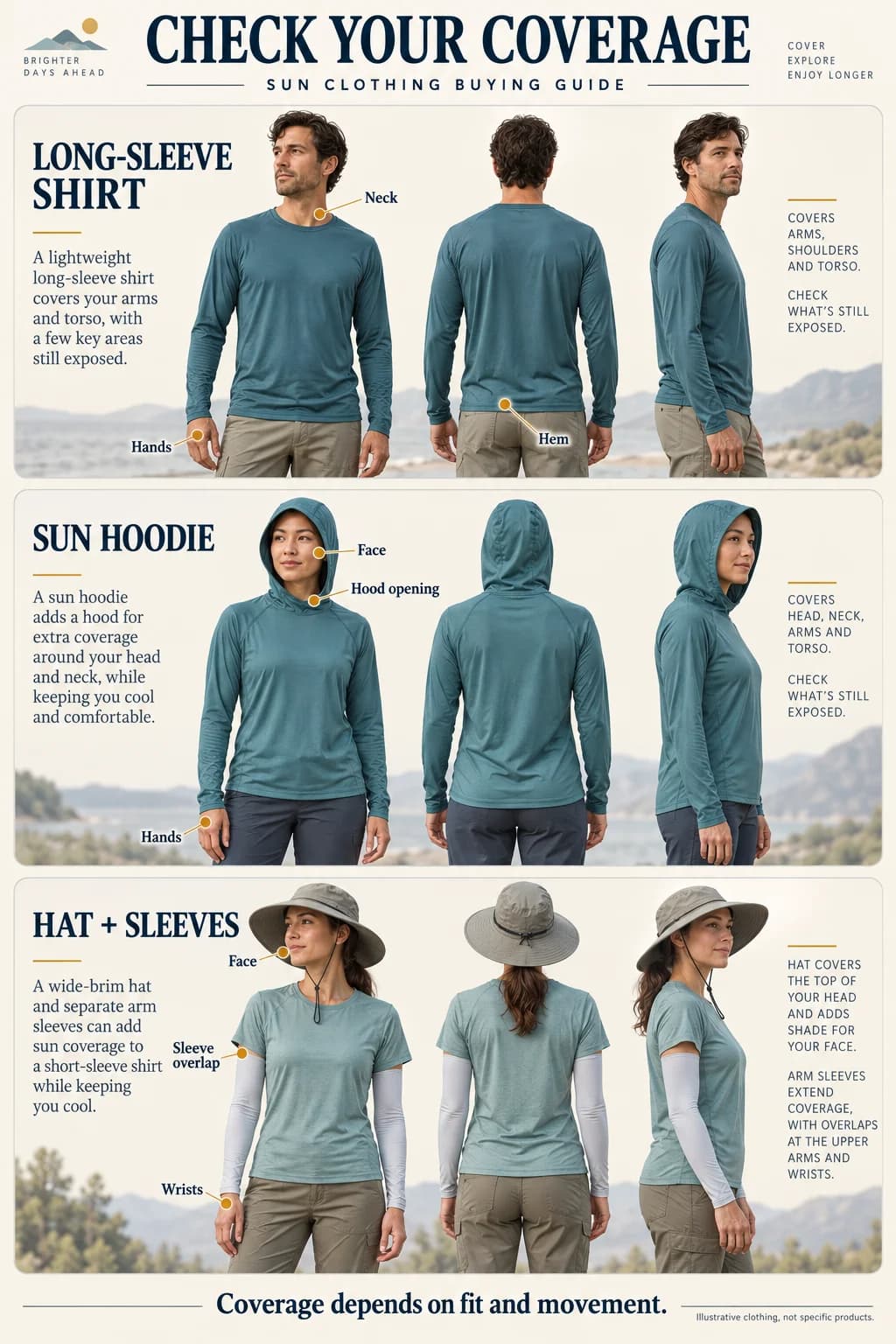
- Long-sleeve shirt: check the neck opening, backs of hands and whether the hem lifts above your waistband.
- Sun hoodie: turn your head and check the hood opening, face and hands. A hood is only useful when it stays in position.
- Hat plus sleeves: check overlap at the upper arm and wrists. A brim adds shade but does not cover all facial skin.
2. UPF Ratings Explained: What Do the Numbers Mean?
UPF stands for Ultraviolet Protection Factor. It expresses how much ultraviolet radiation passes through a tested fabric. Standards bodies define test and labeling rules; ARPANSA provides consumer guidance for the Australian/New Zealand standard.
The categories below follow ARPANSA’s explanation of AS/NZS 4399:2020. Percentages illustrate approximate transmission under test conditions; other labeling systems may differ.
| UPF Rating | UV Blocked | UV Transmitted | AS/NZS 4399:2020 category |
|---|---|---|---|
| UPF 15 | 93.3% | 6.7% | Minimum protection |
| UPF 30 | 96.7% | 3.3% | Good protection |
| UPF 50 | 98.0% | 2.0% | Excellent protection |
| UPF 50+ | 98%+ | <2% | Excellent protection |
The practical difference is best understood as transmission: UPF 30 transmits about 1/30 under test conditions, while UPF 50 transmits about 1/50. Choose the labeled rating, coverage, comfort, and durability that you will actually wear. Ask a clinician for individualized guidance if medication, a condition, or treatment affects photosensitivity.
⚠️ Important: Not All "UPF" Claims Are Equal
Look for a rating tied to the exact garment and a disclosed test or labeling standard. A brand name alone is not proof, and the rating applies only to the covered area.
3. The Fabric Science Behind UV Protection
Three physical mechanisms determine how much UV light a fabric blocks: reflection (the fiber surface bounces photons away), absorption (molecules within the fiber capture photon energy and dissipate it as heat), and scattering (some additives can affect UV transmission). For more on the rating and construction, see The Science of UPF 50+ Fabrics.
Why Fiber Name Alone Is Not Enough
Polyester, nylon, cotton, and blends can all be constructed in different ways. Density, knit or weave, color, stretch, additives, and condition interact, so a polyester label does not by itself establish UPF 50 or wash durability.
A light, loosely constructed shirt may offer less protection than a denser garment, and the CDC notes that a wet T-shirt offers less UV protection than a dry one. Verify a rated garment instead of assigning a universal number to an ordinary cotton tee. See our moisture-management guide for the separate comfort trade-offs.
The Weight Factor: Useful, but Not a Rating
Fabric weight influences hand feel and structure, but it does not independently prove UV protection or comfort. Compare GSM when available, then verify UPF, opacity under stretch, ventilation, and fit. We explore this in Lightweight Fabrics.
4. What to Look for When Buying Sun Protection Clothing
Not every UPF garment fits the same use. These are the features worth checking on the current product page and after try-on:
✅ The Sun Protection Clothing Buyer's Checklist
A documented model-specific UPF rating
AATCC TM 183 measures fabric UV transmission; AS/NZS 4399 also addresses rating labels and coverage. Call a product certified only when its certification is documented.
Moisture-Wicking
Fabric and construction intended to spread and release moisture
Flatlock Seams
May reduce seam bulk; fit and movement still determine comfort
Ventilation Zones
Mesh panels in underarms, back, or sides for airflow
Thumbholes / Extended Cuffs
Keeps sleeves in place; protects backs of hands
Anti-Odor Treatment
Verify the named treatment, care, and longevity claim
Scuba Hood (for hoodies)
Check the actual hood opening and movement; a scuba hood does not automatically cover the lower face
Proper Fit (gender-specific)
Choose the cut that stays covered without binding or excessive stretch
For a deeper breakdown of these features, see: Top 5 Features to Look for in a Sun Hoodie, our sun-protection arm-sleeve buying guide, and Men's vs. Women's Performance Fit.
Do this movement check before keeping a shirt
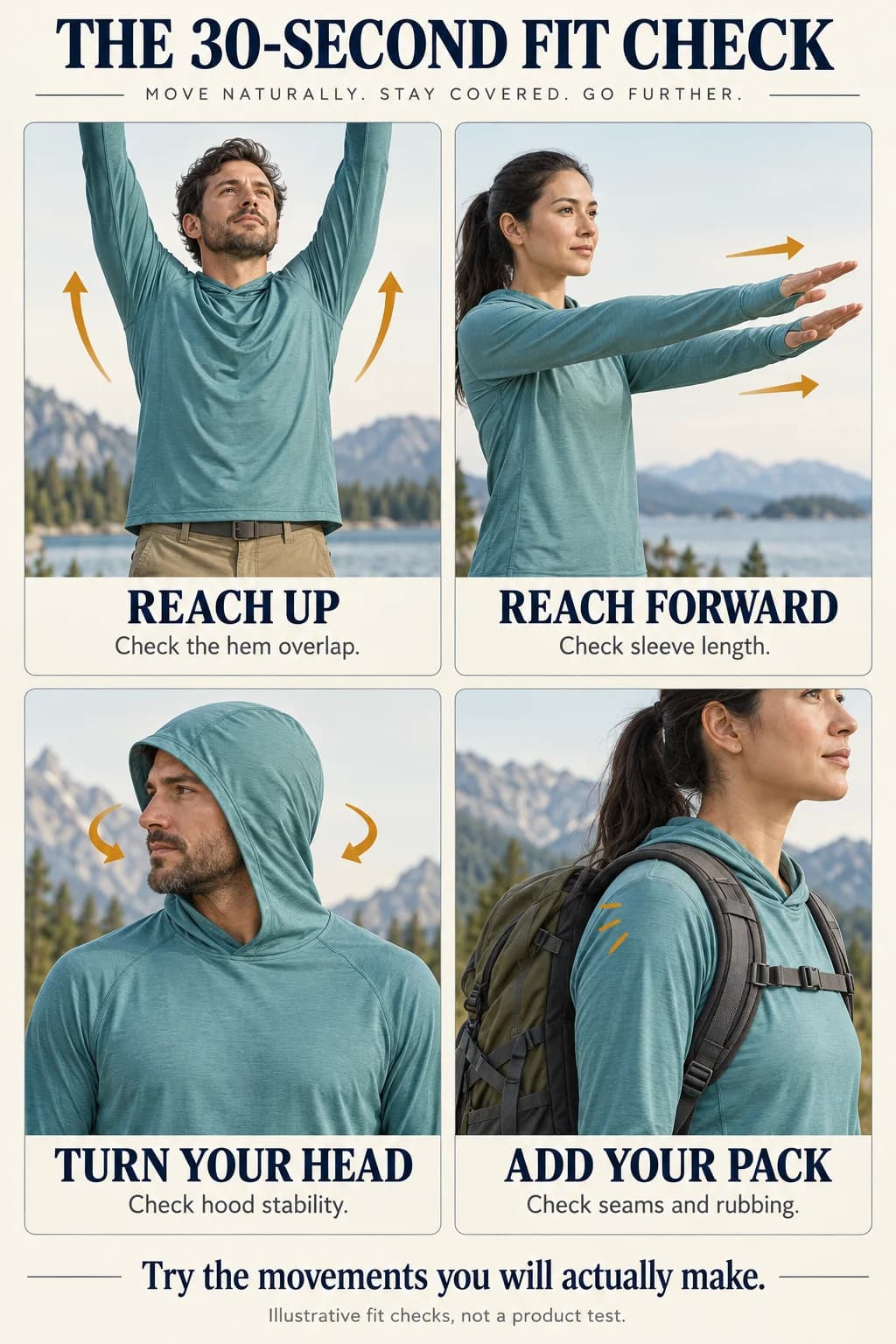
- Reach up: the hem should maintain the coverage you need at the waistband.
- Reach forward: check that cuffs do not pull back farther than expected or thumbholes restrict movement.
- Turn your head: check whether the hood follows comfortably, slips back or interferes with your view.
- Add your pack: check pressure and rubbing at shoulder seams, straps and the waist belt.
Use the exact model's size chart. Do not size down just to stop a loose hem: stretching the fabric and restricting movement can introduce different problems. For repeated trips, compare care instructions and odor-control claims, but do not assume a finish eliminates washing or guarantees all-day freshness.
5. Best Sun Protection Clothing by Activity
Find your starting point
Choose your activity and conditions for a practical shopping checklist.
Start with a rated sun hoodie or long-sleeve hiking shirt.
Try it with your loaded pack: check shoulder seams, hem coverage and whether the hood stays in place when you turn. Inspect pack-contact areas for wear.
Compare room for airflow and vent placement. Try the garment moving: fabric that clings or bunches may be uncomfortable. A quick-dry claim does not establish comfort in high humidity.
Explore the hiking with a pack guide →Editorial selection aid, not a product test or personalized safety assessment. Use clothing alongside shade, a hat, sunglasses and sunscreen on exposed skin.
Different outdoor activities reward different features. Compare coverage, wet use, pack compatibility, ventilation, and freedom of movement before choosing a format.
🎣
Best Fishing Shirts (UPF 50+)
8 shirts compared from AFTCO, Huk, Columbia PFG, and Simms. Head-to-head comparison table.
Read Review →🥾
Best Sun Hoodies for Hiking
8 hoodies compared from Cotopaxi, OR Echo, Black Diamond, and Mountain Hardwear.
Read Review →🏃
Running Essentials: Anti-Chafe Gear
Fabric, seam, fit, and anti-chafe trade-offs for repeatable running comfort.
Read Guide →👕
Best UPF 50+ Shirts for Men
7 shirts compared for hiking, fishing, and running. Full comparison table with expert picks.
Read Review →Anglers should account for long exposure, uncovered hands and face, and reflected light near water. We cover practical heat and coverage choices in Fishing in the Heat: How to Stay Cool and Sun-Safe. For marketplace options, see Best Sun Hoodies on Amazon.
Build an outfit around the actual outing
A hot-weather hike with a loaded backpack
Put the pack on before deciding between sizes. Reach for a bottle and tighten the hip belt: does the shirt pull out at the waist, bunch under the straps or expose your wrists? A hoodie can add coverage, but check that turning your head does not pull it off or block your view. In humid conditions, assess clinging and airflow rather than relying on a cooling label. After trips, inspect shoulder and belt contact points for thinning.
Gardening in humid heat
Try bending, kneeling and reaching overhead in a relaxed long-sleeve shirt. The hem needs to stay over the waistband while you work. Check glove-to-cuff overlap instead of assuming long sleeves cover your hands. A crew neck leaves more neck exposed than a hood or collar; plan a suitable hat and exposed-skin protection. Use shade breaks and judge heat conditions separately from the UPF label. For longer outdoor shifts, use our outdoor-work shirt guide.
Snorkeling, then spending time on the beach
Choose a rashguard with stated water-use suitability, then imitate a swimming reach. It should not restrict your shoulders or leave a gap at the waist. A tight rashguard and a relaxed sun shirt are different cuts even when both say UPF 50+. Check the manufacturer's wet-use guidance and rinse, wash and drying directions. The garment does not cover your face, hands or lower body; build the rest of your coverage around those gaps. See our snorkeling comparison.
Six buying mistakes to catch before removing the tags
- Choosing a smaller size to stop flapping: check chest, shoulder and sleeve reach first. An overly stretched shirt is not a reliable fit solution.
- Checking sleeves only with arms down: reach forward and overhead; look for exposed wrists and a lifting hem.
- Buying a hood without trying it: turn your head both ways. Reject a fit that repeatedly slips or obstructs your view.
- Transferring a rating between colors or generations: match the exact product page and sewn-in label. The Echo comparison below shows why color-specific ratings matter.
- Treating a dry-land shirt as swimwear: look for explicit water-use suitability, rather than inferring it from polyester content.
- Expecting a premium finish to solve everything: cooling and odor-control claims do not establish a wash-free garment or a measured advantage. Read the care label and check return conditions before committing.
Should I size up for sun protection?
Use the model's chart and movement checks rather than automatically sizing up. A dry-land top needs comfortable coverage without excessive stretch; a performance rashguard may intentionally fit closely. Going larger can also change hood stability and hem behavior.
Is a UPF 50+ hoodie always the better purchase?
It adds potential head and neck coverage, but only while the hood stays in place. A shirt may suit pockets, workplace requirements or your preferred hat better. Compare the complete outfit, including exposed face and hands, rather than the hood alone.
6. Real Models Compared: UPF, Fit & Trade-offs
Three UPF 50+ options for different jobs
All three manufacturers explicitly list UPF 50+ for these models. Specifications checked September 18, 2026; recommendations are our interpretation of those specifications. These are men's versions: do not transfer measurements to another cut. For other fits, start with our women's UPF shirt guide.
| Model | Listed sizes | Fit and coverage | Material |
|---|---|---|---|
| Outdoor Research ActiveIce Spectrum Sun Hoodie | S–XXXL listed | Stretch hoodie; thumbholes | 94% polyester / 6% spandex |
| Coolibar Morada Everyday Long Sleeve T-Shirt | S–XXL listed | Relaxed crew neck; no hood | Exact composition not populated in the checked specification fields |
| O’Neill Basic Skins 50+ Long Sleeve Rash Guard | S–XXL listed | Tight performance fit; no hood | Polyester / spandex; proportions not stated |
Outdoor Research ActiveIce Spectrum Sun Hoodie
UPF 50+ · 322376
Three-panel hood, thumbholes and side-slit hem. Manufacturer-listed weight: 255 g; reference size unspecified.
Consider it for: Hiking or fishing when you want a hood and extended sleeve coverage.
Less suitable for: Buyers seeking the lightest top, shirt pockets or confirmed swimming suitability. Cooling is a manufacturer claim, not our comparative test result.
Before ordering: The checked page showed out-of-stock messaging and shipping restrictions for California, New York and Colorado. Confirm current availability and care instructions before ordering.
Coolibar Morada Everyday Long Sleeve T-Shirt
UPF 50+ · 01017, Black
Full sleeves and straight hem; listed body length 30½ inches in Large. No hand-covering feature specified.
Consider it for: Walking, errands and light gardening when you prefer a simple, relaxed shirt.
Less suitable for: Buyers needing an integrated hood, hand coverage or verified swim-specific performance.
Before ordering: Confirm the current fabric and garment care label. Do not substitute specifications from the separately named Pima Sol version. Listed sizes do not establish stock.
O’Neill Basic Skins 50+ Long Sleeve Rash Guard
UPF 50+ · 3342, Smoke
Four-way stretch and flatlock seams. The manufacturer identifies this rashguard as suitable for ocean swimming.
Consider it for: Swimming and snorkeling when you want a close-fitting water-use layer.
Less suitable for: Buyers wanting a loose everyday shirt, pockets or head and hand coverage.
Before ordering: Use the chest and waist chart, then check swimming reach and hem security. Style 4339 is a different, slim-fit sun shirt. Check the sewn-in wash and drying instructions.
Affiliate searches may show different generations or similarly named garments. Match the style number, color and label. We have not tested drying speed, odor retention, abrasion resistance or comfort in controlled conditions, so those remain try-on and care questions rather than scored advantages.
Other models: why the exact rating matters
These men's models illustrate different trade-offs; they are not a ranked or hands-on-tested shortlist. Manufacturer specifications checked September 18, 2026. Fit recommendations below are editorial interpretation.
Columbia PFG Tamiami II Long Sleeve
UPF 40
Listed features: Polyester ripstop, mesh-lined back vent, collar, chest pockets and roll-up sleeve tabs. Columbia describes a loose fit and advises that it runs large.
Buying implication: Worth comparing if you want fishing-shirt storage and ventilation. No integrated hood; rolling the sleeves exposes your forearms. Check the size chart rather than automatically buying your usual size.
Outdoor Research Echo Hoodie
UPF 15 light colors / 20 dark colors
Listed features: Recycled polyester, AirVent fabric, flat seams, three-panel hood and thumbholes. The manufacturer lists quick-drying and odor-control features.
Buying implication: An airflow-focused option to compare for active use, but it is not a UPF 50 hoodie. Check the rating for your color, sleeve reach and hood fit; no comparative cooling or abrasion test is established here.
Patagonia Capilene Cool Daily Hoody
No numeric UPF found in current specifications
Listed features: Current style 45311 lists a regular fit, deep hood, minimal seams, stretch fabric and odor control.
Buying implication: A useful example of why a technical hoodie is not automatically a confirmed UPF-rated pick. If a stated rating is essential, obtain current confirmation for the exact model before buying. Do not transfer older-generation claims.
Amazon links are affiliate links. Match the exact model, color and garment label; search results may include other versions. No prices or availability are implied.
For a detailed head-to-head comparison of the top three fishing brands, see: Huk vs Columbia PFG vs AFTCO: Which Brand Wins?
7. Care, Washing & Long-Term Durability
UPF can come from construction, fiber composition, dyes, or additives. Regardless of how it is achieved, protection may change as a garment stretches, wears, fades, or is exposed to chemicals. Follow the exact product's care instructions.
Best Practices for Longevity
- Read the care label first. Temperature, cycle, and drying advice are garment-specific.
- Avoid unapproved additives. Do not assume bleach, softener, or a home remedy is safe for the fabric or finish.
- Inspect high-stretch areas. Check shoulders, elbows, cuffs, and pack-contact zones for thinning or damage.
- Reassess after hard use. Chlorine, salt, abrasion, and repeated stretching can affect condition.
- Handle odor according to the label. For general fabric trade-offs, see Why Do My Gym Clothes Smell?.
There is no universal safe wash count. When fabric becomes visibly thin, permanently stretched, or damaged, replace it or ask the manufacturer whether the rating still applies.
8. Sun Protection Myths Debunked
❌ MYTH: "Dark clothing is always better for sun protection."
✅ BETTER RULE: Color can influence UV transmission, but the exact fabric construction and tested rating are more useful buying evidence.
❌ MYTH: "Any shirt gives you sun protection."
✅ BETTER RULE: Ordinary shirts provide variable protection. Light, wet, stretched, or worn fabric may protect less, so use a rated garment when the rating matters.
❌ MYTH: "You don't need sun protection on cloudy days."
✅ BETTER RULE: UV exposure can still occur on cloudy days. Check the UV index and use appropriate protection rather than relying on temperature or visible sunshine.
❌ MYTH: "UPF clothing is hot and uncomfortable."
✅ BETTER RULE: Lightweight, ventilated garments can be comfortable, but GSM, fit, humidity, airflow, and activity all affect heat comfort. Try the garment in motion.
People Also Ask: Sun Protection Clothing (2026)
Is UPF 50 better than sunscreen?+
Does the UV protection in clothes wash out over time?+
Does a white shirt protect you from the sun?+
Which color is best for UPF protection?+
How do I know if my clothes have UPF protection?+
Sources and editorial boundary
SleeveShirts did not lab-test the garments named in this overview. We use official sun-safety and clothing-label guidance for the framework, then ask readers to verify the current rating, coverage, and care instructions for the exact product.
📚 Explore Our Sun Protection Library
Deep dives into every aspect of UV protection and performance clothing.
Ready to Upgrade Your Sun Protection?
Browse our curated collection of UPF 50+ apparel — compared for durability, breathability, and coverage signals.
As an Amazon Associate, we earn from qualifying purchases. This helps support our research at no extra cost to you.
Disclaimer: This guide is educational, not medical advice or a laboratory test. If you have concerns about skin cancer, photosensitivity, or treatment-related sun exposure, consult a qualified clinician. Some links contain Amazon affiliate tags; purchases may support ongoing editorial work at no additional cost to you. Content was assisted by AI for research organization and reviewed against SleeveShirts editorial methodology.