SleeveShirts · Practical guide
Running Apparel Guide: Fit, Chafing, Weather & What to Buy
Choose running shirts and layers by movement, friction, weather and sun coverage, with practical fit checks and realistic limits on cooling claims.
SleeveShirts Editorial Review · Updated · 11 min read
Based on the official guidance and manufacturer specifications linked below. Recommendations and try-on checks are editorial judgments, not hands-on or laboratory test results. We may earn a commission from qualifying Amazon purchases.

The practical answer
Choose a shirt that stays comfortable through your arm swing, works with your belt or vest, and provides the coverage your route requires. Fit and seam placement come before a cooling slogan. Use a labeled UPF garment when you need a stated sun-protection rating, and plan heat conditions separately from your clothing choice.
What kind of run are you dressing for?
Start with the simplest comfortable top you already own; buy to fix a specific problem.
- Swing your arms and check the underarms and neck.
- Load your usual belt or phone pocket before judging the hem.
- Check the forecast and route exposure, even for a familiar loop.
Editorial decision aid. It does not calculate safe exposure time, heat tolerance or a product performance score.
Choose the construction around the run
| Situation | Useful starting point | Try-on check | Main trade-off |
|---|---|---|---|
| Short easy run | Simple top with comfortable seams | Natural arm swing | A familiar fit can matter more than extra features |
| Long road run | Top that works with your belt | Loaded pocket bounce and waist friction | A longer hem may bunch under a belt |
| Trail run with vest | Low-bulk seams and suitable coverage | Reach with bottles and pack loaded | Lightness alone does not prove abrasion resistance |
| Exposed route | Verified UPF plus stable coverage | Cuffs, neck and hood in motion | Sun rating does not establish cooling ability |
See what to check
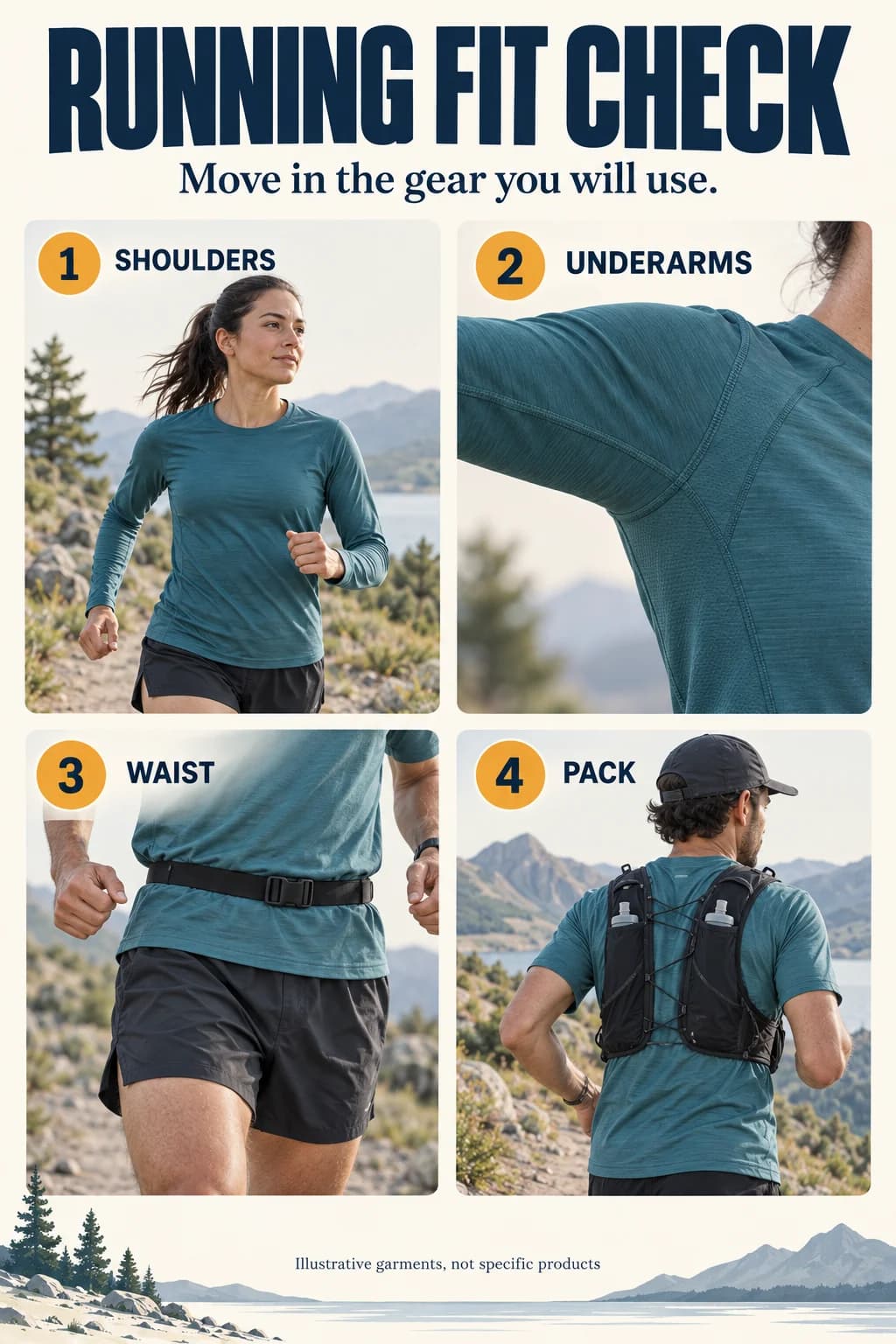
- Swing both arms naturally: shoulders should move without pulling the whole shirt upward.
- Check underarm and side seams for rubbing or bulky folds.
- Wear your belt with its normal contents and examine where it presses the hem.
- Load your hydration vest and reach for bottles; inspect the contact areas afterward.
Start with the problem, not the technology label
A useful running-shirt purchase solves a problem you can name: a collar that rubs, a hem that rides up, a soaked top that clings, or sleeves that leave too much skin exposed. Write down what happened with your current shirt, the conditions and the equipment you wore. That gives you a meaningful comparison when every product page promises comfort.
Separate requirements from preferences. Requirements might include a stated UPF rating, a comfortable arm swing and compatibility with your vest. Preferences might include color, a zip neck or a particular feel against the skin. A shirt can satisfy the first group without carrying every premium finish. Do not replace a comfortable, serviceable garment just because another one has a newer fabric name.
Heat planning is separate from shirt selection
A fabric feature does not determine whether a run is safe. The CDC advises athletes to schedule activity carefully in hot conditions and stop activity and move somewhere cool if they feel faint or weak. Use current local weather guidance, your circumstances and professional advice where needed. A shopping guide cannot calculate a personal safe pace or exposure time.
Describe the conditions you expect: humid and still, dry and breezy, or cool with rain. Check ventilation, vest fit and whether you need a layer for the journey home. Clothing choice does not remove heat risk.
Sources: CDC: Heat and athletes
Reduce friction without a fictional countdown
There is no universal minute at which a seam causes chafing. Fit, moisture, movement, skin sensitivity and equipment contact interact. The American Academy of Dermatology recommends moisture-wicking, loose-fitting clothing during physical activity to help prevent friction-related blisters. A garment still needs a personal try-on: neither a flat seam nor a particular fiber guarantees comfort.
Check where seams sit at the neck, underarms, waist and beneath equipment. Try the movements that usually cause trouble before removing tags or running outdoors.
Introduce a new shirt on a short, familiar outing with an easy way home. Change one item at a time where practical so you can identify what helped. Stop and address rubbing rather than treating discomfort as evidence that the shirt needs breaking in. Persistent or worsening skin symptoms belong with a qualified clinician, not a product-ranking table.
Sources: AAD: Preventing blisters
Road and trail gear differ because the equipment differs
On the road, a phone belt, reflective accessories and repeated arm motion may be your main clothing interactions. On a trail, a vest, pack straps, vegetation and changing exposure can add more contact points. Do not automatically assume that a trail-branded shirt is tougher: look for construction details and ask for relevant durability evidence if abrasion is a major concern.
Test the outfit in the configuration you will use. A vest worn empty at home can sit differently when loaded. A bottle pocket can pull the front panel, and a belt can gather a long hem into folds. Choose enough length to maintain coverage while avoiding a bulky stack at the waist. Recheck fit if you change vest size or equipment placement.
Compare pack and layer checks for trail use →Wicking, quick drying and cooling are different claims
Wicking describes moisture movement through a textile; a quick-dry claim concerns drying behavior. Neither term tells you how a complete shirt will feel in every climate. Compare the exact construction, ventilation and fit, and look for a stated test method before accepting numerical cooling claims.
A close fabric may cling differently from a loose one; a ventilated panel may be covered by your vest. Those interactions can matter more to your experience than a finish name. Treat a branded cooling treatment as a feature to investigate, not evidence of a faster race time. We have not measured temperature reduction, sweat evaporation or performance gains for the options here.
Understand moisture-management terms →There is no universal ideal GSM for running
GSM means grams per square meter of fabric, not total shirt weight. Two tops with the same GSM can have different panel areas, seams, trim, knit structures and fits. A larger garment can weigh more without using heavier fabric. Compare like-for-like sizes and ask which size a quoted weight represents.
Use weight as one input rather than a pass/fail number. If a very light top feels transparent when stretched or rides up under a vest, lower weight has not solved your problem. Conversely, extra weight does not prove durability or sun protection. Verify each relevant property on its own rather than treating 130gsm, or any other number, as a quality certificate.
Read the fabric-weight guide →A repeatable fitting-room routine
Wear the sports bra, base layer or other next-to-skin pieces you normally use. Check chest and waist measurements against the specific brand chart, then raise your arms, rotate your torso and mimic running. The shirt should let you move without a collar pulling across your throat or the lower edge repeatedly lifting out of place.
If you are between sizes, identify the actual conflict. A tight shoulder with a loose waist may mean the cut is wrong, rather than that you need the next size. Check sleeve reach separately from torso fit. Thumbholes should not drag on your fingers; a hood should not pull backward when you turn. Consider a different cut instead of accepting several compromises to keep a favored brand.
Build three practical outfits
For an easy local run, begin with a comfortable top, suitable lower-body clothing and the accessories you normally carry. Check the route and conditions. A short outing is useful for learning how a new seam or pocket behaves; it is not evidence that the same outfit will suit a much longer event.
For a longer run, add your belt or vest during the try-on and trial. Think through access to bottles, a phone and a carried layer. If a seam starts to annoy you after a short trial, do not assume it will become less noticeable over hours. Record the issue and change the relevant piece or fit before extending the distance.
For an exposed trail outing, consider a rated long-sleeve top or a rated sleeve system that stays overlapped. Plan face, neck and hand coverage separately. A hood that works on a sheltered path may behave differently in wind. Long sleeves do not remove the need to judge temperature, exertion and the opportunity to shorten or change the outing.
Compare sleeve fit and overlap →Odor control is not permission to skip care
Ask what an odor-control claim actually says. Does the manufacturer name a treatment, specify care restrictions or provide relevant longevity information? Do not transfer claims from one garment in a collection to every product from that brand. Comfort and odor preference are also personal; a specification is not a promise of freshness after every run.
After use, follow the garment label and avoid leaving wet kit compressed in a bag longer than necessary. A finish does not replace washing. If odor persists despite correct care, investigate the care routine and the particular garment rather than assuming that all synthetic fabric behaves identically.
Keep useful gear working
Read the washing and drying instructions before purchase if your routine is constrained. A top that requires a process you cannot follow is a poor fit for your training schedule. Follow restrictions on softeners, bleach and heat where specified; do not claim that one accidental wash universally destroys all moisture management or UV protection.
Inspect stretched cuffs, rough seams and vest-contact areas. Repairable stitching and a changing fabric surface are different problems. A home inspection can reveal damage but cannot measure remaining UPF. If sun protection is a requirement and the fabric is significantly worn, ask the manufacturer or replace the garment rather than guessing a percentage.
Use the clothing-care guide →Buy for repeated use rather than a trend cycle
Choose a cut you can comfortably wear, a care routine you can maintain and a realistic number of garments for your training. Check recycled-content statements for the exact product, not the brand as a whole. A recycled fiber percentage is a material attribute; it is not a direct measure of drying, durability or comfort.
Compare replacement needs as well as features. An additional shirt can be useful if it makes correct washing and drying practical between sessions. Buying several untried tops in a sale can do the opposite if the cut proves unsuitable. Start with one when you are uncertain and follow the seller's return conditions.
Concrete options and their limits
Use these examples to identify a suitable construction or cut. They are not ranked winners. Match the exact model and label; sizes, colors and availability can change.
Outdoor Research Echo Hoodie — model 287625
Evidence: Manufacturer lists recycled polyester, thumbholes and UPF 15 for light colors / 20 for dark colors.
Consider it when: You want to compare a light hooded design for active movement.
Check the limitation: It is not UPF 50. Confirm the color, size and fit; no fastest-drying or chafe-free result is established here.
Patagonia Capilene Cool Daily Hoody — style 45311
Evidence: Current page lists regular fit, minimal seams and a wicking finish; no numeric UPF is stated.
Consider it when: You want a technical hoodie to assess for seam comfort.
Check the limitation: Do not treat it as a verified UPF-rated pick or reuse an older generation's rating.
Before you buy or head outside
- Identify the problem your current shirt causes before shopping.
- Measure against the exact model chart and wear your normal layers.
- Test arm swing, collar contact and hem position with equipment loaded.
- Verify the garment's actual UPF when buying for rated sun coverage.
- Read care and return conditions before ordering.
- Trial a new combination on a shorter route before a long outing.
Frequently asked questions
Do I need a special shirt for every distance?
No. A comfortable shirt may work for several runs. Longer outings mainly make equipment contact, care, weather planning and repeatable fit more important. Buy another garment when it solves an identifiable problem, not because the distance label changes.
Are flatlock seams guaranteed to stop chafing?
No. Seam position, fabric folds, fit and movement still matter. Check the actual contact areas under a belt or vest. A construction label is useful information, not proof that your skin will stay comfortable.
Is compression the best running fit?
There is no universal best cut for everyone. A close garment may suit one runner while another prefers more room. Choose for comfortable movement and the intended use; do not infer a medical or performance benefit from compression styling alone.
Can I use a sun hoodie instead of sunscreen?
Clothing covers only part of the body. The CDC recommends combining protective clothing with shade, a hat, sunglasses and sunscreen on exposed skin. Pay attention to sleeves or hems that shift while running.
How much faster will a cooling shirt make me?
We cannot assign a performance gain from the specifications here. That would require suitable testing. Use comfort, coverage and equipment compatibility to compare options, and keep heat planning separate.
Sources checked
Reviewed September 18, 2026. Official guidance supports the safety and labeling explanations; manufacturer pages support only the specifications attributed to them.
- CDC: Heat and athletes — Heat planning and stop-activity guidance.
- AAD: Preventing blisters — Friction, moisture and clothing guidance.
- CDC: Sun safety — Combined sun-protection measures.
- Outdoor Research: Echo Hoodie — Exact-model specifications.
- Patagonia: Capilene Cool Daily Hoody — Current features and care; no numeric UPF stated.