Best Sun Hoodies on Amazon: Buy by Evidence, Not Star Count
Specification-based editorial guide, not a hands-on product test. We checked current manufacturer pages on October 10, 2026. Prices, marketplace ratings, sellers, colors, and inventory change and are deliberately not ranked.
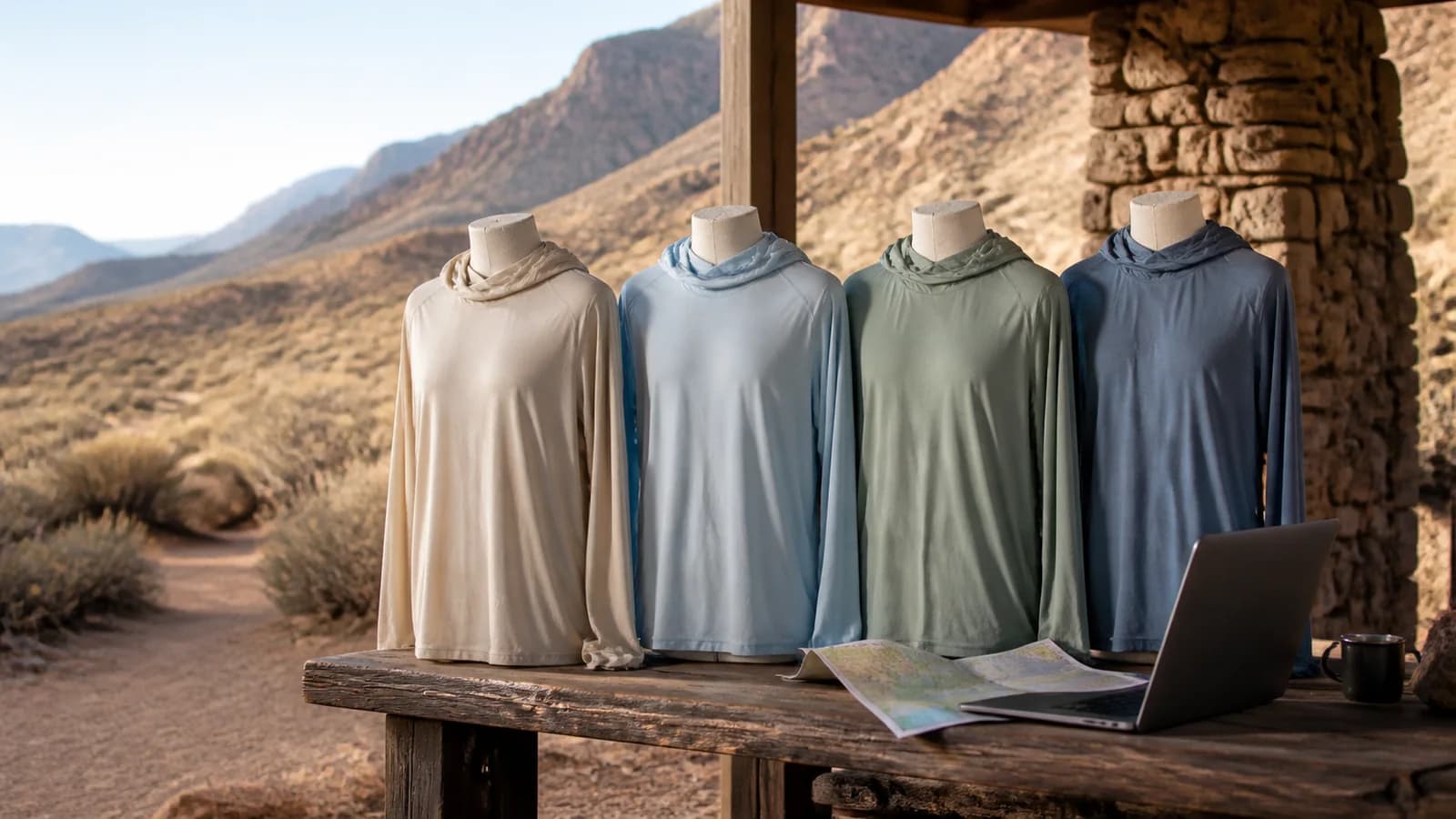
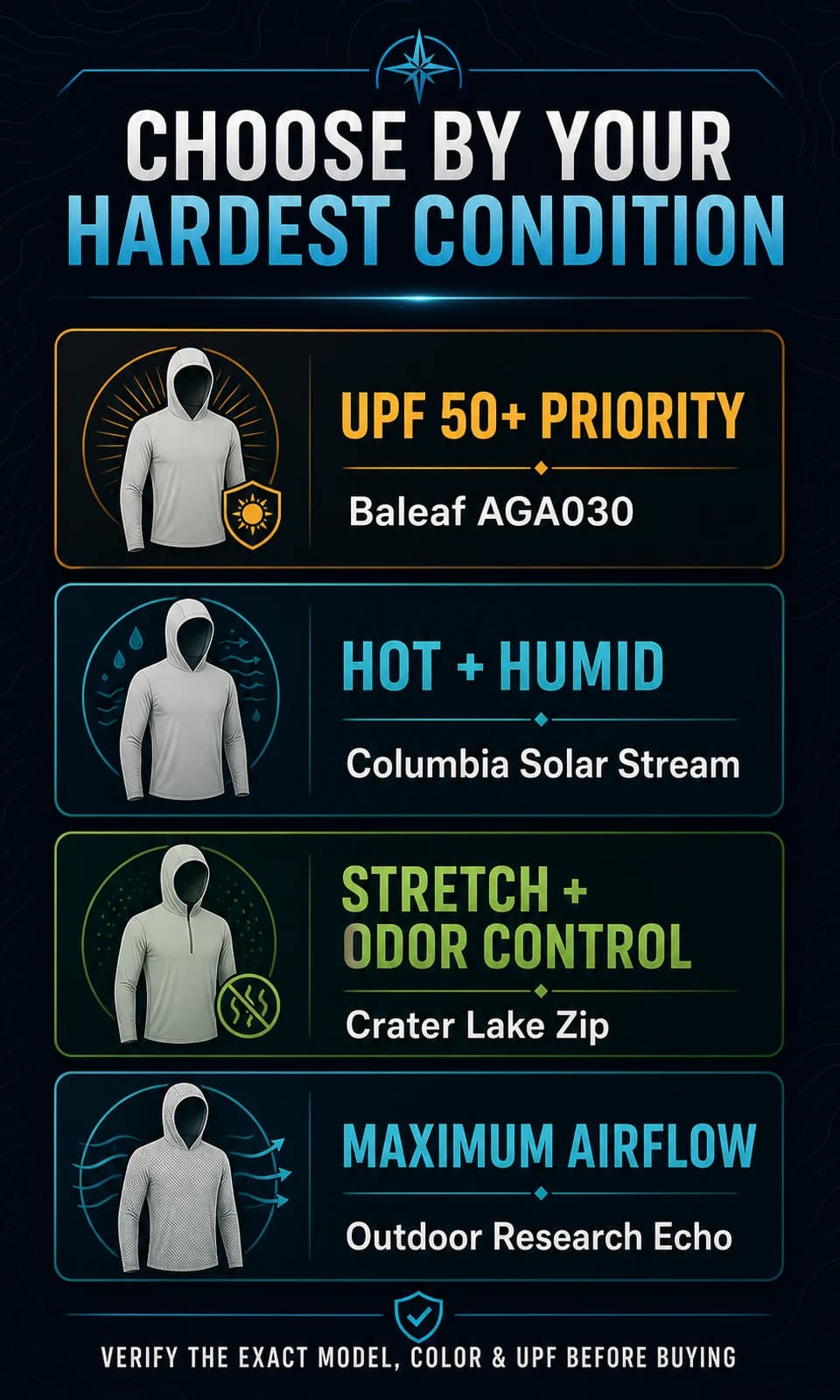
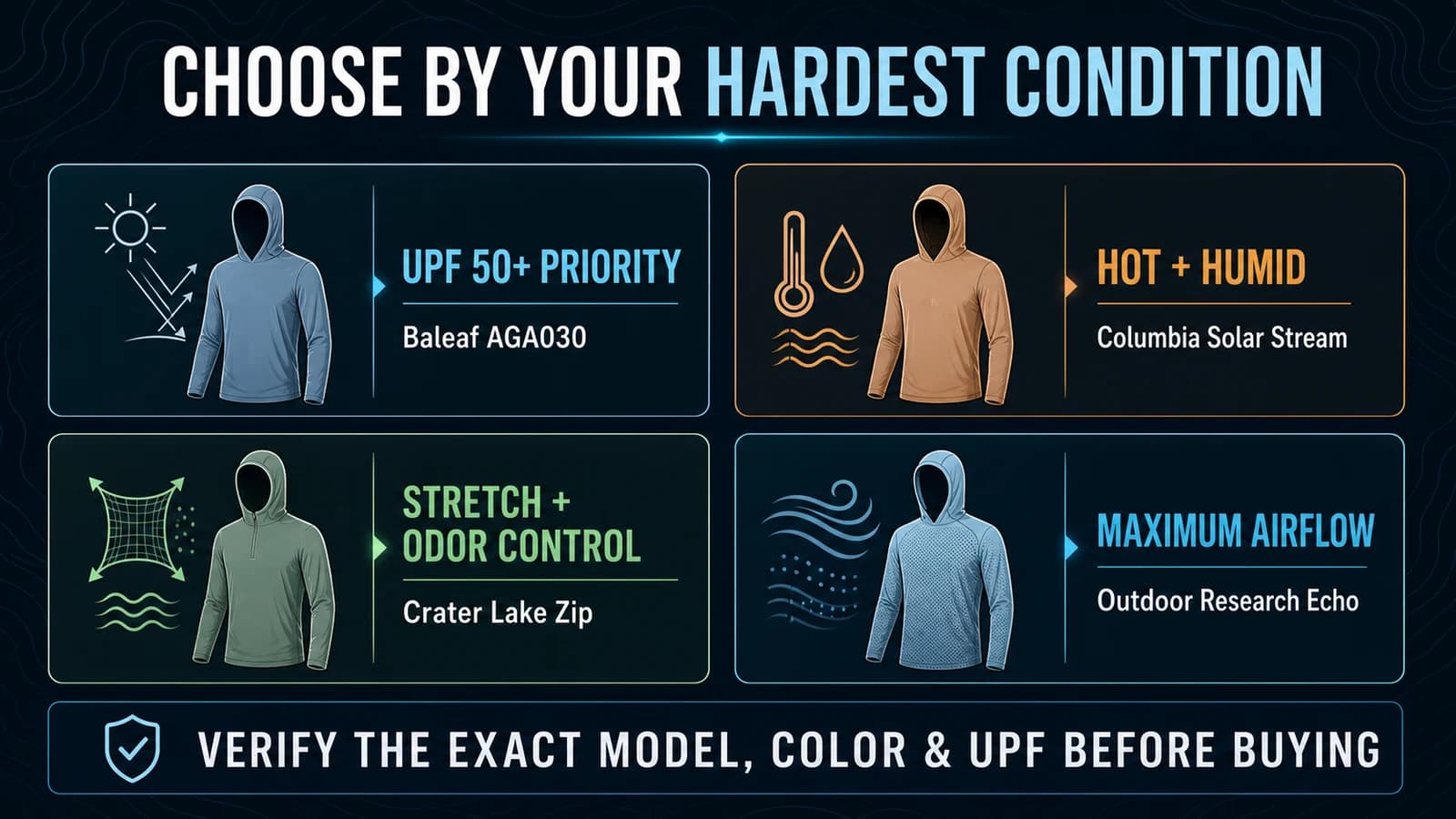
Start with Baleaf for broad budget-friendly basics, Columbia PFG for humid-heat airflow, Mountain Hardwear for stretch and published odor control, or Outdoor Research Echo when maximum airflow matters more than a UPF 50 label. Then verify the exact model before buying.
Direct answer
Use Amazon for fulfillment, not as your specification source
The safest buying sequence is manufacturer page first, Amazon search second. Baleaf’s AGA030 gives a straightforward UPF 50+ hood-and-thumbhole package with sizes listed from XS through 3XL. Columbia’s Solar Stream pairs UPF 50 with an explicit Air Flow construction and a 29-inch center-back length. Mountain Hardwear’s current Crater Lake Zip Hoody adds a three-piece hood, thumbholes, stretch, and HeiQ Mint odor control. Outdoor Research’s Echo is the airflow specialist, but its published UPF is only 15 in light colors and 20 in dark colors. None is universally best; the correct choice depends on whether your hardest problem is budget, humidity, feature coverage, or heat dumping.
Baleaf AGA030
UPF 50+, hood, thumbholes, flatlock seams, quick-dry claim, and XS–3XL sizing. The manufacturer publishes fewer fit and durability details.
Columbia Solar Stream
The clearest airflow story: Broad Spectrum Air Flow UPF 50 plus Omni-Wick, a regular fit, and a published 29-inch back length.
Crater Lake Zip Hoody
UPF 50, stretch, three-piece scuba hood, thumbholes, a 120-gsm fabric specification, and published plant-based odor control.
Outdoor Research Echo
Ultralight, quick-drying, breathable, and odor-treated, but the manufacturer confirms only UPF 15 for light colors and UPF 20 for dark colors.
Visual decision aid
Start with the buying decision
How we compared
Selection and price references
We selected four recognizable marketplace search targets that represent different buyer needs, then checked the current official product page for each exact model. We recorded only details that the manufacturer currently publishes: UPF, material, fit language, garment or fabric measurements, hood construction, odor treatment, drying claims, and size selectors. We did not copy marketplace star averages, review counts, discounts, delivery promises, or seller-written superlatives because those fields change quickly and may refer to a different color, version, or seller.
This shortlist uses published specifications, not our own garment or laboratory tests. Claims such as fast drying, breathable and anti-odor remain manufacturer claims unless a comparable test method is available. None of these brands supplies a directly comparable backpack-abrasion rating. Try on the shoulders, hood and torso with your usual gear before deciding.
Community threads repeatedly ask whether a UPF 50 hoodie is too warm in humid weather, whether a lightweight knit snags under pack straps, and whether hoods stay put in wind. We use those discussions to identify decision fields. We do not treat anonymous comments, “Reddit consensus,” or marketplace reviews as proof that one model dries faster, lasts longer, or protects better than another.
Prices and care references checked October 10, 2026 on the exact US model pages. Prices are for one shirt before tax and shipping, not live Amazon offers. Confirm any unpublished care instruction on the garment label.
Decision table
Compare the fields that change comfort and coverage
For an unpublished specification, check the manufacturer or garment label before relying on it.
| Decision field | Baleaf AGA030 | Columbia Solar Stream | MHW Crater Lake Zip | OR Echo |
|---|---|---|---|---|
| Best starting point | Budget-conscious coverage basics | Hot, humid use and fishing | Balanced coverage, stretch, and odor control | High-output airflow with lower published UPF |
| Climate | Warm mixed-use; breathable claim without airflow data | Humid/hot; textile venting is explicitly described | Dry/hot to mixed; soft stretch knit with wicking | Hot/high-output; strongest breathability emphasis |
| Confirmed manufacturer UPF | UPF 50+ | UPF 50 | UPF 50 | UPF 15 light colors / UPF 20 dark colors |
| Hood stability | Basic hood; no adjuster listed | Hooded top; no adjuster listed | Three-piece scuba hood; no drawcord listed | Three-panel hood; no adjuster listed |
| Torso / sleeve information | Length not published; long raglan sleeves and thumbholes | 29 in center-back; sun-protection cuffs | 27.3 in center-back; low-profile thumbholes | 28 in center-back; raglan sleeves and thumbholes |
| Current size information | XS–3XL | XS–XXL on checked men’s page | Check live selector; range varies by version and color | XS–3XL in current men’s size chart |
| Fit language | “Comfort fit” in product title; no detailed definition | Regular Fit | Standard Fit | Size chart published; product page does not give a comparable fit label |
| Odor control | No treatment listed | No treatment listed | HeiQ Mint listed | ActiveFresh listed |
| Drying / wicking | Moisture-wicking and quick-drying claim | Omni-Wick with rapid-evaporation claim | Moisture-wicking knit; no timed result | Quick-drying and wicking claim |
| Material | 100% polyester | 100% polyester | 88% polyester / 12% elastane | 100% recycled polyester |
| Published weight | Not published | Not published | 120 gsm fabric; not garment weight | 150 g garment weight for checked men’s model |
| Backpack abrasion evidence | No comparable rating published | No comparable rating published | No comparable rating published | No comparable rating published |
| Marketplace warning | Match model AGA030 and garment label | Match Solar Stream model, not a different PFG shirt | Do not substitute a past-season Crater Lake page silently | Color changes the stated UPF, so verify the selected color |
| USD per shirt · checked October 10, 2026 | $36; Gray/S reference | Exact selected-variant price was not retrievable from the maker page | $89 maker reference | $85; Gravel/S reference; other colors had markdowns |
| Care · exact checked model | Machine wash cold with like colors; no bleach; tumble dry low; no iron or dry-clean. | Machine wash; bleach when needed; tumble dry; iron; dry-clean in the online summary. Follow the garment label for settings. | Full wash/dry instructions were not visible on the checked product page; follow the label. | A full wash/dry instruction was not visible on the checked product page; follow the sewn-in label. |
Source review: October 10, 2026. A missing published result is not a performance score.
Budget coverage starting point
Baleaf AGA030: the fundamentals without a premium feature story
Choose it when UPF 50+, a hood, thumbholes, easy-care polyester, and a wide size range matter more than published garment measurements or odor technology.
Baleaf’s current AGA030 page is refreshingly direct about the core package. The fabric is 100% polyester with a manufacturer-stated UPF 50+ rating, plus breathable, moisture-wicking, and quick-drying claims. The hood and thumbholes extend coverage, while flatlock seams, a tag-free collar, and raglan sleeves address movement and chafe. The current selector spans XS through 3XL, which gives this model the broadest clearly visible men’s range in this comparison.
The missing information is just as important. Baleaf does not publish center-back length, garment weight, air-permeability, hood adjustment, odor treatment, or abrasion results on the checked page. That means a marketplace listing should not fill the gaps with assumptions. Long-armed buyers should raise both arms and check whether the cuffs remain over the wrists. Windy-condition buyers should test the hood over their usual cap because the page lists no closure or drawcord.
Why it makes the shortlist
- • Manufacturer-confirmed UPF 50+
- • Hood, thumbholes, raglan sleeves, and flatlock seams
- • XS–3XL current selector
- • Quick-dry and moisture-wicking claims
Where the evidence stops
- • No garment length or weight published
- • No odor-control treatment listed
- • No hood adjuster or wind-retention claim
- • No comparable abrasion or airflow result
Humid-heat starting point
Columbia PFG Solar Stream: the clearest airflow proposition
Choose it when sticky heat is the main problem and you want a regular-fit UPF 50 fishing hoodie with published length and airflow-oriented construction.
Columbia is the strongest starting point for hot, humid use because the current Solar Stream page explicitly connects protection and ventilation. Omni-Shade Broad Spectrum Air Flow UPF 50 uses textile venting, while Omni-Wick is described as moving moisture to the surface for rapid evaporation. The shirt uses 100% polyester, a regular fit, sun-protection cuffs, and a 29-inch center-back length. Those details let buyers make a more concrete fit comparison than a generic “lightweight” label would.
Airflow language still is not a laboratory comparison against Baleaf, Mountain Hardwear, or Outdoor Research. Humidity limits evaporation for every fabric, and a hood can add warmth around the neck. The page does not list a garment weight, odor-control treatment, hood adjuster, or abrasion rating. If you fish in still, humid air, the correct fit should leave enough room for air movement without becoming so loose that the hood and sleeves shift.
Why it makes the shortlist
- • UPF 50 plus explicit Air Flow construction
- • Omni-Wick moisture-management claim
- • 29-inch center-back length
- • Regular Fit and sun-protection cuffs
Where the evidence stops
- • No garment weight published
- • No odor-control treatment listed
- • No hood closure or adjuster listed
- • No timed drying or comparative airflow result
Feature-balanced starting point
Mountain Hardwear Crater Lake Zip: stretch, coverage, and odor control
Choose it when you want UPF 50, a structured three-piece hood, stretch, thumbholes, and a currently published odor-control treatment in one soft technical layer.
The current Crater Lake Zip Hoody page combines a broad set of useful specifications. Mountain Hardwear states UPF 50, broad-spectrum UVA and UVB filtering, a soft moisture-wicking jersey, a three-piece scuba hood, low-profile thumbholes, and HeiQ Mint plant-based odor control. The fabric is 88% polyester and 12% elastane at approximately 120 gsm, and the listed center-back length is 27.3 inches. That makes the page unusually helpful for comparing stretch, fabric mass, and torso coverage.
A shorter published back length is not automatically a flaw; body proportions and the brand’s measuring method matter. It does mean tall or long-torso shoppers should perform the overhead-reach check before keeping it. Elastane adds mobility but does not prove better durability under pack straps. The manufacturer publishes no comparable abrasion score, and “moisture-wicking” does not tell us how many minutes the garment needs to dry in your humidity.
Why it makes the shortlist
- • UPF 50 broad-spectrum claim
- • Three-piece scuba hood and thumbholes
- • 88/12 stretch knit with 120-gsm fabric specification
- • HeiQ Mint odor control listed
Where the evidence stops
- • No hood adjuster listed
- • No comparable drying time or airflow result
- • No pack-abrasion rating
- • Variant naming makes listing verification essential
Maximum-airflow starting point
Outdoor Research Echo: accept lower UPF for an ultralight build
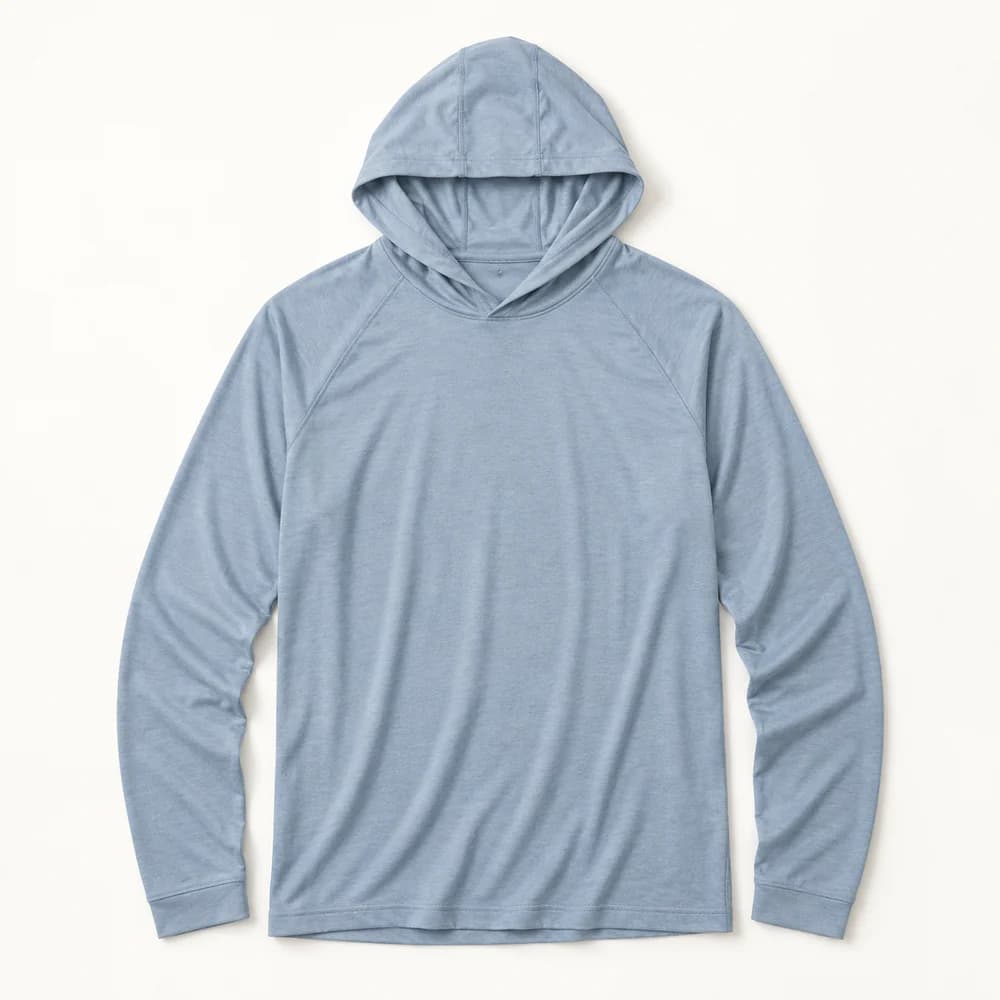
Choose it for high-output activity when breathability, quick drying, low garment weight, and odor control outweigh the desire for a UPF 50 label.
Outdoor Research publishes the most explicit lightweight performance package in this group: a 150-gram men’s garment, 100% recycled polyester, AirVent, quick drying, wicking, breathability, ActiveFresh odor control, flat seams, a three-panel hood, raglan sleeves, and thumbholes. The 28-inch center-back length gives a useful torso reference, and the men’s size chart currently spans XS through 3XL.
The critical tradeoff is protection level. Outdoor Research states UPF 15 for light colors and UPF 20 for dark colors. That is materially different from UPF 50 or 50+, and the color-specific statement must survive all the way from manufacturer page to the exact Amazon selection. A marketplace title that says only “sun hoodie” or repeats a generic UPF claim is not enough. Buyers who prioritize maximum covered-skin protection should choose a higher published rating instead.
Why it makes the shortlist
- • 150 g published garment weight
- • Quick-dry, wicking, breathable, and AirVent claims
- • ActiveFresh odor control
- • 28-inch length and XS–3XL size-chart coverage
Where the evidence stops
- • Only UPF 15 light / UPF 20 dark
- • No hood adjuster listed
- • No abrasion result despite ultralight construction
- • Color-specific UPF demands careful listing verification
Practical decision rules
Choose by your needs
For humid heat, prioritize adjustable ventilation
Start with Columbia’s explicit airflow construction or the Echo’s ultralight build. If the hood traps too much warmth, a ventilated collared shirt plus hat may be the better system.
For high UV exposure, do not blur UPF tiers
Baleaf, Columbia, and Crater Lake publish 50 or 50+. Echo publishes 15 or 20 depending on color. Treat that difference as a real decision, not a footnote.
For long torsos, buy measurements before features
Columbia publishes 29 inches, Echo 28 inches, and the checked Crater Lake Zip 27.3 inches. Baleaf publishes no length. Measurement method and size still need confirmation.
For multi-day wear, look for named odor control
Crater Lake lists HeiQ Mint and Echo lists ActiveFresh. Baleaf and Solar Stream do not list a treatment on the checked pages. Treatments reduce a problem; they do not replace washing.
For pack use, assume uncertainty
None of the four pages publishes a directly comparable abrasion rating. Inspect shoulder zones, avoid rough straps, and prefer a less delicate knit when continuous load matters.
For Amazon purchases, verify the model twice
Check the exact name and features before ordering, then check the sewn-in label and construction when it arrives. Return mismatches rather than rationalizing them.
Check the fit and care before keeping it
Model identity
Does the listing name match the exact manufacturer model, not merely the brand and “sun hoodie” category?
UPF and color
Is the published rating confirmed for the exact garment and selected color? This is especially important for the Echo.
Overhead reach
Raise both arms. The hem should keep the lower torso covered and the cuffs should not pull away from the hands.
Hood with your hat
Turn your head, look down, and face a fan. Check peripheral vision, neckline pressure, and whether the hood slides backward.
Pack contact
Load your usual pack for ten minutes. Check bunching at shoulders, neckline movement, and friction from rough webbing or hook-and-loop.
Return evidence
Keep packaging until the model, label, material, size, and visible construction match the page you intended to buy.
Buying questions
FAQ
Answers use the product sources listed below and the fit and care considerations discussed in this guide.
Can I trust Amazon star ratings for sun hoodies?
Use ratings only as a source of questions to investigate, not as specification evidence. Reviews can combine colors, sizes, old versions, and different sellers. Verify the exact model on the manufacturer page, then confirm the garment label and construction after delivery. This guide deliberately does not rank current stars or review counts.
Which sun hoodie is best for hot, humid weather?
Start with Columbia Solar Stream if you want a UPF 50 garment with an explicit airflow construction, or Outdoor Research Echo if maximum breathability and low weight matter more than a high UPF tier. No manufacturer here publishes a directly comparable humidity test. In still tropical heat, a vented button-up plus hat may release heat better than any closed hood.
Is UPF 15 or 20 enough for a sun hoodie?
It is a lower protection tier than UPF 50, and that tradeoff should be intentional. Outdoor Research states UPF 15 for light Echo colors and UPF 20 for dark colors. Buyers with prolonged exposure, high UV, reflective water or sand, or a strong coverage priority may prefer a confirmed UPF 50 garment. Clothing still needs to be combined with protection for exposed skin.
Which option has the best odor control?
The checked Mountain Hardwear Crater Lake Zip page lists HeiQ Mint, while Outdoor Research lists ActiveFresh on the Echo. The checked Baleaf AGA030 and Columbia Solar Stream pages do not list an odor treatment. Those labels do not provide a directly comparable odor-duration result and do not eliminate care requirements.
Will an ultralight sun hoodie survive backpack straps?
No exact durability conclusion is possible from the current product pages because none publishes a comparable abrasion rating. Lightweight fabric can be more vulnerable to rough straps, snags, and hook-and-loop contact, but construction and fit also matter. Inspect shoulder zones and avoid claiming a mileage lifespan that the evidence does not support.
How do I know whether the hood will stay on in wind?
Look for a closure, binding, drawcord, or cap-compatible three-panel structure. None of these four checked pages publishes a standardized wind-retention test. Try the hood over your normal hat, turn your head fully, and face a fan. If it slides back indoors, it will not become more secure on an exposed ridge.
Should I size up for more airflow?
A slightly relaxed fit can create air space and reduce cling, but oversizing can destabilize the hood, move seams under pack straps, and shorten effective hand coverage. Start with the manufacturer chart, then use overhead reach and hood-turn tests. Columbia labels Solar Stream Regular Fit; Mountain Hardwear labels Crater Lake Standard Fit.
Why might an Amazon product become a search fallback?
A product card appears only when the returned listing can be matched to the evaluated model. If the listing is unavailable or its title and features do not match, the guide automatically falls back to a broader tagged search instead of presenting a questionable direct match. The manufacturer page still defines the evaluated specification set, and every Amazon size, color, seller, price, and return term needs verification before ordering.
Continue your research
Best Sun Hoodies
Use the broader climate-and-activity matrix before narrowing to marketplace availability.
Echo vs. Sahara vs. Sombra
Compare three popular hiking-oriented hoodies with a deeper fit and climate decision aid.
Coolibar vs. Columbia vs. Baleaf
Compare coverage-first, humid-heat, and value brand directions.
Sun Hoodie Buyer’s Guide
Understand hood geometry, cuffs, fabric, and coverage before selecting a model.
Merino vs. Synthetic
Explore odor, drying, durability, and pack-use tradeoffs by fiber category.
How We Evaluate
See the source hierarchy and evidence limits behind SleeveShirts guides.
Sources and research transparency
The manufacturer pages below support the product specifications. The source notes identify their scope and any unresolved details.
- Baleaf AGA030 official product page ↗: UPF 50+, material, hood, thumbholes, seams, drying, and current size selector.
- Columbia PFG Solar Stream official product page ↗: UPF 50, Air Flow, Omni-Wick, fit, material, cuffs, and center-back length.
- Mountain Hardwear Crater Lake Zip official product page ↗: UPF 50, hood, thumbholes, material, fabric mass, length, and odor control.
- Outdoor Research Echo official product page ↗: Color-dependent UPF, garment weight, length, material, airflow, drying, and odor control.
- CDC Sun Safety Facts ↗: Layered sun-protection guidance for clothing, shade, hats, sunglasses, and sunscreen.
- Reddit humid-weather question thread ↗: Question discovery only: humidity, airflow, fit, and durability concerns.
- Reddit hood-and-pack-wear question thread ↗: Question discovery only: hood movement and strap-friction concerns.
- Columbia Men’s PFG Solar Stream Hoodie (2069181) ↗: Exact model, dated cost and care check: October 10, 2026.
- Outdoor Research Men’s Echo Hoodie (287625) ↗: Exact model, dated cost and care check: October 10, 2026.