Merino Wool vs. Synthetic:
Fit, Odor and Care
Choose the fabric and garment for your trip, laundry access and expected weather.
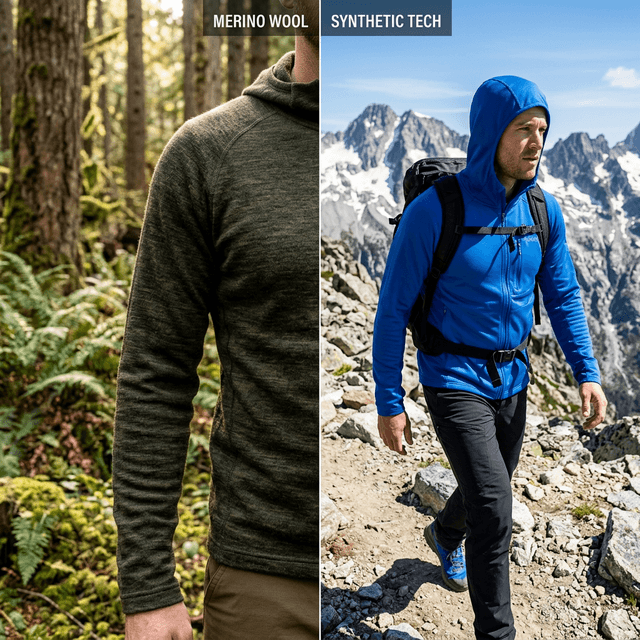
⚡ 2026 Performance Briefing
- 01Reinforced wool construction: Compare reinforced wool constructions at the garment level. A branded yarn claim does not establish the abrasion resistance of every shirt.
- 02Odor management: Check whether the exact synthetic garment documents an odor-control treatment and its durability.
- 03Climate and drying: Drying depends on the shirt, water removal, airflow and humidity. There is no humidity cutoff that makes one fiber the automatic winner.
- 04Material claims: Recycled or plant-based content does not by itself prove biodegradability or a lower total environmental impact.
Choose for your trip
Hikers can reasonably prefer different fabrics depending on the trip. Start with the practical checks: Breathability, Durability, and Odor Control.
Compare the complete garment. Merino, wool blends and synthetics can differ in feel, drying, care and odor retention, but neither fiber category fits every hiker or climate.
This guide covers fiber construction, odor management and practical try-on checks. Branded yarn technologies need model-specific evidence rather than assumed advantages across a whole category.
1. The Molecular Science: Scales vs. Cylinders
Fiber properties differ, while yarn construction, knitting and finishes affect the shirt you wear.
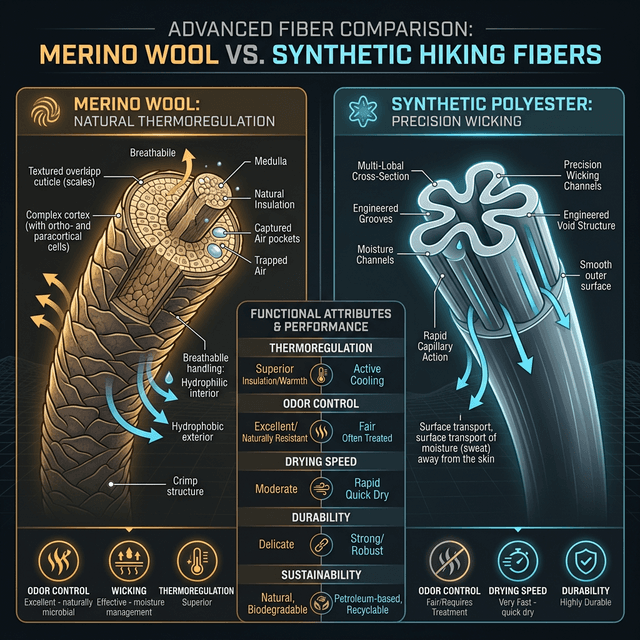
Editorial fiber illustration. It is not a scanning electron microscope image or a measured comparison.
The Merino Mystery: The Cuticle Factor
Wool interacts with moisture differently from polyester. Compare the garment's blend, fabric weight and care instructions before judging how comfortable it will feel.
How damp a shirt feels depends on the fabric and conditions. A moisture-management claim does not guarantee dry skin during exertion.
Synthetic Precision: The Extrusion Engine
Polyester and nylon yarns can have different shapes and constructions. Check which features are actually documented for the garment.
Capillary action can spread liquid through fabric, increasing the area available for evaporation. Drying still depends on the garment and conditions.
2. Odor Control: The Science of "Perma-Stink"
Polyester can retain oils and odor compounds. Washing routine, construction and any documented treatment can affect how a specific shirt smells.
⚠️ Technical Warning: Biofilm
Odor may return when a washed shirt warms up. This is not proof of one universal biofilm mechanism or a fixed odor-free lifespan.
Wool can be useful for odor management, but it is not sterile and does not eliminate washing. Check the wearer’s comfort and the garment's care requirements.
3. Thermoregulation & The "Chill Effect"
Plan for rest stops and changes in weather.
A damp shirt can feel cold when effort stops, especially with wind or falling temperatures. Carry suitable dry or insulating layers for the route.
Do not treat wool's moisture properties as a guarantee of warmth. The whole clothing system and weather matter.
4. NuYarn® and Core-Spun Construction
Wool garments differ in construction and care. Reinforced yarns may address specific weaknesses, but do not make every merino shirt immune to wear or shrinkage.
NuYarn® Technology
NuYarn is a branded yarn technology. Check the exact garment and the scope of any manufacturer comparison rather than applying universal drying or warmth multipliers.
Core-Spun Nylon
Core-spun yarn combines fibers in one construction. Check the blend and any published abrasion information; it does not guarantee a thousand miles of backpack wear.
5. What to Compare Before Buying
| Metric | Merino and wool blends | Synthetic garments |
|---|---|---|
| Odor Control | Check odor management and wash needs | Check any named finish and care instructions |
| Drying Speed | Depends on construction and conditions | Depends on construction and conditions |
| Abrasion Resistance | Compare blend and abrasion information | Compare construction and abrasion information |
| UV Protection (UPF) | Verify the exact garment’s UPF | Verify the exact garment’s UPF |
| Wet Insulating Power | Plan a suitable insulating layer | Plan a suitable insulating layer |
6. Sustainability: The PFAS-Free Shift
Verify any PFAS or water-repellency claim on the exact garment. A general industry trend does not establish the chemistry of a particular shirt.
For wool, check the scope of animal-welfare certifications such as ZQ. For synthetics, verify recycled content and actual recycling access. Neither claim establishes an indefinitely closed material loop.
7. Activity-Specific Recommendation Guide
Mountain Base Layers
Consider for multi-day trips where odor management and care fit your routine.
- • Consider a merino blend if its fit and care suit the trip
- • Use Case: 3-5 day thru-hikes.
- Benefit to compare: odor management between washes.
Desert & Jungle Gear
Consider for active days where fit and drying requirements match the garment.
- • Consider a synthetic model if its fit and care suit the trip
- • Use Case: Day runs, Canyon hiking.
- Benefit to compare: drying and documented garment UPF.
8. The Maintenance Matrix
Wool care
Follow the wool garment's wash and drying instructions.
Synthetic care
Follow the synthetic garment's care label, including softener restrictions.
Two examples of why care and construction matter
Patagonia Capilene Cool Daily 45181 is a regular-fit polyester long sleeve with HeiQ Mint, a published 153 g total weight and warm wash/low tumble care without softener. Smartwool Classic All-Season SW016952 is a slim 88% merino/12% recycled-nylon layer with warm gentle wash/low tumble care. Neither checked product page supplies a current UPF number. Details checked October 10, 2026; use the base-layer comparison for dated prices and trade-offs.
Woolmark’s research explains wool-related odor evidence. Nuyarn’s comparisons concern its yarn construction and stated reference material; they do not justify performance multipliers for every wool shirt. Use the garment label for care, supported by Woolmark’s care guidance.
Frequently asked questions: merino versus synthetic
Is Merino wool too warm for summer hiking in 2026?+
Why do some synthetic shirts smell faster than others?+
Which fabric offers better sun protection (UPF)?+
Is Merino Wool more sustainable than recycled polyester?+
Can I wear Merino wool if I have sensitive skin?+
Choose for Your Trip
Try on the shirt with your pack and planned layers.
Choose the shirt whose fit, care and coverage suit your trip. Consider wool for odor management and synthetics for the specific drying or construction features you need, while checking the exact garment.
Ready to Upgrade Your Kit?
Compare the hiking-shirt guides before choosing a fabric or model.