Huk vs Columbia PFG vs AFTCO: Which Fishing Shirt Fits Your Trip?
Specification-based editorial guide, not a hands-on product test. Sources checked October 10, 2026. How we evaluate
Affiliate disclosure: qualifying Amazon purchases may earn us a commission. Buttons open model searches, not guaranteed listings.
Direct answer
Pick the evidence advantage that matches your hardest day
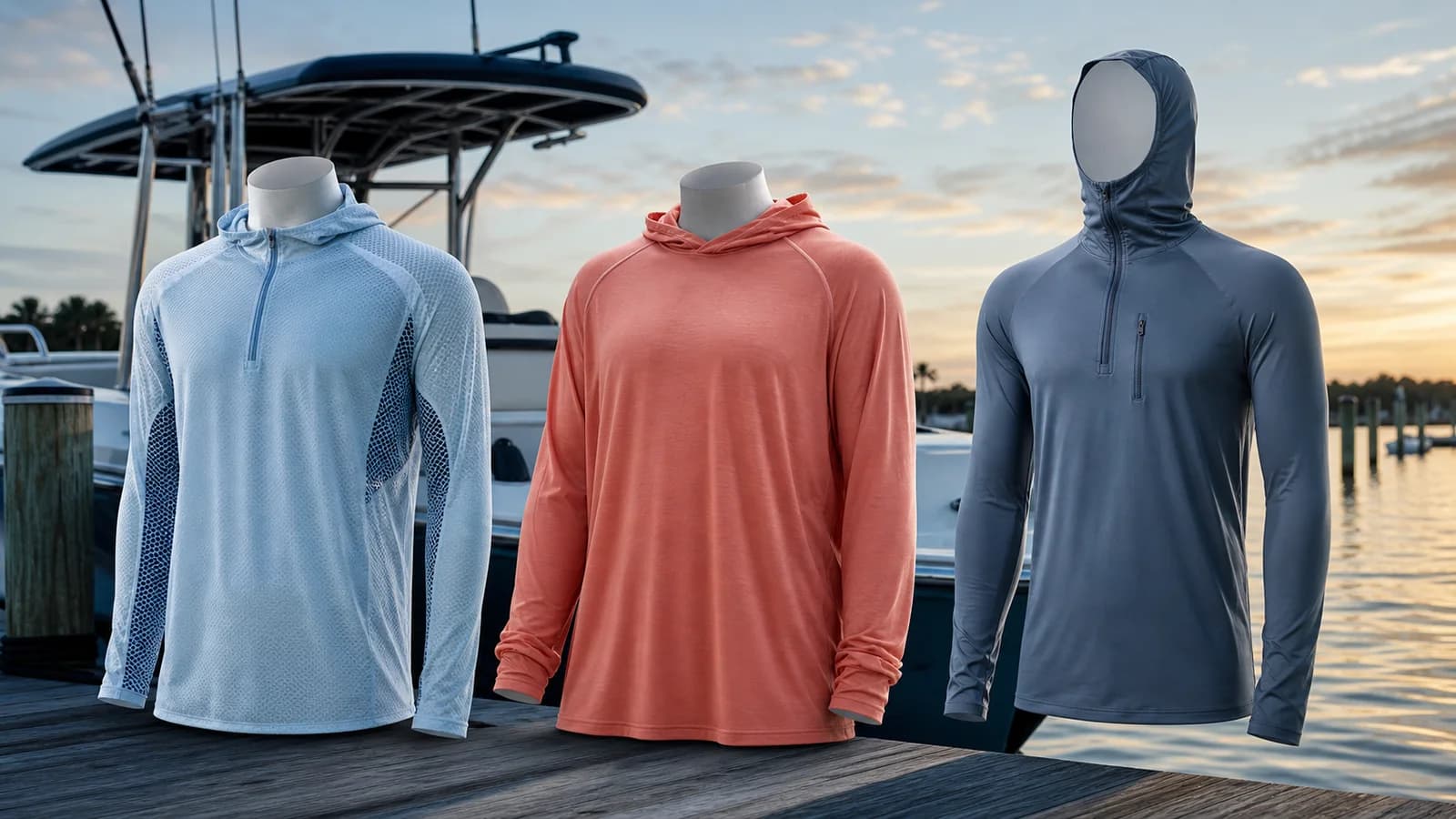
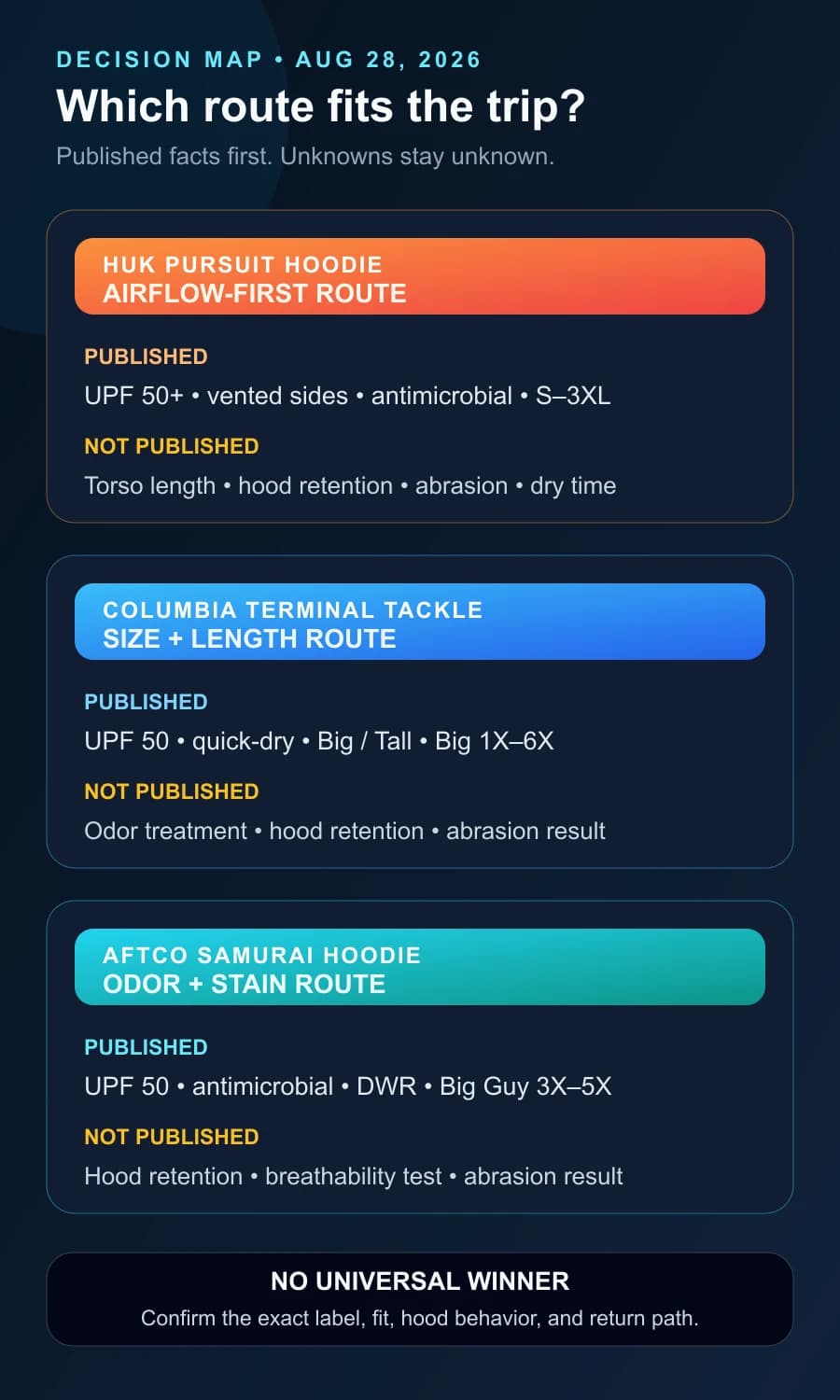
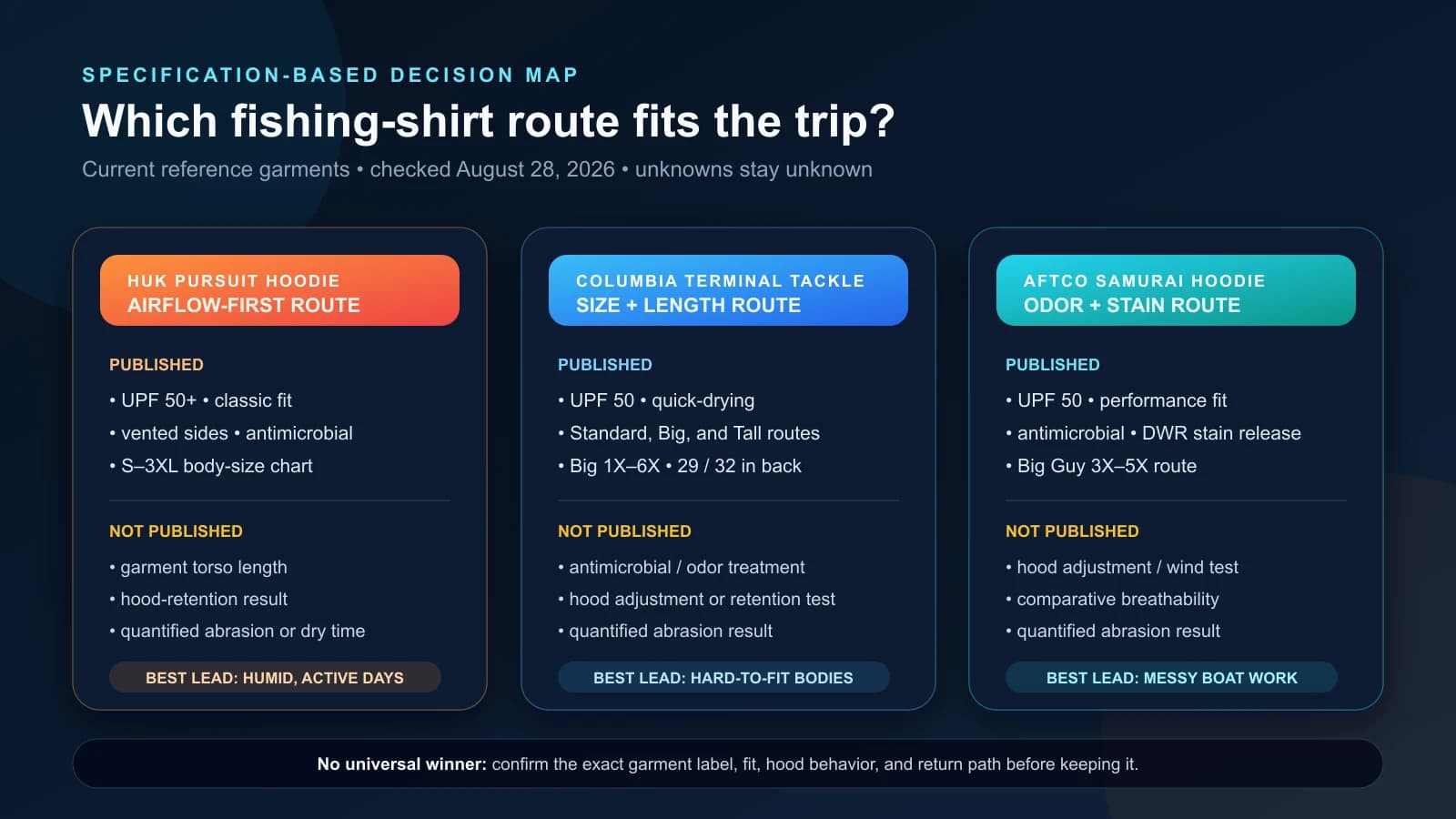
Start with Huk Pursuit when vented sides and a published antimicrobial treatment matter most in humid heat. Start with Columbia PFG Terminal Tackle when Big, Tall, center-back length, and a very broad extended-size route reduce fit risk. Start with AFTCO Samurai when odor control plus a published DWR stain-resistant finish matter around bait, sunscreen, and boat grime. All three reference hoodies publish UPF 50 or 50+; none publishes a comparable hood-retention, backpack-abrasion, or timed-drying test, so those unknowns should not be converted into scores.
Huk Pursuit Performance Hoodie
Vented sides, classic fit, UPF 50+, and an antimicrobial treatment are currently published. Choose it for the clearest airflow-first specification set, not because of an invented cooling score.
Columbia PFG Terminal Tackle Hoodie
Standard, Big, and Tall routes, published center-back lengths, plus a separate 1X–6X Big range make this the easiest place to start when torso room or length is the buying problem.
AFTCO Samurai Sun Protection Hoodie
The current page combines UPF 50, antimicrobial odor control, quick-dry and moisture-wicking claims, and DWR stain resistance in one performance-fit reference garment.
Fit and hood check before loyalty
Brand reputation cannot tell you whether a hood stays up at boat speed or whether the hem remains covered while casting. Keep the garment only after a dry fit-and-motion check.
Visual decision aid
Start with the buying decision
How we compared
Selection and price references
This comparison uses one current hooded reference garment from each brand: Huk Pursuit Performance Hoodie, Columbia PFG Terminal Tackle Hoodie, and AFTCO Samurai Sun Protection Hoodie. That keeps the evidence comparable. A feature found on another shirt in a brand collection is not silently transferred to the reference garment.
We recorded only facts visible on current manufacturer pages and size charts: manufacturer-stated UPF, fit language, published size routes, length information, ventilation construction, quick-dry or moisture-management language, antimicrobial treatment, and stain-resistance claims. We did not use marketplace star ratings, temporary prices, “best seller” labels, or Reddit anecdotes as product-performance evidence.
This is not a field test. We did not run boat-speed hood trials, a climate chamber, an odor panel, a saltwater wash protocol, a backpack-abrasion machine, or a timed drying comparison. When no comparable result is published, the table says “not published.” The editorial recommendation is a fit between published features and a use case, not a laboratory ranking.
Prices and care references checked October 10, 2026 on the exact US model pages. Prices are for one shirt before tax and shipping, not live Amazon offers. Confirm any unpublished care instruction on the garment label.
Decision table
Compare the fields that change comfort and coverage
For an unpublished specification, check the manufacturer or garment label before relying on it.
| Decision field | Huk Pursuit Hoodie | Columbia Terminal Tackle Hoodie | AFTCO Samurai Hoodie |
|---|---|---|---|
| Dry / hot climate | Lightweight polyester and vented sides make it a logical active-heat starting point; no comparative temperature result is published. | Lightweight 100% polyester, Omni-Wick, and quick-drying treatment are published; no mesh-zone claim on this reference page. | Lightweight polyester/spandex jersey, moisture wicking, and quick-dry are published; no comparative cooling result. |
| Humid / hot climate | The clearest airflow-first route because the page specifically publishes vented sides and superior breathability; still not a measured humidity test. | Wicking and quick-dry claims help moisture management, but the page does not publish antimicrobial treatment or vent panels for this hoodie. | Quick-dry plus antimicrobial treatment can help the use case, but the page does not publish a vented-mesh construction. |
| Hood stability | Hood is present. Adjustment, face opening, drawcord, and boat-speed retention results are not published. | Manufacturer calls it a lightweight hood for neck and ear coverage. No adjustment or wind-retention result is published. | Hood is present. Adjustment and boat-speed retention results are not published on the current product page. |
| Torso / sleeve length | Garment torso length is not published. Body-size chart lists center-back sleeve ranges from 33–34 to 38 inches across S–3XL. | Standard center-back length: 29 inches. Separate Big page: 32 inches. Raglan sleeves are published; garment sleeve length is not. | Standard garment dimensions are not published. Separate Big Guy page lists body length 33–35 inches and center-back sleeve 34.75–37.25 inches for 3X–5X. |
| Size range | Current men’s chart shows S–3XL; body measurements, not garment measurements. | Standard route shows XS–XXL with Big and Tall options; separate Big listing shows 1X–6X. Color and stock vary. | Performance-fit standard route plus a separate Big Guy Samurai route in 3X–5X. Availability varies by color and version. |
| Geruchskontrolle / odor control | Manufacturer publishes an antimicrobial treatment. No odor-duration or wash-life result is provided. | No antimicrobial or odor-control claim is published on the reference hoodie page. | Manufacturer publishes an antimicrobial treatment for odor control. No quantified wash-life result is provided. |
| Backpack / boat abrasion | No quantified abrasion, pilling, rail-rub, or pack-friction result is published. | No quantified abrasion, pilling, rail-rub, or pack-friction result is published. | No quantified abrasion, pilling, rail-rub, or pack-friction result is published. DWR stain resistance is not an abrasion rating. |
| Drying | Breathability is claimed, but the current Pursuit page does not publish a timed dry result. | Quick-drying treatment and Omni-Wick moisture dispersal are published; no minutes-to-dry result. | Quick-dry and moisture-wicking are published; no minutes-to-dry result. |
| Confirmed manufacturer UPF | UPF 50+ on the current reference page. | Omni-Shade Broad Spectrum UPF 50 on the current reference page. | UPF 50 on the current reference page. |
| Fit | Classic fit. | Relaxed fit on the standard hoodie; Regular fit on the separate Big version. | Performance fit; the separate Big Guy version is described as Regular fit. |
| Stain resistance | No stain-release or DWR claim is published on the current Pursuit reference page. | No stain-release claim is published on the current Terminal Tackle reference page. | DWR stain resistant / stain release is published on the Samurai reference page. |
| Best evidence-led use | Humid, active fishing when vented sides and published antimicrobial treatment matter. | Buyers prioritizing size breadth, Big/Tall routes, and published back length. | Messy fishing days when odor-control and stain-resistance claims matter together. |
| USD per shirt · checked October 10, 2026 | $50; Black/S reference | Standard-variant price not verified; confirm the selected color and size | $45; Sepia Heather/S reference |
| Care · exact checked model | Full wash/dry instructions were not visible on the checked Black product page; use the garment label. | Machine wash; no bleach; tumble dry; iron; no dry-clean. Temperatures are not supplied in the online care summary. | Full wash/dry instructions were not visible on the checked product page; follow the garment label. |
Source review: October 10, 2026. A missing published result is not a performance score.
Airflow-first route
Huk Pursuit Performance Hoodie

Best starting point here for humid, active days when vented sides and a published antimicrobial treatment matter more than documented torso length or extended sizing.
Huk’s current Pursuit Performance Hoodie page publishes a straightforward specification set: 100% polyester, UPF 50+, antimicrobial treatment, a classic fit, and vented sides. That combination makes it the most direct airflow-first route in this three-product comparison. It is reasonable to connect side ventilation with an airflow-oriented design; it is not reasonable to call the garment objectively cooler than its competitors without a controlled comparison.
The product page’s body-size chart is useful but easy to misread. It lists chest, neck, waist, and center-back sleeve ranges for S through 3XL. Those are body measurements, not a measured garment chest or torso length. Buyers with a long torso therefore still need a try-on or a retailer with easy returns. Published sleeve ranges help narrow a starting size, but they do not answer whether the cuff remains covered during a full cast.
The hood is the main unresolved variable. The page shows and names a hoodie, but it does not publish a drawcord, structured opening, boat-speed retention protocol, or comparative hood depth. Anglers who run open water should put the hood up, turn the head, mimic casting, and use a fan or safe low-speed dockside check before removing tags. Do not infer retention from the product photography.
For odor, the manufacturer does publish an antimicrobial treatment. That supports saying the garment includes an odor-management treatment; it does not establish how many wears it stays fresh or how the treatment performs after repeated washing. Care practices, detergent residue, body chemistry, and drying between uses still matter.
Why it makes the shortlist
- • Current page confirms UPF 50+
- • Vented sides and breathability language support an airflow-first use case
- • Antimicrobial treatment is explicitly published
- • S–3XL body-size chart includes center-back sleeve ranges
Where the evidence stops
- • No garment torso length
- • No hood-retention or wind result
- • No quantified drying time
- • No abrasion or pack-friction result
- • No antimicrobial wash-life claim
Fit-range route
Columbia PFG Terminal Tackle Hoodie
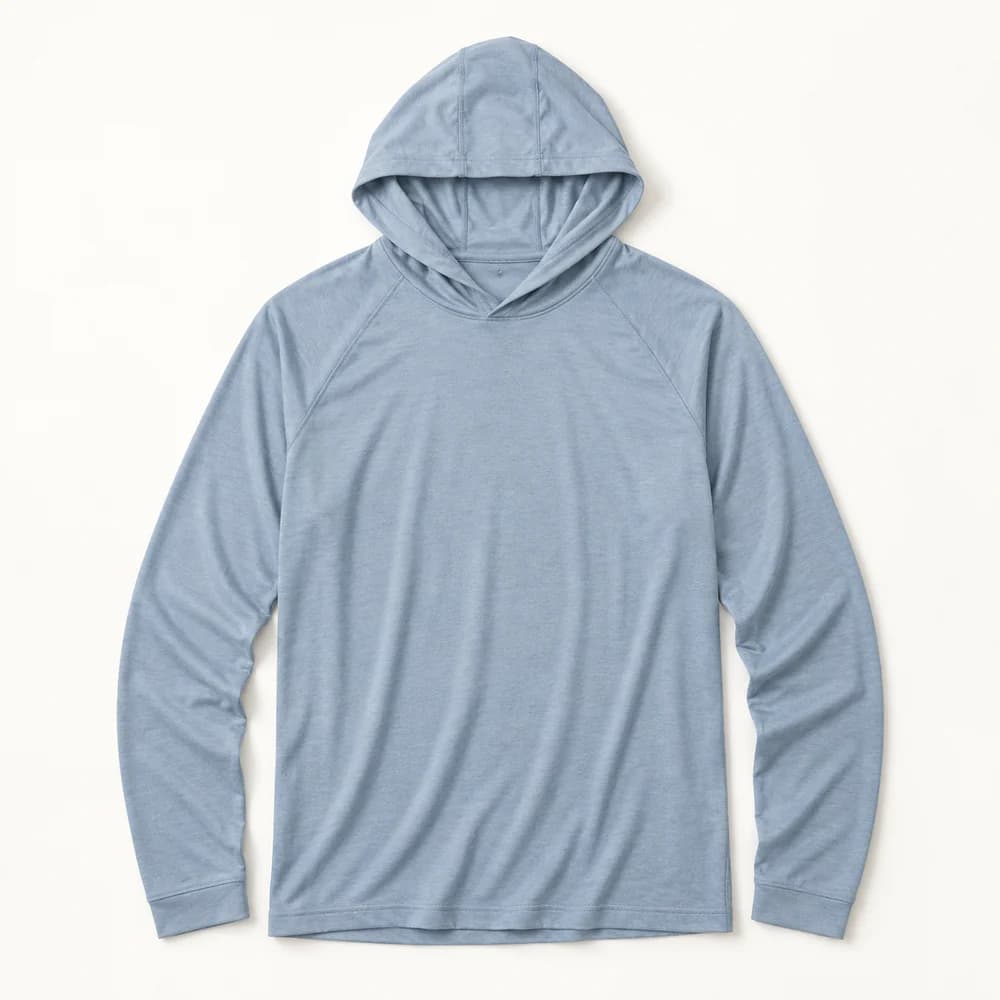
Best starting point for buyers who need published center-back length plus Standard, Big, or Tall paths—and especially for an extended Big range reaching 6X.
Columbia’s current Terminal Tackle Hoodie page confirms Omni-Shade Broad Spectrum UPF 50, Omni-Wick moisture management, a quick-drying treatment, raglan sleeves, a lightweight hood, and a relaxed fit. Those are meaningful published facts. They support a general fishing and hot-weather use case, but they do not establish that Columbia dries faster than Huk or AFTCO because no shared timed protocol is provided.
The strongest differentiator is fit documentation. The standard page publishes a 29-inch center-back length and routes shoppers toward Standard, Big, and Tall sizing. A separate Big product page publishes a 32-inch center-back length and a 1X–6X range. That is unusually useful for people who routinely find that sun hoodies stop above the waistband, pull across the chest, or lose wrist coverage during casting.
Size breadth does not remove the need to check the exact version. Columbia product pages can separate Standard, Big, and Tall variants, and colors or inventory can differ. Confirm whether a length value belongs to the exact SKU in the cart. The standard product is described as Relaxed Fit while the separate Big listing is described as Regular Fit, so the label should be read rather than assumed.
The current reference page does not publish an antimicrobial or odor-control treatment. That is not evidence that the shirt will smell; it means odor control should not be sold as a confirmed feature. It also does not publish a drawcord or hood-retention result. The hood is described as lightweight coverage for the neck and ears, which is useful, but boat-speed stability remains a try-on question.
Why it makes the shortlist
- • Current page confirms Broad Spectrum UPF 50
- • Quick-dry treatment and Omni-Wick are explicitly published
- • Standard, Big, and Tall routes reduce fit risk
- • 29-inch standard and 32-inch Big center-back lengths are published
- • Separate Big route reaches 1X–6X
Where the evidence stops
- • No antimicrobial or odor-control claim on the reference page
- • No hood adjustment or wind-retention result
- • No quantified drying comparison
- • No abrasion or rail-rub result
- • Fit labels vary between reference versions
Odor-and-stain route
AFTCO Samurai Sun Protection Hoodie

Best starting point for bait, sunscreen, and boat-grime exposure because the current page combines antimicrobial odor control, quick-dry moisture management, and DWR stain resistance.
AFTCO’s current Samurai hoodie page publishes a 92% polyester and 8% spandex jersey knit, UPF 50, antimicrobial odor control, quick-dry and moisture-wicking performance, and DWR stain resistance. Within this comparison, it is the only reference page that explicitly combines odor and stain-management claims. That makes it the clearest boat-mess route without pretending that a DWR claim is a laboratory stain score.
The spandex blend and Performance Fit point toward a closer, stretchier cut than Columbia’s relaxed standard hoodie. A close fit can improve control during casting, but too much stretch can also change comfort and coverage. Buyers between sizes should raise both arms, rotate the torso, and make a full casting motion. If the hem lifts or the fabric becomes visibly over-tensioned across shoulders and stomach, the next size or Big Guy route deserves consideration.
AFTCO also publishes a separate Big Guy Samurai hoodie in 3X, 4X, and 5X. That page provides garment-oriented body length from the high-point shoulder—33, 34, and 35 inches—and center-back sleeve lengths of 34.75, 36, and 37.25 inches. These measurements are valuable, but they belong to the Big Guy reference and should not be copied onto the standard Performance Fit garment.
As with the others, the hood is not a scored feature here. The page does not publish drawcord details, opening measurements, or a boat-speed retention protocol. DWR stain resistance also should not be confused with abrasion durability: the page does not quantify pilling, backpack rub, gunwale contact, or hook snagging.
Why it makes the shortlist
- • Current page confirms UPF 50
- • Antimicrobial treatment is explicitly published
- • Quick-dry and moisture-wicking claims are published
- • DWR stain resistance is published
- • Separate Big Guy 3X–5X page includes useful length measurements
Where the evidence stops
- • No comparative stain or odor score
- • No antimicrobial wash-life claim
- • No hood-retention or wind result
- • No quantified breathability result
- • No abrasion or snag protocol
Practical decision rules
Choose by your needs
Choose Huk when airflow construction is the lead requirement
Vented sides plus published breathability and antimicrobial treatment make Pursuit the clearest humid-heat specification route. Do not translate that into an unmeasured temperature advantage.
Choose Columbia when fit failure is the expensive risk
Standard, Big, Tall, published center-back lengths, and the separate 1X–6X route give shoppers more documented paths before ordering.
Choose AFTCO when bait and grime are routine
Samurai is the only reference garment here whose current page combines antimicrobial treatment and DWR stain resistance with quick-dry language.
Treat every hood as unverified until it survives your motion check
None of the three current pages provides a comparable boat-speed retention test. Hood presence is confirmed; stability is not.
Treat backpack abrasion as unknown for all three
No current reference page publishes a comparable pack-friction or pilling result. If you carry gear, inspect the shoulder and lower-back zones during the return window.
Ignore temporary price gaps until the product identity is confirmed
A cheaper listing can be an older fabric, a different fit, a crew instead of a hoodie, or a marketplace seller. Verify model name, UPF, size chart, return path, and garment label first.
Check the fit and care before keeping it
Confirm the exact model
Match the listing title and garment label to Pursuit Performance Hoodie, Terminal Tackle Hoodie, or Samurai Sun Protection Hoodie. Do not transfer features from a neighboring line.
Raise, reach, and cast
With the hood up, raise both arms, rotate the shoulders, and mimic a full cast. Reject a hem that exposes the waist or cuffs that retreat excessively.
Test the hood safely
Turn the head, bend forward, and use a fan or safe stationary airflow. A boat run is not the place to discover that the hood collapses or blocks peripheral vision.
Inspect measurement type
Body-size charts and garment measurements are not interchangeable. Confirm whether chest, sleeve, and body length describe you or the shirt.
Check carry-contact zones
If you use a backpack, PFD, sling, or shoulder strap, inspect seams and fabric where the gear rubs. No brand here provides a comparable abrasion score.
Read the care label before washing
Treatments and stretch fibers can have specific care requirements. Follow the exact garment label rather than a generic brand-care assumption.
Buying questions
FAQ
Answers use the product sources listed below and the fit and care considerations discussed in this guide.
Which is better for hot, humid fishing: Huk, Columbia PFG, or AFTCO?
Huk Pursuit is the clearest airflow-first starting point because its current page publishes vented sides, breathability, and antimicrobial treatment. Columbia publishes wicking and quick-dry treatment, while AFTCO publishes quick-dry plus antimicrobial treatment. No shared humidity or temperature test proves an absolute winner, so fit and hood behavior still decide the real result.
Which brand has the most useful big-and-tall sizing?
For these exact reference hoodies, Columbia publishes the broadest route: Standard, Big, and Tall, plus a separate Big listing from 1X through 6X and center-back lengths. AFTCO offers a documented Big Guy Samurai route from 3X to 5X with useful body and sleeve lengths. Huk’s current men’s chart runs S through 3XL.
Will the hood stay on while the boat is moving?
The current pages confirm that the garments have hoods, but none provides a comparable boat-speed retention result. Columbia describes a lightweight hood; Huk and AFTCO do not publish a retention protocol. Check the face opening, head-turn comfort, and stability in safe stationary airflow before removing tags.
Does Columbia PFG have odor control?
The current Terminal Tackle Hoodie page reviewed here does not publish an antimicrobial or odor-control treatment. That does not prove the shirt will smell; it means odor control is not a confirmed feature for this comparison. Huk Pursuit and AFTCO Samurai do publish antimicrobial treatments.
Is AFTCO automatically more durable because it has DWR?
No. DWR is a water- and stain-management finish, not an abrasion score. AFTCO’s current page supports a stain-resistance claim, but it does not quantify backpack rub, rail contact, pilling, or hook snagging. Durability remains an evidence gap for all three reference garments.
Do Huk, Columbia PFG, and AFTCO all publish UPF 50?
For the exact current reference pages checked, Huk publishes UPF 50+, Columbia publishes Omni-Shade Broad Spectrum UPF 50, and AFTCO publishes UPF 50. Recheck the exact listing and sewn label because ratings can differ between old models, regional versions, and neighboring product lines.
Which one dries fastest?
There is no comparable timed result. Columbia publishes a quick-drying treatment and Omni-Wick. AFTCO publishes quick-dry and moisture wicking. Huk Pursuit publishes breathability and vented sides, but the current reference page does not provide minutes-to-dry. A numerical winner would be invented.
Can Reddit decide which fishing-shirt brand is best?
Reddit is useful for finding recurring questions about heat, fit, hood stability, smell, and durability. It is not controlled evidence of product performance. Use community discussions to build the checklist, then verify claims on current manufacturer pages and use your return window for fit-dependent questions.
Continue your research
Best Fishing Sun Hoodies
Compare additional reference hoodies by boat wind, humid heat, fit, odor, drying, carry wear, and current manufacturer UPF.
Best Fishing Shirts
Expand beyond these three brands and decide whether a hooded knit or vented button-up better fits the day.
Fishing Apparel Guide
Build a complete on-water clothing system around sun, spray, wind, temperature, and mobility.
Best Sun Hoodies
Compare hiking, running, fishing, and travel routes with the same evidence boundaries.
UPF 50 vs UPF 30
Understand what the laboratory rating measures—and what it cannot tell you about fit or coverage.
How SleeveShirts Evaluates Gear
See how manufacturer facts, editorial reasoning, unknowns, and affiliate links are separated.
Sources and research transparency
The manufacturer pages below support the product specifications. The source notes identify their scope and any unresolved details.
- Huk — Pursuit Performance Hoodie ↗: Current reference for UPF 50+, vented sides, antimicrobial treatment, classic fit, materials, and S–3XL body-size chart.
- Columbia — PFG Terminal Tackle Hoodie ↗: Current reference for UPF 50, Omni-Wick, quick-dry treatment, hood, raglan sleeves, fit, and 29-inch center-back length.
- Columbia — Terminal Tackle Hoodie Big ↗: Separate reference for 1X–6X Big sizing and 32-inch center-back length.
- AFTCO — Samurai Sun Protection Hoodie ↗: Current reference for UPF 50, performance fit, antimicrobial, quick-dry, moisture-wicking, and DWR stain resistance.
- AFTCO — Big Guy Samurai Hoodie ↗: Separate reference for 3X–5X sizing and published body and center-back sleeve lengths.
- CDC Yellow Book — Sun Exposure in Travelers ↗: Official guidance on protective clothing, reflected UV, shade, and sunscreen for exposed skin.