UPF 30 vs UPF 50: The Real Difference in Sun Shirts
Specification-based editorial guide, not a hands-on product test. We checked current manufacturer pages on August 28, 2026. Prices, marketplace ratings, sellers, colors, and inventory change and are deliberately not ranked.
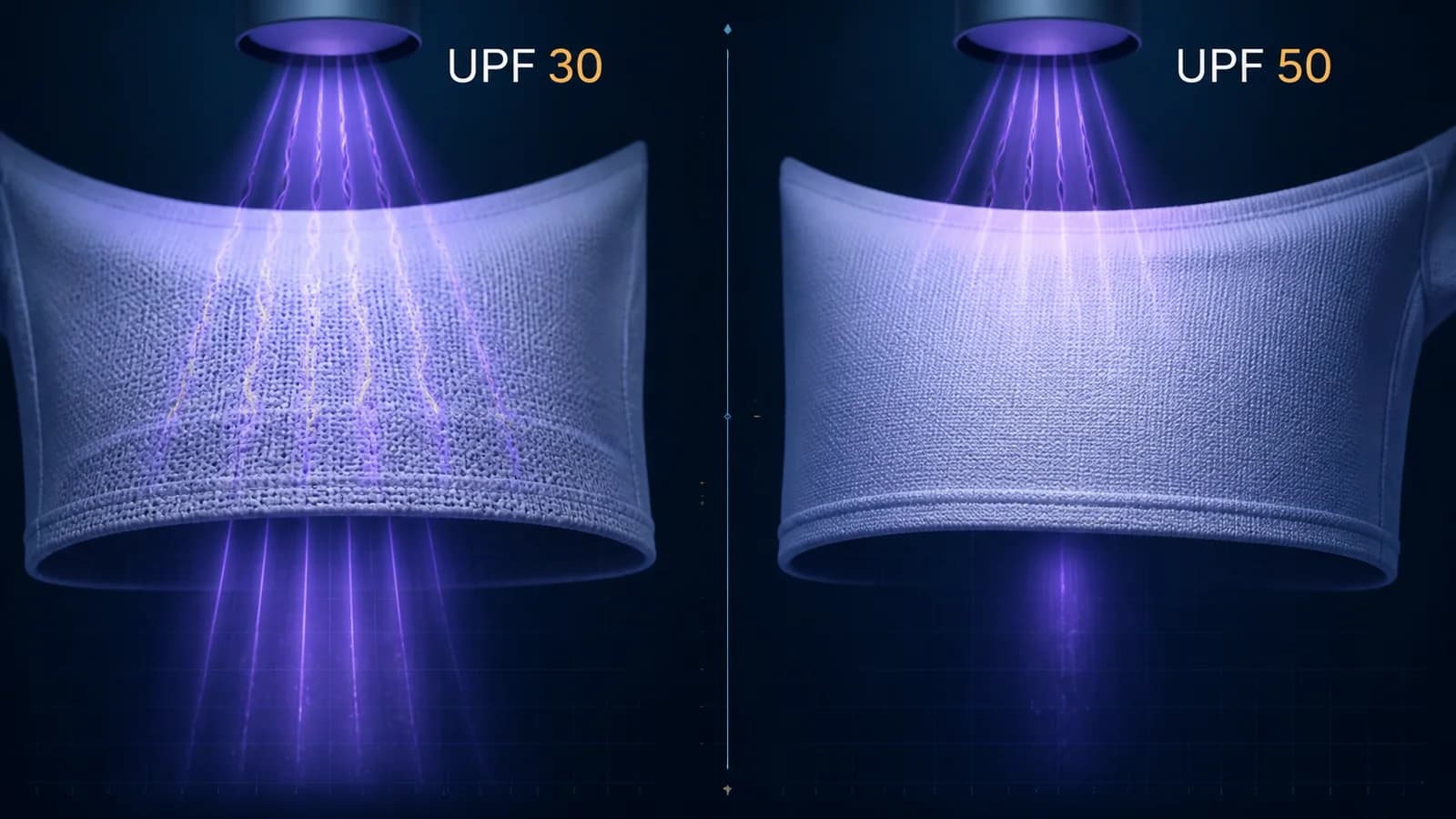
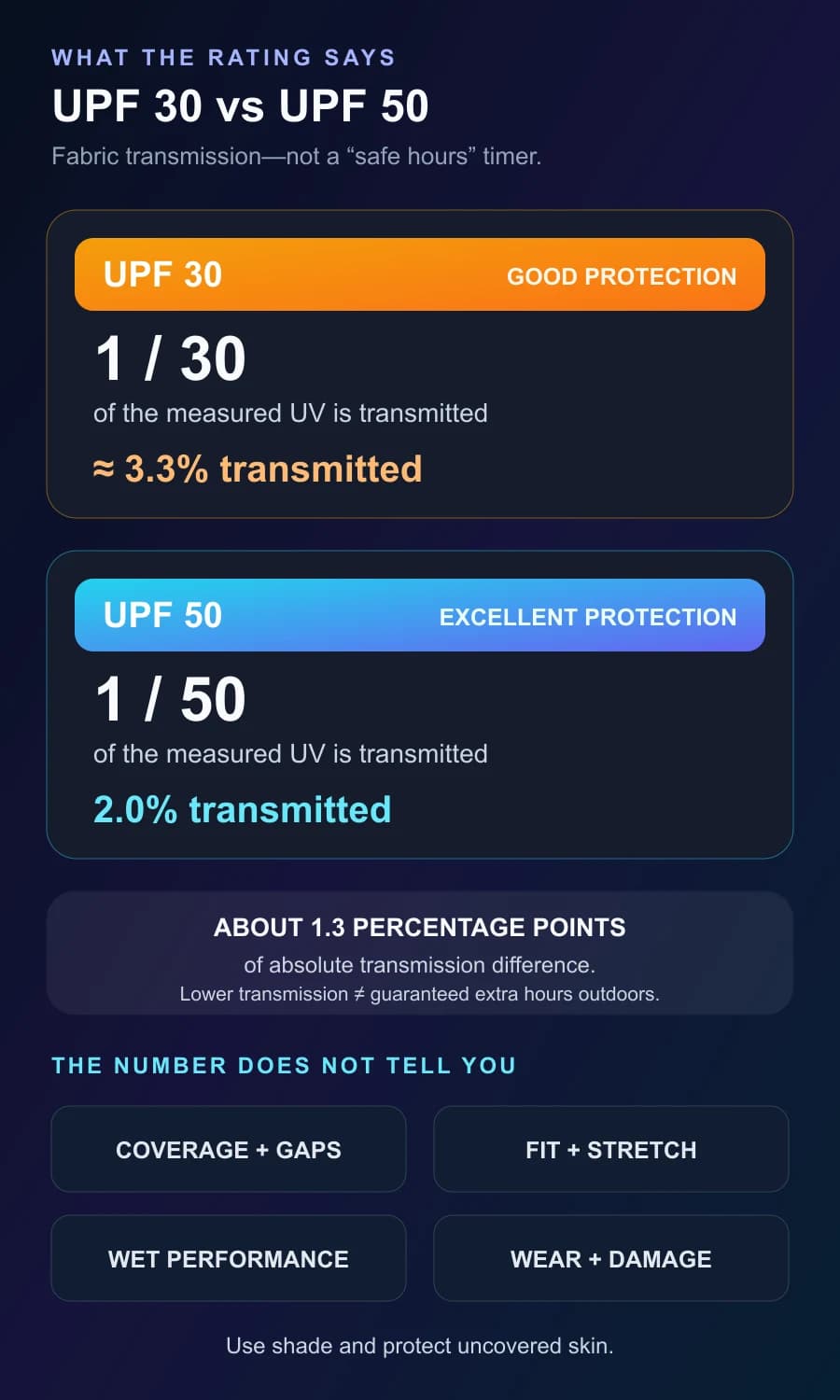
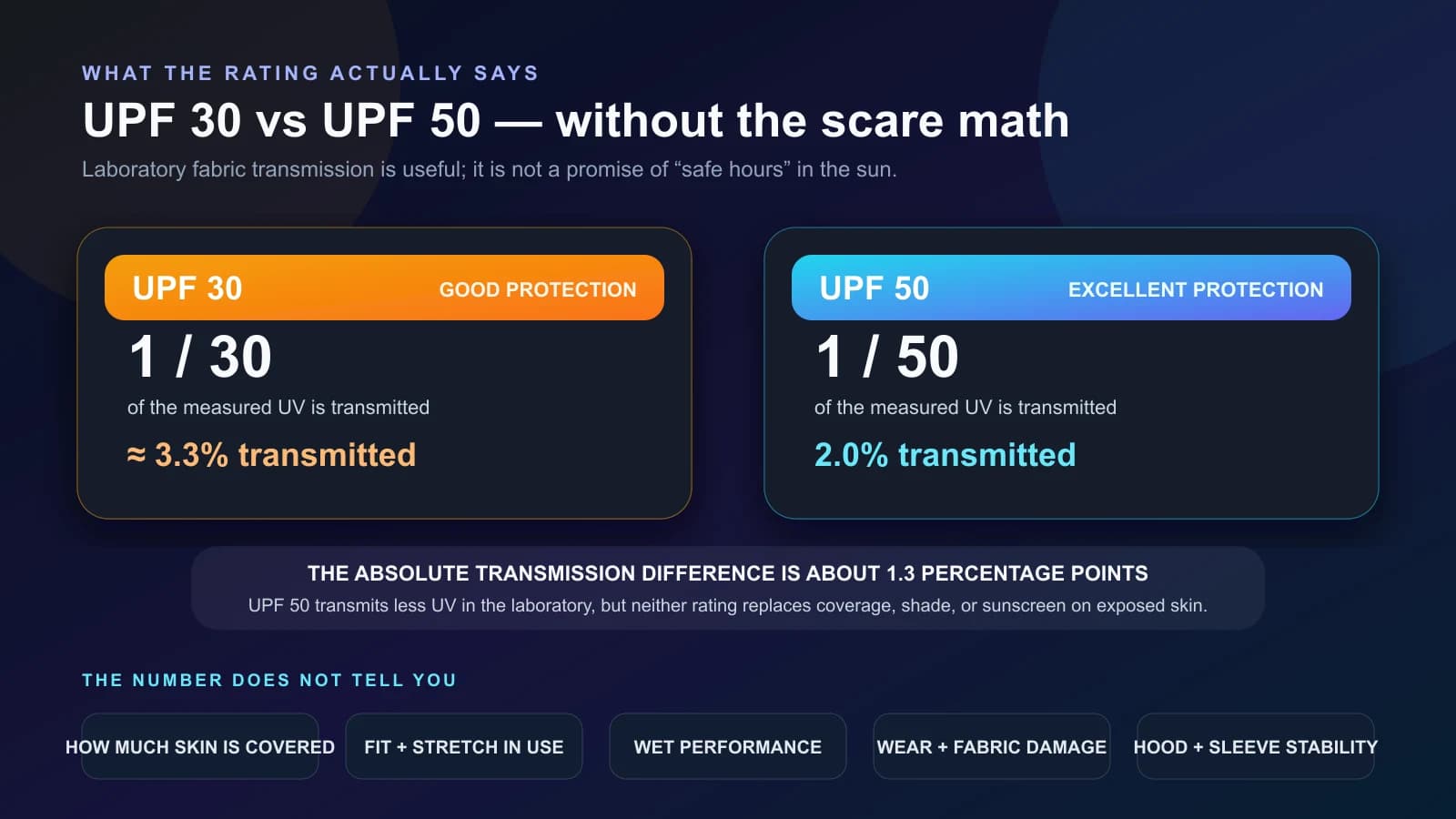
UPF 30 allows about 1/30 of the measured ultraviolet radiation through the tested fabric, while UPF 50 allows 1/50 through. That is roughly 3.3% versus 2.0% transmission. UPF 50 is the stronger laboratory rating, but coverage, fit, stretch, wetness, fabric condition, and the exact garment label can matter more than turning the difference into dramatic “extra hours” claims.
Direct answer
UPF 50 is stronger; UPF 30 can still be a sound choice
Choose UPF 50 or 50+ when exposure is long, the UV index is high, water or snow adds reflected radiation, or the garment will be stretched during active use. Choose a well-fitting UPF 30 garment when official labeling is clear, coverage is stable, and comfort makes you more likely to keep it on. Do not convert either rating into a promise of safe hours. A UPF number describes tested fabric transmission; it does not measure how much skin the garment covers or how the garment behaves on your body.
UPF 30
ARPANSA classifies UPF 30 as good protection. The rating corresponds to about 1/30, or roughly 3.3%, of the measured UV passing through the tested fabric.
UPF 50 / 50+
ARPANSA classifies UPF 50 and 50+ as excellent protection. UPF 50 corresponds to 1/50, or 2.0%, of the measured UV passing through.
A stable garment can beat a higher number that shifts
A long sleeve that stays at the wrist, a hem that remains down, and a hood that covers the ears protect skin that an unstable garment exposes.
Use a complete sun-protection plan
Shade, timing, hat, sunglasses, and sunscreen on uncovered skin still matter. Water, sand, and snow can increase reflected exposure.
Visual decision aid
Start with the buying decision
How we compared
Selection and price references
For US-method context, see the UPF science guide linked below: AATCC TM183 measures weighted transmission, ASTM D6544 prepares specimens and ASTM D6603 addresses labeling. Simulated conditioning is not a real-world lifespan guarantee.
The math here uses the definition of ultraviolet protection factor: a UPF value describes the fraction of erythemally weighted ultraviolet radiation transmitted through a tested fabric. UPF 30 therefore corresponds to 1/30 transmission and UPF 50 to 1/50. Percentages are rounded for readability: approximately 3.3% and 2.0%.
Protection classifications come from the current Australian sun-protective clothing standard guidance published by ARPANSA: UPF 15 is minimum protection, UPF 30 is good protection, and UPF 50 or 50+ is excellent protection. CDC travel guidance also recommends lightweight long-sleeved garments made with fabric above UPF 30 and explains that UPF 50 means 1/50 of ambient ultraviolet radiation passes through the fabric.
A fabric rating cannot establish safe outdoor hours. Official guidance says stretch, wetness, color, structure, and wear can change fabric protection, but the direction and size of the change depend on the fabric. Without an exact garment test under the stated condition, a precise universal drop is not defensible.
Decision table
Compare the fields that change comfort and coverage
For an unpublished specification, check the manufacturer or garment label before relying on it.
| Decision field | UPF 30 | UPF 50 / 50+ |
|---|---|---|
| Fraction transmitted | About 1/30 of the measured UV. | UPF 50: 1/50 of the measured UV. A 50+ label indicates performance above the numerical labeling ceiling used by the applicable scheme. |
| Approximate UV transmitted | 3.3% | 2.0% at UPF 50 |
| Approximate UV blocked | 96.7% | 98.0% at UPF 50 |
| ARPANSA classification | Good protection | Excellent protection |
| Absolute transmission difference | About 1.3 percentage points more transmitted than UPF 50. | About 1.3 percentage points less transmitted than UPF 30. |
| Relative transmission difference | Transmits about 1.67 times as much as UPF 50 under the rating math. | Transmits about 40% less than UPF 30 under the rating math. This is not 40% more “safe time.” |
| Long / reflected exposure | Can be appropriate with stable coverage and a complete sun plan; less laboratory margin than UPF 50. | Stronger starting point for long exposure, high UV, and reflected radiation from water, sand, or snow. |
| Fit and stretch | A good fit matters. Stretch can reduce protection, but no universal 10%-stretch drop applies to every fabric. | Higher starting rating can provide more laboratory margin, but it does not make overstretch irrelevant. |
| Wetness | Wetness can increase or decrease protection depending on the fabric. Verify swim or wet-use claims for the exact garment. | Same limitation: UPF 50 on a dry product page is not automatically a wet-performance certification. |
| Wear and damage | Thinning, holes, worn zones, and open structure can reduce protection. | The higher label does not make holes, severe pilling, or stretched-out panels protective. |
| Coverage | The number applies only where the rated fabric covers skin. | The number applies only where the rated fabric covers skin. Hood, cuff, hem, and neckline stability remain separate decisions. |
| What the rating cannot tell you | Breathability, drying speed, odor control, hood stability, torso length, abrasion resistance, or comfort. | Breathability, drying speed, odor control, hood stability, torso length, abrasion resistance, or comfort. |
Source review: August 28, 2026. A missing published result is not a performance score.
Good protection
When UPF 30 is a rational choice
UPF 30 is not a failed or token rating. ARPANSA classifies it as good protection, and CDC guidance points travelers toward lightweight long-sleeved fabrics above UPF 30. The garment still needs stable coverage and a trustworthy label.
UPF 30 transmits about 3.3% of the ultraviolet radiation used in the rating calculation. ARPANSA classifies it as good protection. Compare an exact label and stable coverage; the number cannot measure your personal exposure time.
Choose a comfortable, credible UPF 30 garment when it suits your use and the rest of the sun-protection plan. If a higher-rated shirt is similarly suitable, its lower transmission gives you another reason to consider it.
Why it makes the shortlist
- • Officially classified as good protection by ARPANSA
- • About 96.7% blocked under the rating math
- • Can be lighter or more comfortable depending on the specific garment—not guaranteed by the rating alone
- • A valid option when stable coverage and wear compliance are strong
Where the evidence stops
- • Lower laboratory margin than UPF 50
- • No promise of safe exposure time
- • No information about hood, cuff, or hem stability
- • No universal wet or stretched rating
- • Visual inspection cannot verify the UPF
Excellent protection
When UPF 50 or 50+ is worth prioritizing
UPF 50 is the stronger fabric rating: about 2.0% transmission versus roughly 3.3% at UPF 30. Prioritize it when exposure is long, UV is high, reflection is substantial, or extra laboratory margin matters.
UPF 50 transmits about 2.0% in the rating calculation: about 1.3 percentage points less than UPF 30, or 40% less relative transmission. Neither calculation means 40% more safe time outdoors.
Consider the higher rating for prolonged or intense exposure while still checking fit, motion and uncovered skin. UPF 50+ is a labeling category; it does not establish infinite protection, cooling or an unlimited service life.
Why it makes the shortlist
- • Officially classified as excellent protection by ARPANSA
- • About 98.0% blocked at UPF 50 under the rating math
- • Lower measured transmission than UPF 30
- • Useful extra margin for long, reflected, high-UV, or stretch-prone use
Where the evidence stops
- • Still applies only to covered areas
- • Does not establish wet performance unless that use is supported
- • Does not measure comfort or breathability
- • Does not make damaged fabric protective
- • 50+ is a labeling category, not an infinite score
Where ratings meet real clothing
Fit, stretch, wetness, and wear can change the decision
The label is the starting point, not the whole answer. Coverage geometry and the condition in which the garment is used determine whether rated fabric is actually over the skin you intend to protect.
Fit determines where the rated fabric remains over skin. Raise your arms, bend and turn; check the hem, neckline and cuffs. For swimming or repeated soaking, look for evidence and instructions for the exact wet-use garment.
UK guidance identifies stretch, wetness, construction, color and wear as factors that can affect protection. There is no universal fixed drop from wetting or stretching. Inspect thinning or damaged areas and follow the label rather than retiring every shirt at one age or wash count.
Why it makes the shortlist
- • Explains why exact garment labeling matters
- • Accounts for motion and coverage rather than fabric math alone
- • Uses official caution around stretch, wetness, and wear
- • Provides a practical inspection process
Where the evidence stops
- • Cannot predict a specific garment’s wet or stretched UPF without testing
- • Cannot assign a universal retirement wash count
- • Does not replace medical advice for photosensitivity
- • Does not establish sunscreen performance
Practical decision rules
Choose by your needs
Use UPF 50 for the higher-margin exposure scenarios
Long duration, high UV index, reflective water or snow, altitude, and stretch-prone activity are strong reasons to prioritize UPF 50 or 50+.
Do not reject a well-designed UPF 30 garment automatically
UPF 30 is officially classified as good protection. Stable coverage and consistent wear can make it a practical part of a complete protection plan.
Never translate the number into guaranteed safe hours
UPF is a fabric transmission factor, not a timer. UV intensity, reflection, skin, medication, gaps, motion, and exposure history vary.
Prefer the exact garment label over a marketplace headline
Match the model, material, color or variant where relevant, intended use, and sewn label. Do not borrow a rating from another item in the collection.
Treat wetness and stretch as garment-specific questions
Official guidance says both can change protection, but no universal fixed drop applies. Look for testing or claims that match the actual wet or active use.
Coverage is a separate specification
Sleeve length, torso length, neckline, hood, thumb loops, and movement determine whether the rated textile remains over the intended skin.
Check the fit and care before keeping it
Read the sewn label
Confirm the UPF rating on the exact garment, not only a retailer title, review, or image badge.
Check coverage in motion
Raise both arms, bend, turn, and reach. The hem, cuffs, and hood should remain where protection is needed.
Check for over-stretch
If the textile becomes visibly more open, shiny, or over-tensioned across the body, try another size or cut.
Match wet use to evidence
For swimming or repeated spray, confirm that the exact garment is designed and labeled for that condition.
Inspect wear zones
Look at shoulders, lower back, elbows, cuffs, seams, and snags. Replace or repurpose damaged sun-protection clothing.
Protect what clothing does not cover
Use shade, hat, sunglasses, and sunscreen on exposed areas according to current public-health guidance.
Buying questions
FAQ
Answers use the product sources listed below and the fit and care considerations discussed in this guide.
Is UPF 50 twice as protective as UPF 25?
Not in the everyday “twice as much protection” sense. UPF 25 transmits 1/25, or 4%, while UPF 50 transmits 1/50, or 2%. UPF 50 transmits half as much ultraviolet radiation under the rating math, but both the absolute percentage difference and real garment coverage matter. The rating should not be converted into guaranteed hours outdoors.
Is UPF 30 enough for everyday use?
UPF 30 is classified as good protection by ARPANSA and can be a sound everyday choice when the label is credible, the garment covers the intended skin, and it stays comfortable and stable in motion. Longer or more intense exposure, reflection, altitude, or photosensitivity are reasons to prioritize a higher rating and professional guidance where appropriate.
Does UPF 50 mean I can stay in the sun 50 times longer?
No. The number is a fabric transmission factor, not a safe-exposure timer. UV intensity, reflection, skin, medication, garment gaps, stretch, wetness, and cumulative exposure vary. Use clothing with shade and protection for uncovered skin rather than calculating an exposure deadline.
Does a UPF shirt lose protection when wet?
It depends on the fabric. Official UK guidance says wetness can increase or decrease the protection factor. Do not apply one fixed drop to every garment. For swimming, sweat, or spray, look for evidence or labeling that covers the exact garment and intended wet use.
Does stretching always cut a UPF rating in half?
No universal percentage applies. Stretch can reduce protection by opening the textile structure, but the result depends on the fabric and amount of stretch. A precise claim such as “10% stretch turns UPF 30 into UPF 15” requires exact test evidence and should not be generalized.
Is a darker shirt automatically UPF 30 or UPF 50?
No. Color can influence protection, but fiber, thickness, weave or knit, treatments, stretch, and wear also matter. Government guidance says consumers cannot reliably determine protection by visual inspection. Use an exact garment label or credible manufacturer evidence.
Do I need sunscreen under a UPF shirt?
Public-health guidance focuses sunscreen on skin not covered by protective clothing. The fabric only protects where it remains over the skin. Apply sunscreen to exposed areas such as the face, ears, hands, neckline gaps, and any skin a moving garment uncovers, following current label and health guidance.
What does UPF 50+ mean?
It indicates performance above the highest numerical label used by the relevant clothing-rating scheme. It does not mean unlimited protection, and it does not reveal comfort, coverage, wet performance, or durability. Confirm the exact garment and treat 50+ as an excellent-protection category rather than an infinite score.
Continue your research
The Science of UPF Fabrics
Explore how structure, fibers, dyes, and testing influence ultraviolet transmission.
Sun Protection Clothing Guide
Build a complete clothing system around coverage, activity, climate, and comfort.
Best Sun Hoodies
Compare current hoodies by climate, fit, hood behavior, drying, abrasion limits, and manufacturer UPF.
Sunscreen vs Sun Shirts
Understand the different jobs of topical sunscreen and protective clothing.
UPF Wash Durability
Learn how to inspect and care for sun-protection garments without relying on a universal wash-count myth.
How SleeveShirts Evaluates Gear
See the evidence boundary used for claims, unknowns, and affiliate recommendations.
Sources and research transparency
The manufacturer pages below support the product specifications. The source notes identify their scope and any unresolved details.
- ARPANSA — Australian sun protective clothing standard ↗: Official UPF classifications: 15 minimum, 30 good, and 50 or 50+ excellent protection, plus garment-coverage context.
- CDC Yellow Book — Sun Exposure in Travelers ↗: Official explanation of UPF transmission, protective clothing, reflected UV, and complete sun-safety measures.
- UK Government — UPF frequently asked questions ↗: Official description of controlled spectrophotometer testing and factors including structure, stretch, and wear.
- UK Government — UVR clothing protection ↗: Official discussion of laboratory measurement, visual-inspection limits, wetness, stretch, color, and fabric structure.
- CDC — Sun Safety Facts ↗: Current public-health guidance for protective clothing, shade, and sunscreen as complementary measures.